

Published Mar 07, 2026 | 8:00 AM ⚊ Updated Mar 07, 2026 | 8:00 AM

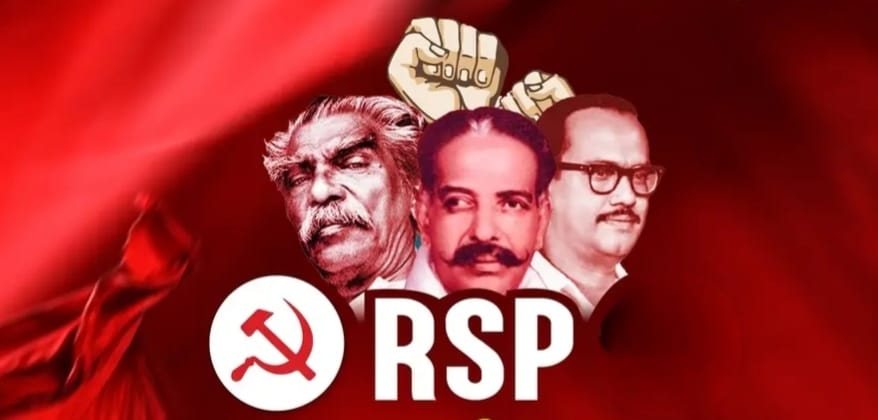
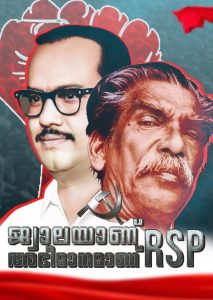
RSP logo with leaders N. Sreekandan Nair, T.K. Divakaran, and Baby John
Synopsis: The Revolutionary Socialist Party (RSP), once a dominant Left force in Kerala built on labour struggles in cashew, coir, and fishing sectors, now confronts an existential crisis ahead of the 2026 Assembly elections. Repeated splinters, a 2014 shift from LDF to UDF, electoral wipeouts, and fresh internal rifts over dynastic candidate choices—like in Eravipuram—threaten its relevance and cadre base. Victory could revive it; defeat may seal its marginalisation.
For a party that once strode confidently through Kerala’s political landscape, the approaching Assembly election carries the weight of reckoning.
The Revolutionary Socialist Party (RSP) forged in the heat of trade union struggles — among cashew workers, coir labourers, fisher workers, and farmers —with its stronghold being Kollam, now finds itself battling not just opponents but its own history, splinters, shrinking electoral returns, and shifting loyalties.
For them, the upcoming Assembly polls is not merely another contest for seats. It is a test of whether the party can reclaim credibility, repair internal fractures and reconnect with a voter base that once saw it as a natural political home.
With its legacy stands at a crossroads, the verdict of the coming polls may well decide whether it begins a new chapter or fades further into the margins.
Emerging from the socialist currents of the 1940s, it was the Kerala Socialist Party which eventually evolved into the Revolutionary Socialist Party, following a merger that happened in 1950.
Its early growth was powered by cashew workers, coir labourers, fish workers along the coast and farmers in the interior. By the 1960s, the party had peaked at 12 MLAs and two MPs — a remarkable footprint for a cadre-based Left formation.
Leaders such as N Sreekandan Nair, T.K. Divakaran, R.S. Unni, K. Balakrishnan, Baby John and K. Pankajakshan shaped its ideological and organisational trajectory.
For decades, RSP functioned as a dependable Left ally while fiercely guarding its independent identity.
The first serious tremor came in 1980s, following the defeat of Sreekantan Nair in the General Elections 1980 as he lost Quilon Lok Sabha seat.
He further formed RSP(S).
Internal differences over leadership and direction led to a splintering that would become a recurring pattern in the party’s history.
The second major rupture unfolded amid a prolonged tussle between V.P. Ramakrishna Pillai and Babu Divakaran, resulting in rival factions — RSP (B) and RSP (M).
The period was marked by intense internal competition, including a contest over ministerial aspirations when veteran leader Baby John’s ill health created a vacuum. The splinter culture weakened the party’s once cohesive base.
A watershed moment came in 2014 during the Lok Sabha elections.
A dispute over the Kollam parliamentary seat triggered RSP’s dramatic exit from the Left Democratic Front (LDF) and its entry into the United Democratic Front (UDF). This got materialised after RSP decided to merge with RSP(B). The latter was then part of UDF and Shibu Baby John its leader was a minister in the then UDF government led by Oommen Chandy.
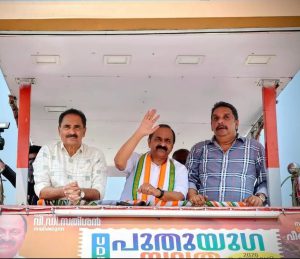
N K Premachandran with V D Satheesan and Shibu Baby John during Puthu Yuga Yatra
The decision reshaped the party’s electoral fortunes. The move also unsettled its traditional Left-leaning vote base, creating a disconnect between organisational loyalty and voter sentiment.
This merger resulted in another splinter group. Thanks to Kovoor Kunjumon. He launched RSP (Leninist) or RSP(L). From 2001 to 2011 he won from Kunnathur Assembly Constituency in Kollam as an RSP candidate. But he represented the 2016 and 2021 elections as an RSP(L) candidate and won.
Following the 2014 episode, RSP’s electoral trajectory turned turbulent.
In the 2016 Assembly elections, contesting five seats — Kaipamangalam, Chavara, Kunnathur, Eravipuram, and Attingal — the party failed to open its account.
At Chavara, Shibu Baby John suffered a loss of over 8,000 votes to N. Vijayan Pillai. Meanwhile, Kovoor’s RSP(L) managed to win Kunnathur.
The 2021 election told a similar story. RSP contested from Mattannur, Eravipuram, and Chavara but drew a blank. Once again, Kunnathur slipped into the hands of the Kovoor faction.
Yet the party’s grassroots apparatus has not collapsed entirely.
In the 2025 local body elections, RSP secured 57 wards across Kerala — 42 in grama panchayats, four in block panchayats, two in district panchayats, five in municipalities and four in corporations.
The numbers may not signal resurgence, but they reflect a residual organisational presence.
As Kerala heads towards the 2026 Assembly election, RSP is again in the eye of a political storm — this time over candidate selection and the larger question of survival.
Eravipuram has become the flashpoint, but the crisis reverberates beyond one constituency.
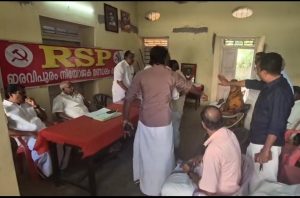
A squabble during candidate selection discussion for Eravipuram Assembly Constituency
It’s voting history underlines the paradox confronting the party.
The constituency has drifted away from the Left fold only thrice — in 1970, 1977 and 1991.
In 1970, RSP’s R.S. Unni won the seat while aligned with a CPI-Congress front. Except for those rare departures, the constituency has largely remained loyal to the Left.
After shifting to UDF in 2014, RSP found Eravipuram unforgiving.
A.A. Azeez, who had won three consecutive terms with LDF support from 2001, lost in 2016 following the party’s realignment. he lost to M Nousad by more than 28,000 votes.
In 2021, Babu Divakaran’s candidacy failed to dent the CPI(M)’s dominance, with M. Noushad winning by over 28,000 votes and crossing the 50 per cent vote share mark in successive polls.
For the upcoming polls, a section within the party pushed for fielding Karthik Premachandran, son of Kollam MP N.K. Premachandran, arguing that his image, youth connect and cross-community appeal could give the UDF a fighting chance.
Nearly 38 local Congress leaders petitioned Opposition Leader V.D. Satheesan, insisting that Karthik’s candidature was essential to generate momentum against the LDF’s entrenched advantage.
They cited N.K. Premachandran’s impressive parliamentary margins as proof of enduring influence.
But resistance within RSP was fierce.
Critics labelled the proposal “dynasty politics,” contending that promoting a political heir over grassroots activists would demoralise the cadre.
The internal split culminated in the selection of Vishnu Mohan, state secretary of the Revolutionary Youth Front, as a compromise candidate.
The fallout was immediate.
State committee member Saji D. Anand resigned. Eravipuram mandalam secretary N. Naushad stepped down, publicly questioning Vishnu Mohan’s winnability against an LDF candidate who commands a 28,000-vote margin.
The state committee meeting on 27 February reportedly witnessed heated exchanges, exposing the fault lines between competing power centres, including factions aligned with senior leader Shibu Baby John.
The dissent has spilled into the UDF camp.
Youth wings of both Congress and IUML have expressed unease, fearing that unresolved factionalism may gift the LDF an easy victory.
Meanwhile, when internal debates were already rippling through the party, the RSP moved to signal readiness elsewhere.
During the Puthu Yuga Yatra led by Leader of the Opposition V.D. Satheesan, the party sprang a quiet but politically significant announcement.
On 4 March, Santhosh Bhadran was declared as the UDF candidate for the Attingal Assembly constituency — an early move seen as an attempt to project clarity amid turbulence in other segments.
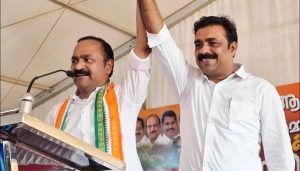
V D Satheesan with UDF Attingal Assembly Constituency candidate Santhosh Bhadran
Attingal, however, is no easy battleground.
In the 2021 Assembly election, CPI(M)’s O.S. Ambika secured the seat with a commanding margin of over 31,000 votes.
The BJP finished second, while the RSP was pushed to third place — a reminder of both the LDF’s entrenched strength and the triangular nature of the contest.
By naming its candidate well ahead of schedule, the RSP appears keen to avoid the perception of drift.
Party insiders say the idea is to give Bhadran time to build momentum, reconnect with booth-level workers and consolidate anti-LDF votes before the campaign enters its high-pitch phase.
Whether that early start translates into a revival in Attingal remains to be seen.
But the timing of the announcement — coinciding with internal dissidence over candidate selection— suggests that the party is aware it can no longer afford hesitation.
At the same time, a leader with Kollam DCC told South First “Candidate selection is entirely the RSP’s prerogative, and we respect that. But as allies, we cannot ignore the political reality on the ground.
Eravipuram is not a constituency where we can experiment — it requires a face that can consolidate votes across communities and energise neutral voters. When there is visible dissent within a partner party, naturally it affects the overall campaign climate. At a time when unity should be our biggest strength, any sign of division only helps our opponents.”
For RSP, the stakes transcend Eravipuram.
Since its 2014 realignment, the party has not won a single Assembly seat under the UDF banner.
Its historic bastions have eroded, splinter groups have outperformed it in select constituencies, and its core working-class identity has blurred amid alliance politics.
An RSP leader summed up the stakes candidly to South First.
“We cannot console ourselves with memories of the past or with the presence of a single MP in Delhi. Yes, N.K. Premachandran has won twice with margins of over one lakh votes. That shows personal credibility. But a parliamentary victory alone cannot sustain a political party’s base in Kerala. We need MLAs, we need a visible presence on the ground, and we need to show our cadre that we are capable of winning,” the leader said.
He added that cadre morale has been eroding quietly over successive defeats.
“Young activists want to belong to a party that has a future. If we fail again in 2026, the message will go out that the RSP is no longer electorally viable. That will accelerate migration — both of leaders and ordinary workers — to other formations. We are already seeing restlessness at the grassroots,” he said.
According to him, the party’s ideological identity is also at stake.
“Our strength historically came from representing workers and ordinary people. If we are seen merely as a minor ally dependent on the fortunes of bigger parties, our relevance diminishes. This election must re-establish that we are not just passengers in an alliance but a force with independent credibility,” the leader remarked.
The 2026 election is therefore less about expanding influence and more about political relevance. A victory could revive morale, consolidate fractured ranks and prove that the party’s shift to UDF was not a strategic blunder. Another defeat, especially amid visible internal discord, may accelerate cadr,e migration and deepen voter scepticism.
From commanding double-digit representation in the 1960s to struggling for a foothold today, the upcoming election will test whether the party can reinvent itself without losing its ideological moorings — or whether history will record this phase as the twilight of a once-formidable socialist force.
(Edited by Amit Vasudev)


