



Published Jan 22, 2026 | 7:10 PM ⚊ Updated Jan 22, 2026 | 7:10 PM

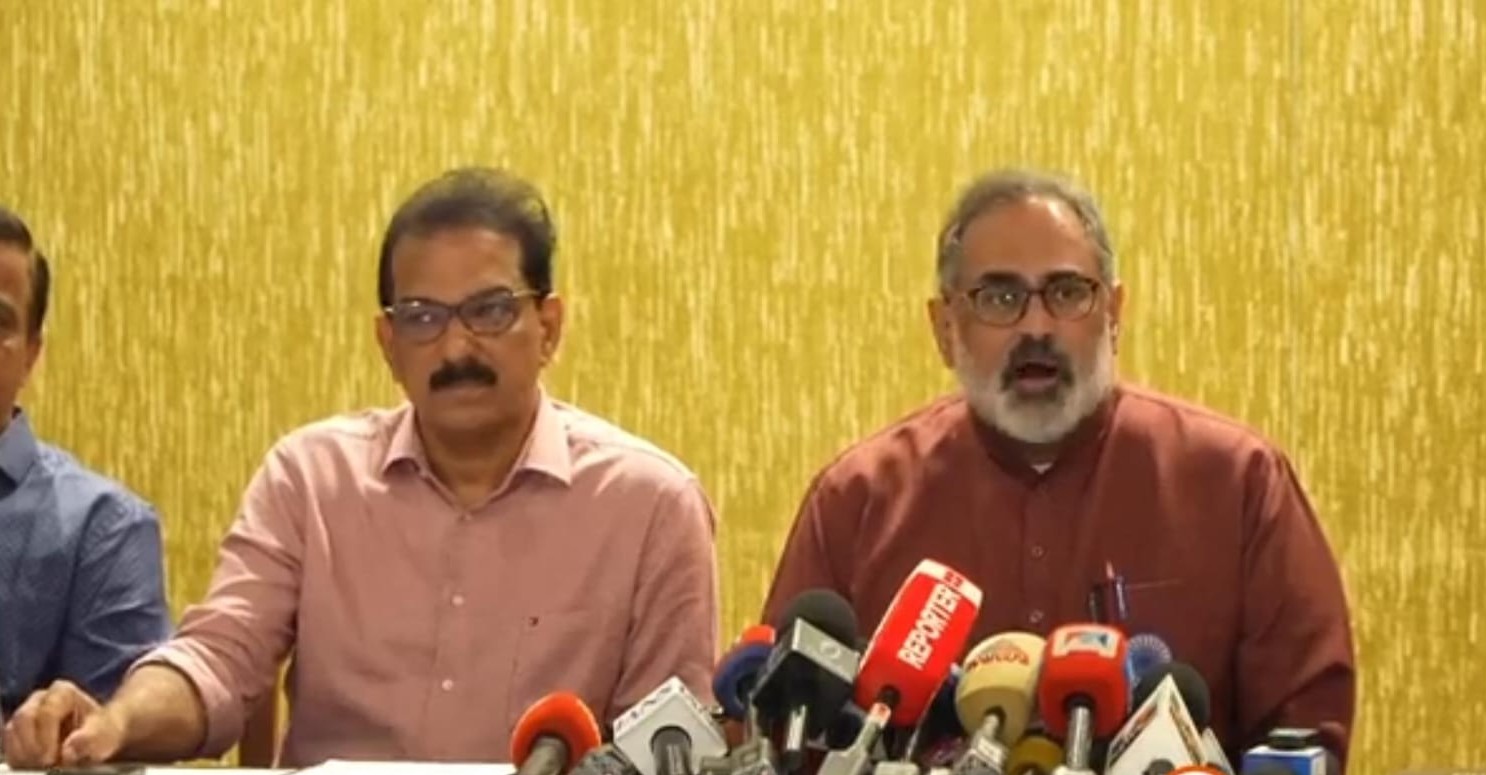
Twenty20 chief Sabu M Jacob with BJP state president Rajeev Chandrasekhar in Thiruvananthapuram on 22 January 2026.
Synopsis: Launched in 2013 with the promise of transforming Kizhakkambalam into a model village, Twenty20 stunned the state in the 2015 local body polls by winning 17 of 19 wards in the panchayat, positioning itself as a disruptive force that unnerved all three fronts, especially both the UDF and the LDF. However, of late, Twenty20 was looking to ally with any of the three fronts.
Eleven years after its unlikely leap from corporate social work into the rough-and-tumble of Kerala politics, Twenty20 has sprung a surprise in the state’s electoral landscape.
The Anna-Kitex Group-backed Twenty20, which carved out a reputation by upending traditional politics in pockets of Ernakulam, has formally aligned with the BJP-led National Democratic Alliance—just as the race towards the 2026 Assembly polls begins to gather pace.
The announcement, made on Thursday, 22 January, comes on the eve of Prime Minister Narendra Modi’s visit to Thiruvananthapuram to unveil the BJP-led Corporation’s vision document for a “Developed Thiruvananthapuram.”
Adding political heft to the moment, Sabu M Jacob, the chief coordinator of Twenty20, is expected to share the stage with the Prime Minister—an appearance that doubles as a clear signal of the party’s intent to activate its Assembly campaign well ahead of schedule.
For the BJP, the entry of Twenty20 into the NDA fold is more than a symbolic gain.
For Twenty20, it marks another sharp turn in a journey that began not in party offices or protest grounds, but as a corporate social responsibility experiment in Ernakulam’s Kizhakkambalam—one that would go on to challenge entrenched political equations at the grassroots.
At a press conference in Thiruvanathapuram, Twenty20 leader Jacob, also the Managing Director of the Kitex Group, announced that his party will ally with the National Democratic Alliance (NDA).
The announcement was made in the presence of the BJP’s state president, Rajeev Chandrasekhar.
Calling it a “decisive decision” for both his personal political journey and the future of Twenty20, Jacob said the move was triggered by what he described as a “hostile unity” between the LDF and the UDF.
He pointed to the recent local body elections, where cadres of both fronts reportedly worked in tandem to defeat Twenty20 candidates, even abandoning party symbols in some wards.
“We alone cannot achieve the vision of a developed Kerala. Joining the NDA is the best option to show how change is possible,” Jacob said, adding that the alliance was also a response to attempts to politically marginalise his party.
Chandrasekhar said the NDA was welcoming a party that had demonstrated a development-oriented approach at the grassroots and addressed everyday civic issues that mainstream politics had failed to resolve.
Describing Jacob as an entrepreneur who had generated large-scale employment, including outside Kerala, he said such leadership was essential for economic renewal in the state.
Chandrasekhar added that Twenty20’s entry into the NDA signalled a larger political churn in Kerala and expressed confidence that voters would respond decisively to the alliance in the coming elections.
The Twenty20 movement’s decision to explore an alliance with the NDA marks the sharpest strategic shift since it burst onto Kerala’s political scene a decade ago as a CSR-driven experiment in alternative governance.
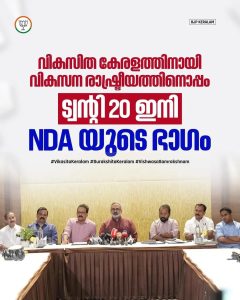
A BJP poster announcing that Twenty20 is now a part of the NDA.
Launched in 2013 with the promise of transforming Kizhakkambalam into a model village, Twenty20 stunned the state in the 2015 local body polls by winning 17 of 19 wards in the panchayat, positioning itself as a disruptive force that unnerved all three fronts, especially both the UDF and the LDF.
That early sheen, however, has steadily dulled.
The just-concluded local body elections exposed a visible strain: the outfit lost control of Kunnathunadu and Mazhuvannoor panchayats it had swept in 2020, scraped through with reduced margins in its headquarters Kizhakkambalam, and failed to make any real impression in Kochi Corporation, where its vote counts slid into single and double digits in several divisions.
Against this backdrop of erosion, came an announcement last week from party chief coordinator Jacob that Twenty20 was open to alliances with any of the three major fronts — including the NDA — signalling a turn driven less by ideology than by political survival.
While Jacob insisted that no front was “untouchable” and that the party must secure a deal that preserves its identity, insiders acknowledge that efforts to strike understandings with the UDF or the LDF came to naught, narrowing Twenty20’s options.
However, the suddenness of the move to become part of NDA has also unsettled the rank and file.
Eldho Paul, a Twenty20 representative from Kizhakkambalam panchayat, told South First that party workers learnt of the decision only through television channels.
“Usually, such political matters are discussed in regular party meetings, but none of us were informed about this move,” he said, adding that decades of being sidelined by the two dominant fronts left the party little choice.
Aligning with the NDA, he argued, was seen as necessary to keep alive Twenty20’s development-centric politics, even as internal discussions on the implications are yet to begin — underscoring that this is a discreet, top-down call whose ripples within the party are still unfolding.
Meanwhile, talking to South First, Jacob said the decision to align with the NDA was a crucial political move and not one taken overnight.
He said Twenty20 stands for corruption-free, development-oriented politics and is looking at bigger opportunities through the NDA.
Citing his experience, Jacob said he had created around 50,000 jobs in Telangana and similar large-scale employment initiatives were planned for Kerala as well, provided there is a conducive environment. He added that Kerala required his services and expertise for development.
This is not the first time that Twenty20 has ventured into a larger political experiment.
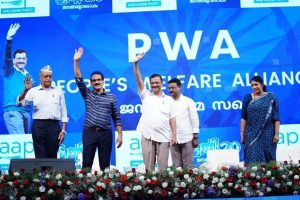
Twenty20’s alliance with AAP was short-lived.
In 2022, Twenty20 sought to expand its footprint by allying with the Aam Aadmi Party (AAP), projecting it as a vehicle for “political change” in Kerala.
Announcing the tie-up at a joint meeting in Kizhakkambalam, the then Delhi Chief Minister and AAP national convenor Arvind Kejriwal said the alliance would transform Kerala, drawing on what he described as the globally admired “Delhi model” of governance.
He contrasted Delhi’s pre-AAP years — marked, he said, by corruption, failing schools, power cuts and a bribery-ridden bureaucracy — with the reforms his party claimed to have delivered in education, basic services and governance.
The partnership was formalised in May 2022 as the People’s Welfare Alliance, amid considerable public curiosity and expectations among voters weary of traditional parties.
However, the experiment proved short-lived.
By December 2023, Twenty20 announced its exit from the alliance, with its president, Jacob, citing the absence of a minimum common programme, unresolved organisational and political issues, and growing ideological differences.
While disbanding the alliance, Jacob reiterated that Twenty20 would continue pursuing its stated goal of combating corruption, wasteful spending and Kerala’s deepening financial crisis—underscoring, yet again, its readiness to test unconventional political paths.
The Twenty20 movement has repeatedly grabbed headlines over the years for its bruising turf war with Kunnathunad MLA PV Sreenijin, a rivalry that has steadily escalated from political sparring into serious allegations and police complaints.
The latest flashpoint came in January 2024, when Twenty20 dismissed police complaints filed by the CPI(M) and the MLA against Jacob as “fabricated” and driven by political vendetta.
This confrontation, however, is rooted in a far graver episode from 2022, when Jacob publicly demanded an investigation into the alleged role of the MLA in the death of CK Deepu, a 38-year-old Twenty20 area secretary and Dalit activist.
Deepu had allegedly been assaulted by CPI(M) workers during tensions sparked by Twenty20-ruled panchayats observing a “lights out” protest against an order halting the outfit’s controversial ‘Street Light Challenge’.
Jacob described the attack as a planned, professional operation and alleged that forensic analysis of phone records would expose a wider conspiracy.
The MLA, for his part, has consistently rejected the allegations, accusing Jacob of pursuing a business-driven agenda under the guise of politics.
Sreenijin told South First that Jacob and the NDA were heading towards a disaster in Kerala.
He claimed that with Kitex’s US market shrinking and its share price recently falling from 342 to 147, Jacob was now looking at northern markets and needed the support of the Kerala BJP and the Union government to survive.
Sreenijin also alleged that the Twenty20 party had lost its base, noting that its vice-president, Gopakumar, was earlier with the BJP and that 12 party members had joined the BJP in recent years.
“This move is driven by personal rivalry with me. He tried to defeat me in Kunnathunad, but failed. This is entirely a business move, not a political one,” he added.
Whether the Twenty20–NDA tie-up can translate into electoral traction beyond symbolic moments now remains an open question. It also remains to be seen what Twenty20 gains within the NDA itself, especially since Jacob has told South First that he has not placed any demands before the BJP—including on seat-sharing—as a precondition for joining the alliance.
After its recent reverses at the grassroots, the alliance offers Twenty20 visibility and relevance, but rebuilding trust among cadres and voters will be the real test.
(Edited by Majnu Babu).


