

Published Mar 15, 2026 | 2:45 PM ⚊ Updated Mar 15, 2026 | 2:45 PM

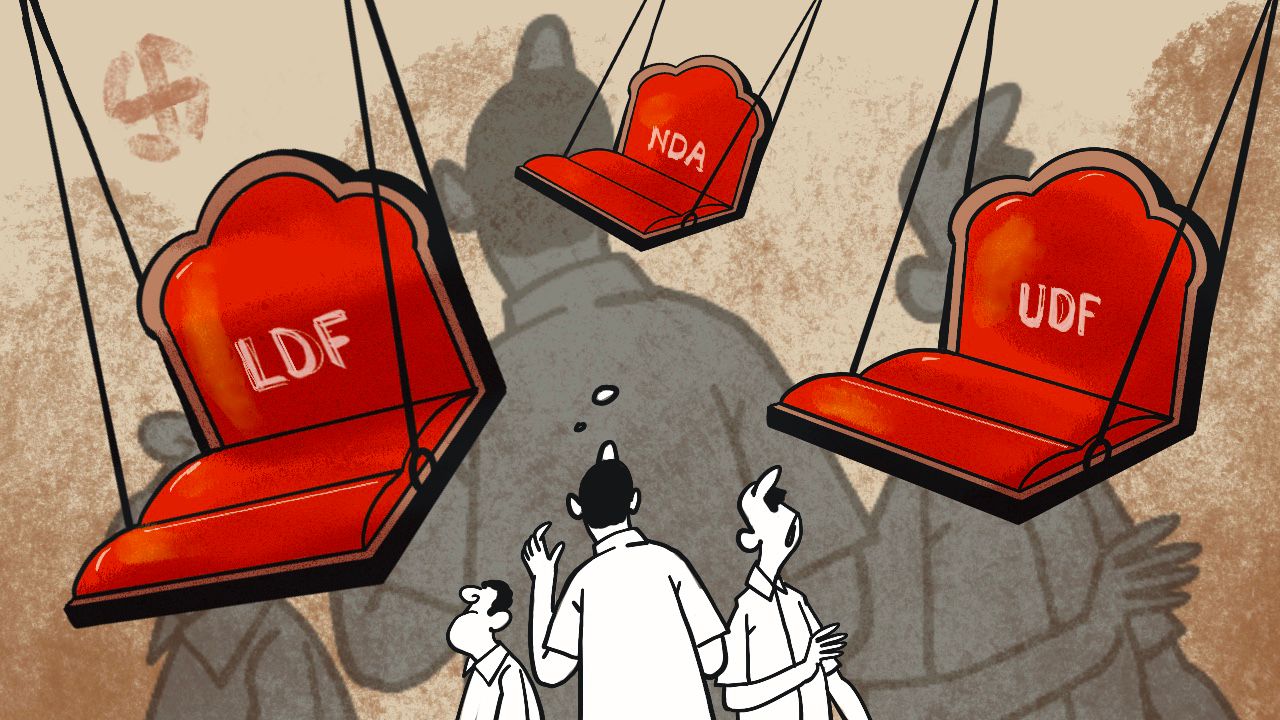
The NDA gaining prominence could alter the bipolar political equation in many constituencies.
Synopsis: Certain constituencies in Kerala can be called as ‘bellwether’ segments as they have always alternated between the LDF and UDF, and elected the candidate who will definitely be part of the ruling front. However, with the NDA emerging as a force that cannot be ignored, will the trend continue?
As Kerala heads towards another high-stakes Assembly election, a few constituencies that have historically mirrored the state’s final verdict are once again under close watch.
These are the so-called bellwether seats— constituencies whose electoral choices have repeatedly aligned with the front that ultimately forms the government.
In electoral terms, a bellwether is a constituency where the local result tends to track the broader political mood.
These seats often switch sides only when power itself changes hands, making them closely watched indicators of the direction in which the electorate may be leaning.
Among them, the Ollur Assembly constituency in Thrissur stands out prominently. Since 1982, the front that has emerged victorious in Ollur has invariably gone on to form the government in the state.
Over the decades, this striking pattern has turned the constituency into a political barometer, drawing keen interest from analysts and party strategists alike.
Ollur, however, is not the only constituency.
A few other segments have also demonstrated a similar tendency, often reflecting the larger electoral tide sweeping the state.
When it comes to predicting the winner, political watchers often turn their attention to Ollur.
For decades, this constituency has earned the reputation of a near-perfect bellwether — electing the candidate from the front that ultimately forms the government in the state.
Psephologists usually take 1982 as the base year for analysing Kerala’s electoral trends.
It was when the UDF and LDF alliances formally took shape, creating the bipolar political contest that continues to define the state’s politics.
In that election, Congress candidate Raghavan Puzhakadavil won Ollur when the K. Karunakaran-led UDF came to power.
The pattern continued in the years that followed.
In 1987, when the EK Nayanar-led LDF assumed office, Ollur elected CPI candidate AM Paraman.
In the subsequent elections, the constituency consistently chose the candidate from the front that formed the government — PP George (Congress) in 1991, CN Jayadevan (CPI) in 1996, George again in 2001, Rajaji Mathew Thomas (CPI) in 2006, and MP Vincent (Congress) in 2011.
The trend continued in the last two elections as well.
CPI’s K Rajan won the seat in both 2016 and 2021, and the LDF returned to power in the state on both occasions. In the first term, he served as the government chief whip and in the second term, he became Revenue Minister.
Rajan is now likely to seek a third consecutive term from the constituency, potentially extending both his personal winning streak and that of the front he represents.
Interestingly, Ollur had long been known for another electoral quirk — since 1980, the constituency had never given consecutive victories to the same front.
That pattern changed when Rajan retained the seat in 2021, even as the LDF secured a rare second consecutive term in Kerala.
Ollur is one of the 13 Assembly constituencies in Thrissur district and forms part of the Thrissur Lok Sabha constituency. The seat came into existence in 1957.
The constituency includes divisions 13, 14, 23 to 33 and 42 to 45 of the Thrissur Corporation, parts of divisions 17 and 24, and the panchayats of Madakkathara, Vatthara, Panancherry and Puthur.
In the 2021 Assembly election, Rajan defeated Congress candidate Jose Vallur by a majority of 21,506 votes. In 2016, Rajan had won by 13,248 votes.
In 2021, the BJP contested the seat directly after earlier being represented by its NDA ally BDJS.
The party fielded then state spokesperson B Gopalakrishnan, who was brought in as a last-minute surprise candidate.
The political history of Ollur stretches back to the first Assembly election in 1957, when PR Francis won from the constituency.
A prominent local leader, Francis contested from Ollur seven times and won four of them.
Parassala, the southernmost Assembly constituency in Thiruvananthapuram district bordering Tamil Nadu, has long carried a reputation for defying predictable political patterns.
Often described as a bellwether seat, the constituency has historically swung between fronts — and occasionally even backed individuals over party symbols.
The constituency’s electoral history shows a pattern of testing both the Left Democratic Front (LDF) and the United Democratic Front (UDF).
Congress leader N Sundaran Nadar won the seat in 1982 when K. Karunakaran led the government in Kerala.
He repeated the feat in 2001 when the AK Antony-led UDF came to power.
In a striking deviation, Nadar contested as a Congress rebel in 1996 and won as an Independent, even as the LDF formed the government in the state.
Over the decades, the seat has alternated between the two fronts.
CPI(M)’s N Sathyanesan won in 1987 (LDF-led by Nayanar formed the government), while Congress candidate MR Raghuchandrabal secured victory in 1991 (UDF-led by K Karunakaran formed the government).
Ahead of the VS Achuthanandan government in 2006, CPI(M)’s R Selvaraj captured the constituency.
In 2011, Congress’s AT George edged past CPI(M)’s Anavoor Nagappan by a slender margin of 505 votes, and became part of the treasury bench led by Oommen Chandy.
The political equation changed significantly in 2016 when CPI(M)’s CK Hareendran defeated George by 18,566 votes, reclaiming the seat for the LDF.
Hareendran retained the constituency in 2021 as well, defeating UDF candidate Ansajitha Russell by 25,828 votes with 78,548 votes against her 52,720.
And on both occasions, the LDF came to power.
What has added a new dimension to Parassala’s politics in the past decade is the emergence of the BJP as a third force.
While the constituency once witnessed a straight fight between the Left and the Congress-led UDF, the BJP’s growing vote share has turned it into a triangular contest.
In 2011, BJP candidate S Suresh polled 10,310 votes.
The party made a dramatic leap in 2016 when Karamana Jayan secured 33,028 votes, tripling its earlier share.
Though the BJP’s tally dipped to 29,850 votes in the 2021 Assembly election, it continued to remain a significant factor.
The trend was visible in the 2024 Lok Sabha elections as well.
In the Assembly segment, the UDF secured 59,026 votes, the LDF 46,654 and the BJP 45,957 — underlining the tightening triangular competition.
Parassala Assembly constituency, formed in 1957, comprises the panchayats of Amboori, Aryancode, Kallikkad, Kollayil, Kunnathukal, Ottasekharamangalam, Parassala, Perumkadavila and Vellarada in Neyyattinkara taluk.
Despite the LDF’s consecutive wins in the last two elections, the constituency continues to resist political monopolies.
Local body election trends and renewed grassroots activity have revived UDF hopes, while the BJP is keen on recovering the momentum it briefly demonstrated in 2016.
Parassala’s electorate has also shown a willingness to back strong personalities over party establishments.
Leaders such as Kunjukrishnan Nadar and Sundaran Nadar managed victories as independents or rebels, underscoring the constituency’s independent streak.
With shifting political equations, emerging triangular contests and the weight of local factors, including community equations, the big question now is whether Parassala will once again live up to its reputation as Kerala’s political bellwether.
Aranmula assembly constituency in Pathanamthitta has long been regarded as a political bellwether in Kerala, with its electoral verdict often mirroring the formation of the government in the state.
Since 1991, the constituency has repeatedly elected candidates who later found themselves on the treasury benches.
The trend began when NDP candidate R Ramachandran Nair won the seat as part of the UDF wave.
In the elections that followed, Kadammanitta Ramakrishnan of the LDF (1996), Malethu Saraladevi of the Congress (2001), KC Rajagopalan of the CPI(M) (2006), and K Sivadasan Nair of the Congress (2011) all emerged victorious from Aranmula, with their respective fronts going on to form the government.
The pattern continued in 2016 when CPI(M) leader Veena George won the constituency as the LDF returned to power in the state.
She retained the seat in 2021 as well, securing a decisive margin of 19,003 votes, improving on her 2016 victory margin of 7,646 votes.
Aranmula is part of the Pathanamthitta Lok Sabha constituency and includes the Pathanamthitta municipality in Kozhenchery taluk.
The assembly segment also covers Aranmula, Chenneerkara, Ilanthur, Kozhenchery, Kulanada, Mallappuzhassery, Mezhuveli, Naranganam and Omallur, along with Eraviperoor, Koipram and Thottapuzhassery panchayats in Thiruvalla taluk.
Speaking to South First, Dr G Gopakumar, former Vice-Chancellor of the Central University of Kerala and a noted political scientist and psephologist, said what journalists often describe as “bellwether constituencies” are more accurately understood by scholars as “shifting constituencies.”
According to him, such constituencies exist across almost every district in Kerala.
“Except for Malappuram, most districts have at least one constituency that can be considered a shifting constituency in one way or another,” he said.
Kumar recalled a study conducted in 1987 that attempted to identify such seats.
Researchers initially shortlisted one shifting constituency from each district and analysed their voting patterns.
“We found that in most districts there were actually one or two constituencies that could fall under this category,” he explained.
Eventually, one constituency from each district was selected through a draw, resulting in a list of 14 constituencies that broadly reflected the state’s electoral mood.
He attributes the phenomenon largely to Kerala’s long-standing bipolar political structure, dominated by the Left Democratic Front (LDF) and the United Democratic Front (UDF).
Within this framework, several constituencies remain strongholds or “pocket boroughs” of particular parties.
“These are seats that can almost always be claimed by parties like the CPI(M) or the IUML,” he said, citing Taliparamba Assembly constituency, which has been consistently held by the CPI(M) since 1977.
At the same time, he noted that constituencies that do not fall into such firm pockets tend to swing between the two fronts, thereby reflecting the broader political trend in the state.
However, Kumar felt that the traditional pattern may be entering a phase of change.
The emergence of the BJP-led National Democratic Alliance (NDA) as a potential third force, he said, is gradually complicating Kerala’s once-stable bipolar contest.
“With this election, we are likely to witness changes in the coalition dynamics that Kerala has been familiar with for decades,” he said, adding that the shift toward a more triangular political contest could alter how these so-called bellwether constituencies behave in the future.
The word bellwether traces its origins to sheep farming.
A wether is a castrated ram, and shepherds traditionally placed a bell around the neck of one such sheep.
As it moved, the ringing bell helped both the shepherd and the flock sense the direction in which the group was heading.
The bell-wearing sheep effectively became the guide for the rest.
The Oxford English Dictionary records the earliest confirmed use of the term in this literal sense around 1430.
Over time, the image of a sheep leading the flock evolved into a broader metaphor.
Bellwether came to describe any person, institution, or indicator whose behaviour signals the direction others may follow.
Today, the word appears in several fields, including the stock market and economic analysis.
In journalism and political commentary, it is most often used in the context of elections.
Certain constituencies are called bellwethers because their voting patterns tend to mirror the outcome.
The idea is captured in the familiar formulation: “As goes X, so goes the nation/state.”
In the United States, for decades, the saying “As Maine goes, so goes the nation” reflected the state’s reputation as an electoral bellwether, though that predictive streak eventually faded with time.
(Edited by Majnu Babu).


