


Published Jan 09, 2026 | 1:00 PM ⚊ Updated Jan 26, 2026 | 8:48 AM

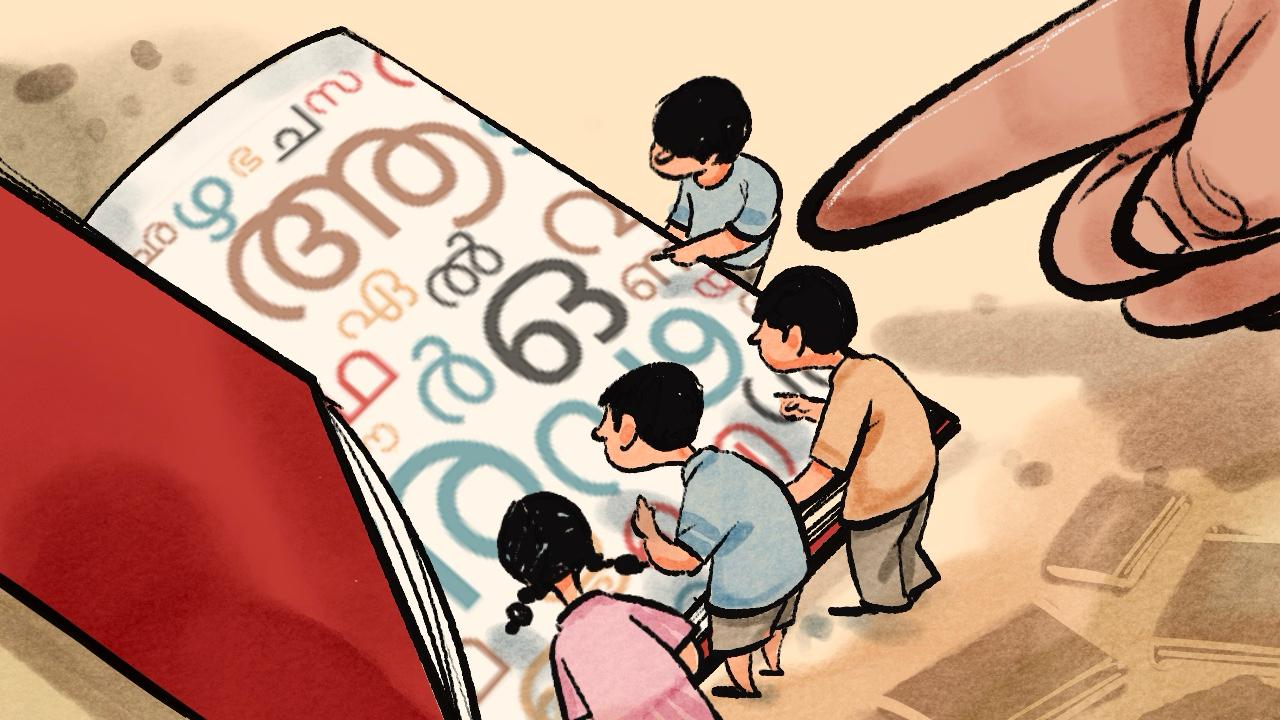
Malayalam Language Bill.
Synopsis: Kerala’s Malayalam Language Bill 2025, which mandates Malayalam as the first language from Classes 1 to 10, has revived old tensions in Kasaragod, a border district known for its long-standing multilingual character and large Kannada-speaking population. Terming the Bill “unconstitutional”, the Karnataka Border Areas Development Authority said it runs contrary to the interests of the Kannada-speaking linguistic minority in the district. The Kerala government, however, has maintained that the new Bill is aimed exclusively at safeguarding linguistic minorities.
Kasaragod is a living mosaic of tongues and home to some of Kerala’s most linguistically diverse communities. Alongside a majority of Malayalam speakers lives a sizeable population of Kannada and Tulu speakers. The district is also home to Konkani, Beary, Marathi and Urdu speakers, as well as communities speaking Havyaka, Kodava, Markada and others.
Even the Malayalam spoken here differs from that of the rest of the state. These languages have coexisted for generations.
But there is now growing concern that Kerala’s Malayalam Language Bill 2025—which mandates Malayalam as the first language from Classes 1 to 10 in all government and private schools—may upend this multilingual fabric.
The Bill has also become the latest flashpoint between Karnataka and Kerala. The Karnataka Border Areas Development Authority (KBADA) submitted a memorandum to Kerala Governor Rajendra Vishwanath Arlekar on Wednesday, 7 January, seeking a halt to and reconsideration of the legislation.
Terming the Bill “unconstitutional”, the KBADA argued that it runs contrary to the interests of the large Kannada-speaking linguistic minority residing in Kasaragod district.
Kannada is the second most widely spoken scheduled language in Kasaragod, according to the 2011 Census. For years, Kannada-speaking communities in Kerala’s border districts have voiced concerns over “Malayalam imposition”.
A previous attempt to make Malayalam compulsory as the first language in schools from Classes 1 to 10, introduced in 2017, met with widespread opposition from Kannadigas.
Protesters, including pro-Kannada organisations, laid siege to the Kasaragod District Collector’s office, alleging that Kannada was being erased from the district’s cultural soil. Kannada-medium schools observed the day as a ‘black day’ in protest against the proposed legislation.
The resistance also moved to the courts. Families of four Kannada-speaking linguistic minority students in Kasaragod approached the Kerala High Court in 2017, seeking the repeal of the Bill on the grounds that it violated Articles 14, 19 and 29 of the Constitution, which safeguard the rights of linguistic minorities.
In their petition, they argued that it was “impossible” for a Kannada-speaking student to acquire Malayalam under such compulsion.
In its recent memorandum to the Kerala Governor, the KBADA warned that enforcing the latest Bill would compel Kannada-speaking students to learn Malayalam even when they have no prior familiarity with the language.
Such a move, it argued, could have far-reaching consequences for students’ education and future prospects, particularly for those pursuing higher studies outside Kerala.
Karnataka’s concerns also extend to Kannada-medium schools, where students currently study Kannada as their first language.
The Kerala government has maintained that the new Bill is aimed exclusively at safeguarding linguistic minorities. Prathapachandran, Additional Secretary of the Law Department, told South First that the legislation is designed to strengthen, not dilute, minority protections.
He said that students whose mother tongue is a language other than Malayalam will, in line with the national curriculum, be allowed to choose languages of their preference from those available in State-run schools.
He added that for students coming to Kerala from other States or from abroad, writing the Malayalam paper will not be compulsory in Classes IX and X, or at the Higher Secondary level.
“In addition, in areas declared by the State Government as minority language regions, where Tamil or Kannada linguistic minorities reside, the State Secretariat and the concerned departmental heads will ensure that all communication between the State Government and its regional offices permits the use of the respective minority languages, and that replies are also issued in those languages,” he said.
A similar Bill passed by the Kerala legislature in 2015 had failed to secure Presidential assent after objections were raised over its conflict with Section 6 of the Official Languages Act, 1963, as well as concerns relating to linguistic minority rights, trilingual education under the national curriculum, and compliance with the Right to Education Act, 2009.
Learning from that setback, the Kerala government said the Malayalam Language Bill 2025 has been redrafted as a more comprehensive and legally aligned piece of legislation.
While continuing to promote Malayalam in governance and public life, it said the revised draft seeks to address earlier objections by incorporating special provisions for linguistic minorities, including Tamil and Kannada speakers.
These include the use of minority languages for official communication in designated areas and the right of students to study in their preferred language wherever available, while ensuring exposure to Malayalam.
Across Kerala’s border districts, the functioning of Kannada-medium schools has long been a point of contention between Kerala and Karnataka, most notably in 2022 and 2023, when Malayalam-speaking teachers with no knowledge of Kannada were appointed to Kannada-medium institutions.
In one such instance in 2023, a Malayalam-speaking teacher was appointed to teach social science at the Government Higher Secondary Kannada Medium School in Adoor, Kasaragod district, triggering protests by students.
At the time, the KBADA told the media that Kerala Chief Minister Pinarayi Vijayan had assured that such incidents would not recur.
Earlier, in January 2022, the Principal Secretary of the General Administration (Services-D) Department of the Kerala government stated, in a communication to the Chennai-based Assistant Commissioner of Linguistic Minorities (Southern Zone) under the Union Ministry of Home Affairs, that the appointment of teachers unfamiliar with Kannada was “strictly avoided”.
The government, however, acknowledged a shortage of teachers proficient in Kannada in schools along the Karnataka border.
The communication also asserted that linguistic minority students were neither barred from learning their mother tongue nor compelled to learn Malayalam. The latest Bill, critics argue, marks a departure from this assurance.
The KBADA has since urged the Kerala Governor to exclude Kasaragod from the purview of the Bill, claiming that over 70 percent of the district’s population is Kannada-speaking.
Meanwhile, former Kasaragod District Education Officer K Nagaveni told South First that the district has several Kannada–Malayalam schools where students are taught in both languages, and that enrolment in Kannada-medium schools has been steadily declining over the past few years.
“Even if there is just one student who prefers Kannada, we ensure education in that medium,” she said, adding that most Kannada-medium schools are located in the Manjeshwar educational district.
Nagaveni said many parents, particularly speakers of Tulu, Kannada and other languages, now prefer Malayalam-medium education, as it offers wider opportunities for higher studies.
Despite declining enrolment, she noted, Public Service Commission appointments for Kannada teachers continue at the LP, UP and higher secondary levels.
A mandatory condition for appointment, she said, is that candidates must have studied Kannada from Classes 1 to 10. “So how can anyone claim that Kannada teachers in Kasaragod lack language proficiency?” she asked.
She also recalled instances where a few teachers appointed from southern districts were later found to be weak in Kannada despite holding certification. Following complaints from students and parents, inquiries revealed irregularities in their language proficiency certificates.
“Immediate action was taken, and the teacher was transferred to an SSC post with the same pay scale,” she said.
Government Higher Secondary School, Bandadka, which serves Kasaragod, Kumbla and Manjeshwar, was originally established as a Kannada-medium institution to cater to border-area villages. It is now predominantly Malayalam medium.
“Our school started as a Kannada-medium school for people living in border villages. Malayalam medium came much later,” said Babu, a primary school teacher at the school, speaking to South First.
Students at the school, many of whom come from Bandadka, Kundamkuzhy, Adoor, Pandy, Kumbla, Thalappady and Manjeshwar, are largely Kannada speakers, according to Babu.
“Most children from these border areas speak Kannada, and they are given the option to write their examinations in Kannada,” he added.
At the same time, children from Classes 1 to 4 study Malayalam, Kannada, English and Hindi.
“For small children, handling so many languages can sometimes be difficult,” Babu noted. From Classes 1 to 10, students, except those in the English-medium stream, are allowed to choose whether to write their examinations in Malayalam or Kannada.
Babu also pointed out that the region has a sizeable Tulu-speaking population. “Tulu has its own script, called Tigalari, but it is mostly written using the Kannada script. Many Tulu speakers here prefer to study in Kannada medium,” he said.
He added that those aspiring to a career in teaching, particularly candidates from border areas, often opt for Kannada medium.
“A Kannada-medium teacher can become a headmaster after 12 years of service. In Malayalam medium, teachers often have to wait nearly 20 years and face competition from across Kerala, from Thiruvananthapuram to Kasaragod,” he said.
(Edited by Dese Gowda)


