

Published Feb 21, 2026 | 8:26 PM ⚊ Updated Feb 21, 2026 | 8:26 PM

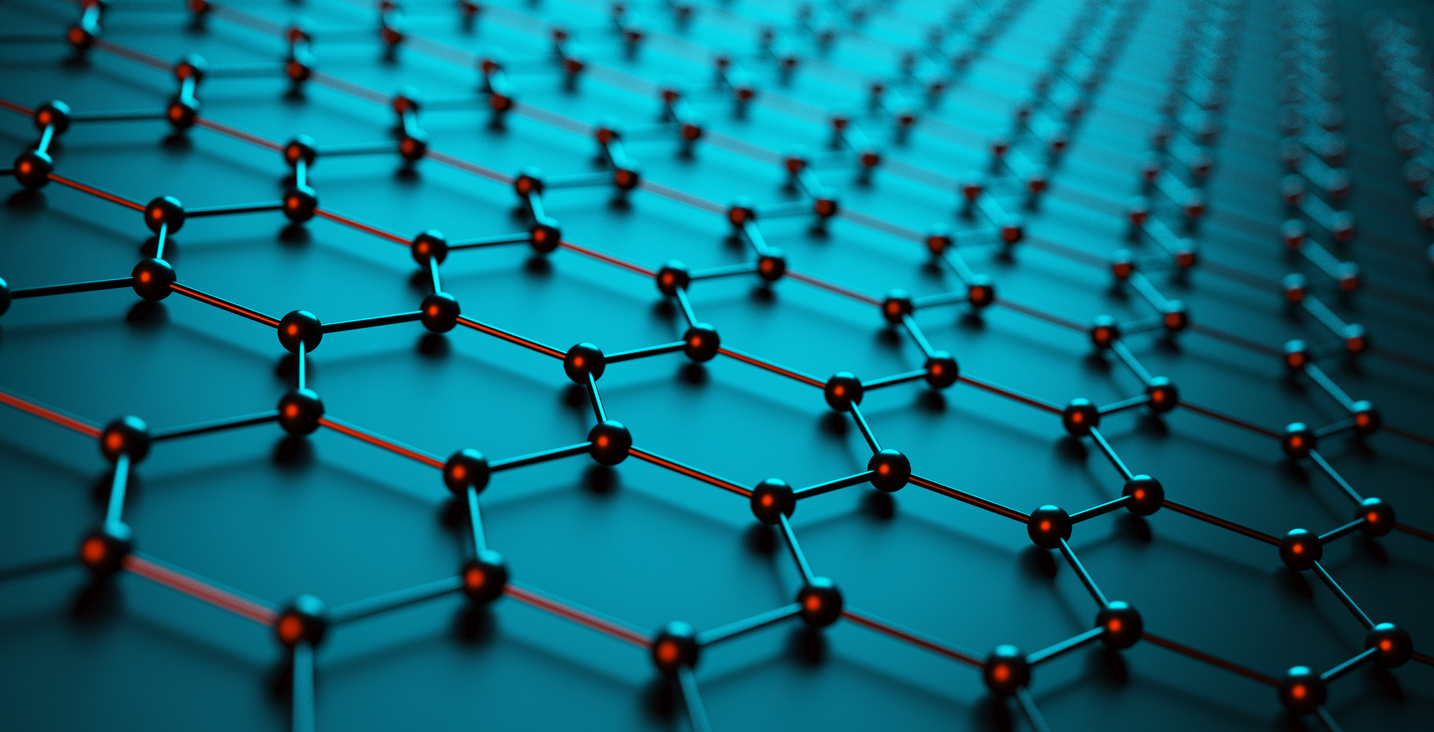
Representational image for graphene. Credit: iStock
Synopsis: Kerala has become the first Indian state to adopt a dedicated Graphene Policy, cleared by the Cabinet on 13 February. The ambitious framework aims to establish a leading national hub through an Innovation Centre, pilot plants, and an industrial park, boosted by Budget allocations. It seeks to spur research, commercialisation, and integration into traditional sectors whilst attracting global investment—yet questions linger over production costs, environmental risks, and potential health impacts.
When the Kerala State Cabinet cleared the Kerala Graphene Policy on 13 February, it marked an ambitious turn in the state’s industrial strategy — but not without raising a few careful eyebrows.
Touted globally as a “wonder material”, graphene — a one-atom-thick layer of carbon stronger than steel and more conductive than copper — promises to power everything from next-generation electronics to advanced energy storage.
By becoming the first Indian state to adopt a dedicated graphene-focused policy, Kerala has signalled its intent to anchor itself in the fast-evolving world of advanced materials.
With this policy, the state is seeking to attract investment and global collaboration, positioning itself as India’s gateway to the advanced materials revolution — betting that tomorrow’s industries may well be built on a sheet of carbon just one atom thick.
Yet, even as the government outlines plans for research hubs, pilot plants and industrial parks, questions around production costs, environmental safeguards and long-term health impacts linger in the background.
The policy, therefore, represents not just a bold technological bet, but a test of whether the state can balance innovation with responsibility as it steps into the graphene age.
Graphene is a single, ultra-thin layer of carbon atoms arranged in a hexagonal, honeycomb-like pattern. Although it is only one atom thick—about a million times thinner than a strand of hair—it is extraordinarily strong, around 100 times stronger than steel, yet light and flexible.
It conducts electricity and heat extremely well and allows nearly 98 percent of visible light to pass through it, making it both transparent and highly conductive. Because it has no energy bandgap, it behaves like a semimetal and supports fast electron movement.
Graphene is produced through different techniques depending on its intended use. It is usually made in two main ways: a top-down method and a bottom-up method.
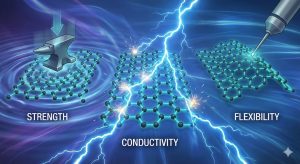
Some of the properties of graphene
In the top-down approach, scientists start with graphite and peel or separate its layers to get thin sheets—this includes mechanical and liquid exfoliation, which are good for producing graphene flakes for bulk uses.
In the bottom-up approach, graphene is built atom by atom, most commonly through chemical vapor deposition (CVD), where carbon gas forms a thin sheet on a heated metal surface.
While CVD is preferred for making large, high-quality films, exfoliation methods are widely used for large-scale, practical applications like composites.
Thanks to its high surface area and excellent electrical properties, graphene is now used in batteries, supercapacitors, sensors, coatings, electronics, medical devices, and energy systems, and ongoing research aims to make it more affordable and energy-efficient to produce.
Graphene policy
The policy highlighted that Kerala is positioning itself to become India’s leading centre for graphene research, production and industry by building a full ecosystem around the advanced nanomaterial.
Although graphene use in India is currently limited to select sectors such as batteries, rubber, paints, lubricants, polymers and energy storage devices due to cost constraints, the state believes that large-scale production and focused research can unlock wider commercial applications.
Announced in the Kerala Budget 2022–23, the plan proposes a three-tier development model.
The first step is the establishment of the India Innovation Centre for Graphene as an idea-to-prototype facility that will focus on research, innovation and product development. In the State Budget 2026-27, Finance Minister KN Balagopal stated that the Centre has accorded administrative sanction for this initiative. For the ₹86.40 crore activities, an amount of ₹6.50 crore is allocated as the state share.
The second stage will see the creation of a Graphene Pilot Plant Facility along with the Graphene Aurora initiative to promote commercialisation and industry partnerships.
The final phase envisions a full-fledged Graphene Industrial Park with a large-scale production facility using chemical vapour deposition (CVD) technology to manufacture large-area, low-cost graphene.
The state government has earmarked ₹237 crore to set up an intermediary graphene production park, with Kerala Digital University acting as the nodal agency and KINFRA handling infrastructure development.
The India Innovation Centre for Graphene is being jointly implemented by the Kerala government and the Ministry of Electronics and Information Technology with Tata Steel Limited as industrial partner and C-MET and Digital University as implementing agencies.
Companies such as General Graphene, a subsidiary of Graphite India Ltd., are expected to build and operate pilot production units.
In addition to that, in a significant push to strengthen Kerala’s emerging graphene ecosystem, the State Budget 2026–27 has announced the launch of Graphene Aurora, an ambitious new scheme designed to accelerate innovation and commercialisation in the sector.
The initiative will be jointly implemented by Digital University and the Indian Graphene Engineering and Innovation Centre (IGEIC), a Section 8 company created to drive focused research and industry collaboration.
With an estimated total investment of ₹94.85 crore, the project signals a serious commitment to translating laboratory breakthroughs into real-world products and scalable businesses.
The state has earmarked ₹3.80 crore as its share for the scheme in the current financial year, laying the groundwork for a larger, multi-phase development effort.
Beyond high-tech applications, Kerala also plans to integrate graphene into its traditional industries like rubber, coir, plastics and wood, opening doors for new products, investment and job creation while aiming to make the State a hub for next-generation technology manufacturing in India.
Kerala’s new graphene policy reflects the state’s ambition to step confidently into the future of advanced materials and high-tech manufacturing.
By focusing on graphene, an official with the Industries Department said, the state hopes to build a strong ecosystem that connects research labs, startups, manufacturers and global partners under one vision.
The policy aims to turn scientific breakthroughs into real-world products, from next-generation electronics to sustainable energy solutions, while ensuring that development remains responsible and environmentally conscious.
With its educated workforce, strong academic institutions and growing innovation culture, the state sees an opportunity to create high-value jobs, attract ethical investments and expand into global markets.
The policy also encourages startups and research institutions working on graphene and other 2D materials to scale up from laboratory innovation to commercial production.
According to the Chief Minister’s Office, the policy is not merely about promoting research, but about building an integrated graphene ecosystem — from laboratories to industry. It focuses on creating a dedicated graphene habitat, strengthening R&D infrastructure, nurturing startups, enabling industry partnerships, and facilitating global collaborations. The initiative will also extend financial advisory support, technical assistance and market linkages to ensure that innovations move swiftly from prototype to production.
It also added that, the government sees graphene as a strategic opportunity to place Kerala on the global innovation map, generate high-value employment, and attract international investments.
As per the Cabinet decision, the policy, framed as a sub-sectoral policy under the Kerala Industrial Policy 2023, will come into effect from April 2026.
Even as graphene is celebrated as a breakthrough material that could transform electronics, energy storage and construction, officials are quietly flagging concerns about its environmental and health footprint.
A 2022 review by the European Union Observatory for Nanomaterials examined a decade of research on graphene and other two-dimensional materials and found that certain forms can have toxic effects, depending on dosage and exposure. The concerns begin at the production stage.
Conventional methods used to make graphene oxide depend on strong acids and oxidising chemicals, generating hazardous waste if not handled properly.
Some studies suggest that producing graphene can be highly energy-intensive, adding to its carbon footprint. Scientists have also warned about occupational risks. Because graphene particles are extremely thin and light, they can be inhaled easily.
Laboratory findings indicate that prolonged exposure may irritate lung tissue and trigger inflammation.
Environmental researchers, meanwhile, point to possible nanotoxicity concerns. Because graphene is extremely thin and microscopic, it can pass through biological barriers and enter the cells of plants, fish, and potentially even humans if it finds its way into water systems.
Research also suggests that in aquatic environments, graphene particles may trigger respiratory stress and cellular damage in some organisms. Another concern is that it does not readily break down in nature, raising questions about long-term accumulation and ecological impact.
While experts stress that risks vary with type and use, they agree that tighter oversight and safer manufacturing practices are essential as graphene moves from lab to large-scale industry.
“We are not questioning graphene’s potential — it is, without doubt, a transformative material,” a senior Industries Department official said.
“But every transformative technology comes with responsibilities. Policy cannot focus only on investment and innovation; it must also address safe production methods, worker protection, waste management and long-term environmental monitoring. If we are serious about building a sustainable graphene ecosystem, these safeguards have to be built into the framework from the very beginning, not added as an afterthought,” the official added.
However, a senior official of the Kerala State Industrial Development Corporation (KSIDC) dismissed the concerns as misplaced, pointing out that sustainability and innovation are woven into the very fabric of the policy.
“The framework places strong emphasis on research and development, with a built-in feedback mechanism to regularly refine and strengthen the strategy in tune with the evolving graphene ecosystem,” the official said.
The official also points out that the policy encourages green and sustainable practices across the sector, promotes research into environmentally friendly production methods, and calls for close collaboration with environmental organisations and regulatory bodies.
The broader aim, the official noted, is to ensure that graphene-related initiatives not only drive industrial growth but also advance the state’s commitment to a cleaner and more sustainable future.
(Edited by Amit Vasudev)


