


Published Jan 21, 2026 | 12:19 AM ⚊ Updated Jan 21, 2026 | 12:19 AM

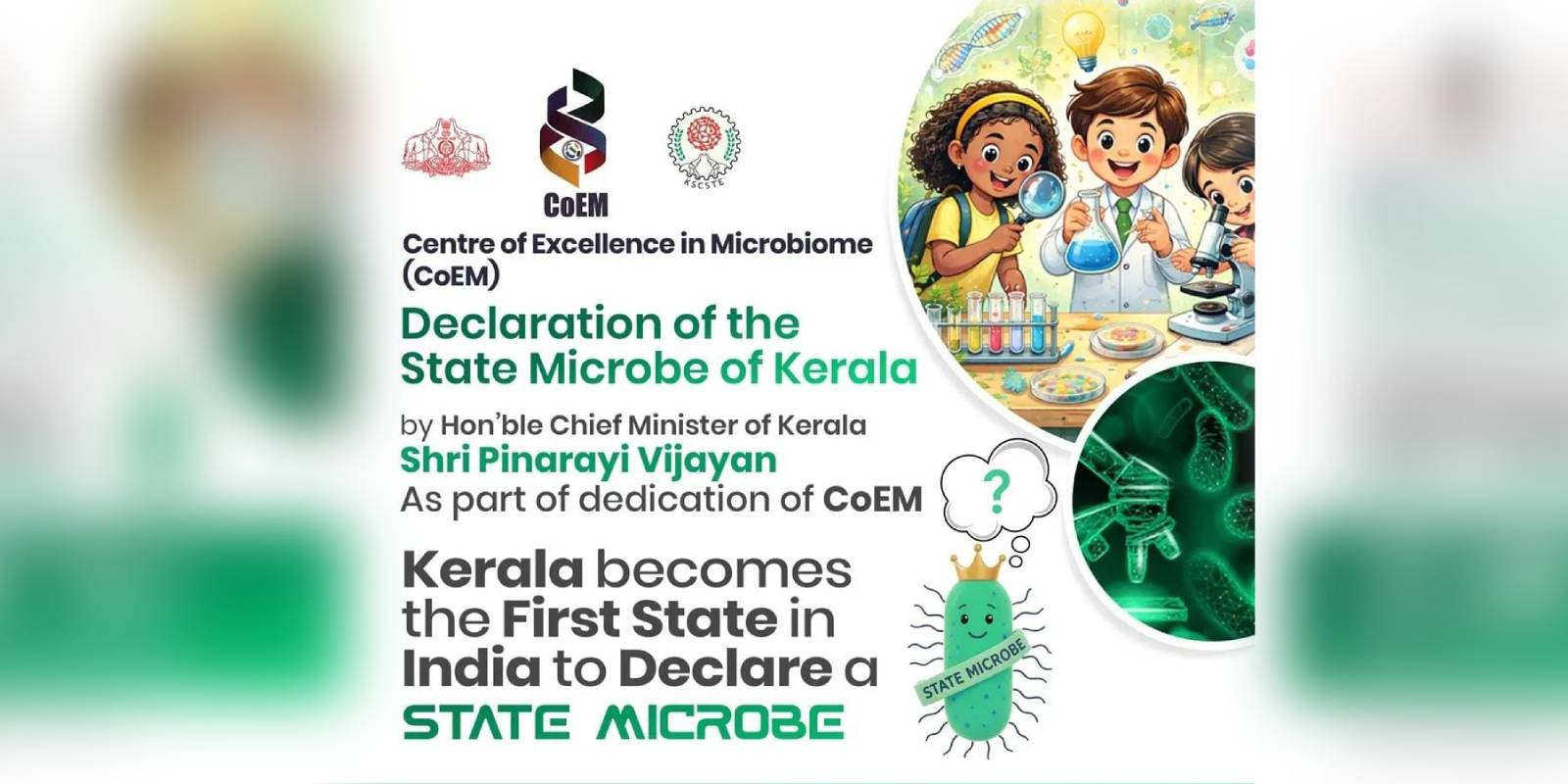
Kerala is set to officially declare a State Microbe
Synopsis: After rigorous evaluation, the committee selected a microorganism that meets stringent criteria: it is non-pathogenic, reported from Kerala, economically valuable, useful across multiple sectors, and certified as GRAS (Generally Recognized As Safe).
In a first-of-its-kind move in the country, Kerala is set to officially declare a State Microbe, marking a significant shift in how microorganisms are perceived—from invisible threats to indispensable allies of life.
Chief Minister Pinarayi Vijayan will make the landmark declaration on 23 January, alongside the dedication of the Centre of Excellence in Microbiome (CoEM), positioning the state at the forefront of microbiome science and public engagement.
The initiative springs from a simple but powerful idea: microorganisms are far more than pathogens. They are central to digestion, immunity, soil health, agriculture, ecological balance, and sustainable livelihoods.
The concept of a State Microorganism, it’s said was proposed by Dr. Sabu Thomas, Director of the CoEM, with the aim of sparking informed public discourse on the immense and often overlooked benefits microbes provide in everyday life, while also encouraging their conservation.
Recognising the scientific and symbolic value of the proposal, the Kerala government constituted an expert committee chaired by the Executive Vice President of the Kerala State Council for Science, Technology and Environment (KSCSTE).
The panel brought together clinicians, microbiologists, academicians, scientists, and representatives of the State Biodiversity Board.
After rigorous evaluation, the committee selected a microorganism that meets stringent criteria: it is non-pathogenic, reported from Kerala, economically valuable, useful across multiple sectors, and certified as GRAS (Generally Recognized As Safe).
Crucially, the chosen bacterium benefits humans, animals, aquatic systems, plants, and the environment, embodying the “One Health” approach that links human health with ecological well-being.
While the name of the State Microbe will be formally announced at the ceremony, the very act of designating one places Kerala in a rare global space where microbiology meets public policy and popular awareness.
At the national level, India took a similar symbolic step more than a decade ago.
In October 2012, Lactobacillus delbrueckii subsp. bulgaricus—a probiotic bacterium central to the production of curd, yoghurt, and cheese—was declared the National Microbe of India by the Ministry of Environment and Forests.
The decision followed an innovative public voting process conducted aboard the Science Express Biodiversity Special, with schoolchildren across the country choosing the microbe that best represented India’s biological and cultural heritage.
Then Minister of State for Environment and Forests Jayanthi Natarajan announced the decision, highlighting the role of microbes in nutrition and immunity.
Kerala’s initiative builds on that national precedent but goes a step further by embedding microbiome science into its development vision.
The Centre of Excellence in Microbiome, under whose aegis the declaration will be made, was initiated by the Government of Kerala through KSCSTE, in partnership with the Kerala Development and Innovation Strategic Council (K-DISC), and with scientific mentoring from the Rajiv Gandhi Centre for Biotechnology (RGCB).
The CoEM aims to promote cutting-edge research, innovation, and entrepreneurship across domains such as human health, animal health, agriculture, aquaculture, and environmental sustainability.
Guided by the motto “Microbes for Life”, the centre seeks to harness microbiota from human, animal, plant, aquatic, and environmental ecosystems to generate solutions to pressing health and environmental challenges.
(Edited by Sumavarsha, with inputs from Dileep V Kumar)


