



Kerala’s presence this year was shaped by the momentum generated by the Invest Kerala Global Summit and its top ranking in India’s Ease of Doing Business.
Published Jan 23, 2026 | 11:33 AM ⚊ Updated Jan 23, 2026 | 11:33 AM

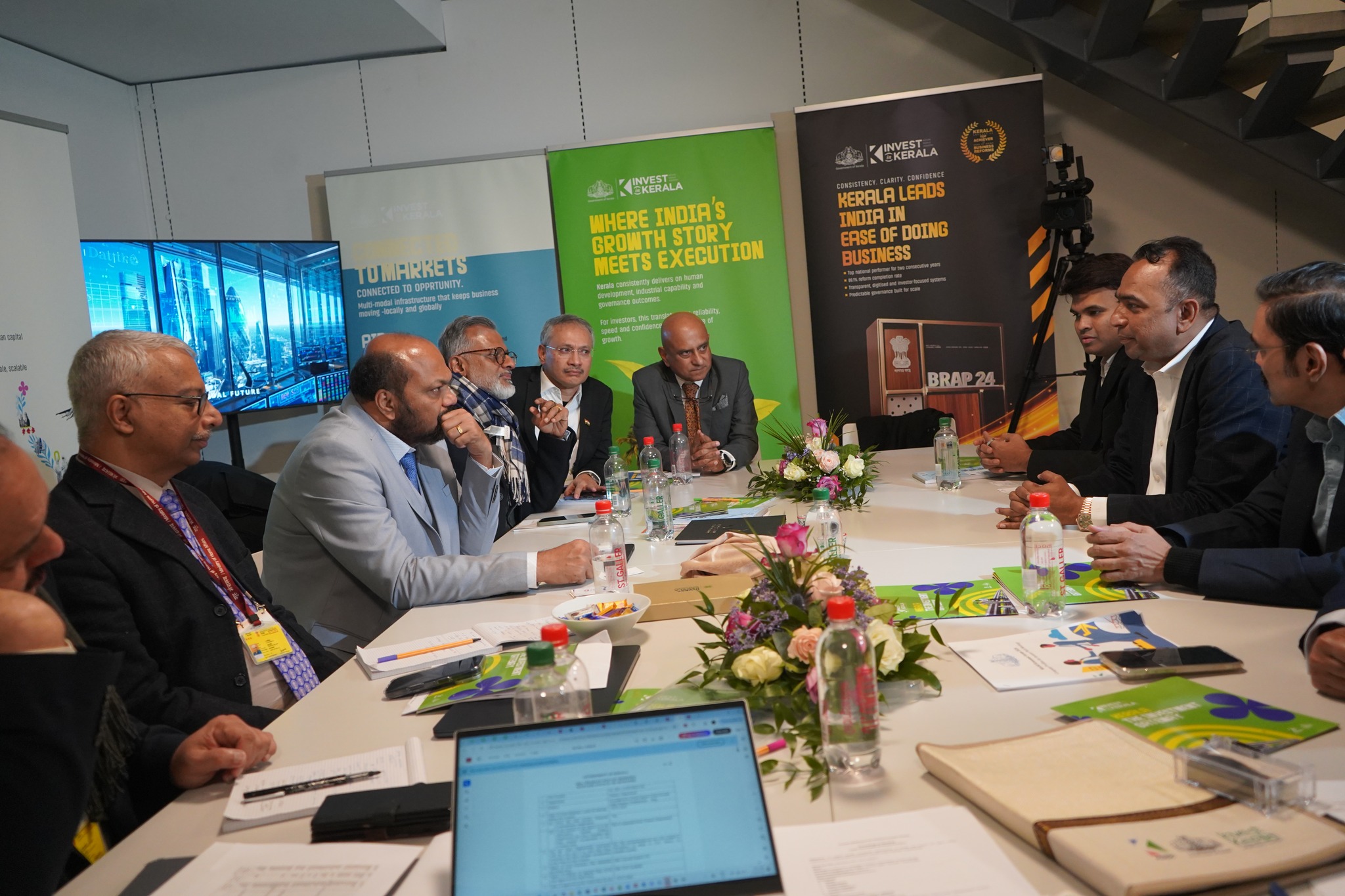
A team led by Minister P Rajeev at WEF Annual Summit 2026.
Synopsis: Kerala attended the World Economic Forum Annual Meeting, underscoring a deliberate shift in how the state engages with the global economy. Kerala positioned itself as one of India’s most future-ready investment destinations — rooted in sustainability, driven by talent, and open to global collaboration.
For the second time in a row, Kerala attended the World Economic Forum (WEF) Annual Meeting, underway in Davos-Klosters, Switzerland, underscoring a deliberate shift in how the state engages with the global economy.
According to the state Directorate of Industries and Commerce, Kerala positioned itself as one of India’s most future-ready investment destinations — rooted in sustainability, driven by talent, and open to global collaboration.
The Kerala delegation, led by Industries, Law and Coir Minister P Rajeev, along with Chief Secretary Dr A. Jayathilak IAS, Additional Chief Secretary (Industries) APM Muhammed Hanish IAS, Director of Industries and Commerce Vishnu Raj IAS, and senior officials are conducting the engagements, signalling both political commitment and administrative readiness.
Rajeev said the state is looking ahead with optimism as it lines up major investment commitments from global players, adding that the state secured expressions of interest worth about $14 billion (₹1.18 lakh crore) across diverse sectors, such as renewable energy, global capability centres, healthcare, tourism, and financial services.
Emphasising Kerala’s investor-friendly climate, Rajeev pointed to its fully digital literacy, recognition of internet access as a basic right, and a development model that balances ecology and industry under the principle of “nature, people, industry” to convince investors from the US, UK, Germany, Italy, Spain and African nations.
One of the early highlights was a meeting with Sachidanand Upadhyay, CEO and Managing Director of Lord’s Mark Industries Limited.
With healthcare and medical technology identified as priority sectors under Kerala’s industrial policy, discussions explored investment opportunities in medical devices, diagnostics, and technology-enabled manufacturing.
Minister Rajeev assured complete support from the state government, noting Kerala’s growing stature as a medical technology manufacturing hub in India.
The state’s ambition to attract world-class enterprises in medical device manufacturing and biotechnology was echoed in discussions with European partners, reflecting a consistent narrative: Kerala wants value-added, innovation-driven manufacturing rooted in global standards.
Officials with Kerala State Industrial Development Corporation (KSIDC), an agency mandated for industrial and investment promotion in Kerala, told South First that Kerala’s technology story found strong resonance in meetings with global software and fintech leaders.
At the Kerala Pavilion, Minister Rajeev met Rajiv Shesh, Chief Revenue Officer of HCL Software, to explore collaboration across sectors, including investments in startups and emerging technologies.
Both sides discussed industry – startup collaboration, pilot deployments, and scale-up support, with Kerala projecting itself as a launchpad for co-creating innovation at scale.
Fintech was another area of convergence.
Interactions with Sabeer Nelli, Founder and CEO of Zil Money Corporation, focused on digital payments, SaaS-driven financial platforms, and global-scale fintech businesses — areas where Kerala highlighted its deep talent pool, robust digital infrastructure, and progressive policy support.
KSIDC later noted that fintech leaders are drawn not merely to markets but to ecosystems — precisely what Kerala aims to offer.
Kerala’s sustainability narrative was reinforced during discussions with Girish Tanti, Vice Chairman of Suzlon, one of the world’s leading renewable energy companies.
The meeting reflected a shared commitment to clean energy transition and green investments.
Rajeev highlighted Kerala’s pioneering ESG (Environmental, Social, and Governance) policy — the first of its kind in India — which emphasises environmental responsibility, social inclusion, and transparent governance.
Similar themes emerged in conversations with Gautham Reddy, Founder and CEO of Re Sustainability, where circular economy models, advanced waste management, and resource recovery were discussed as pillars of responsible industrial growth.
Strengthening ties with Europe and global policymakers
At the policy level, Kerala’s engagements extended beyond industry to diplomacy.
Swiss Federal Assembly Member Niklaus Samuel Gugger — himself a native of Thalassery — visited the Kerala Pavilion and spoke of the state’s potential within the broader India–Switzerland cooperation framework.
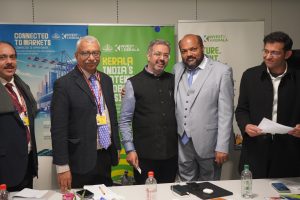
Swiss Federal Assembly Member Niklaus Samuel Gugger with Minister P Rajeev
As one of the key architects of the Swiss–India Free Trade Agreement, Gugger highlighted opportunities in clean technologies, innovation-driven industries, and sustainable development.
Economic cooperation with Poland also gained momentum through discussions with Malgorzata Mroczkowska-Horne, Director General of the Polish Confederation Lewiatan.
The talks explored cross-border collaboration in medical devices, IT/ITeS, digital services, and biotechnology, with a proposal to send a Polish business delegation to Kerala to assess opportunities firsthand.
KSIDC described these interactions as critical in positioning Kerala as a preferred European partner — policy-stable, skilled, and infrastructure-ready.
Beyond high technology, Kerala used Davos to reinforce its traditional strengths.
Meetings with Rajeev Sinha of SINHAS GmbH focused on taking Kerala’s spices and food products to global markets by strengthening export-ready SMEs.
A separate discussion with Drip Capital CEO Pushkar Mukewar explored innovative trade finance solutions to help Kerala’s SMEs scale globally, with an invitation extended to participate in TradeX Kerala 2026.
KSIDC is the view that Kerala Pavilion emerged as a hub of global engagement at Davos 2026, attracting international ministers, investors, and industry leaders. Kerala, KSIDC noted, is being positioned as “future-ready,” with a strong focus on technology, innovation, sustainable industries, and advanced manufacturing.
Highlighting Kerala’s credentials — India’s No.1 in SDG performance, top-ranked in Ease of Doing Business, and a knowledge-based economy — KSIDC emphasised that the state’s growth model balances nature, people, and industry.
Officials pointed out that, from meetings with Maldives’ Economic Development Minister Mohammad Saeed to engagements with European policymakers and global CEOs, the message from Davos was consistent.
Kerala is no longer just emerging — it is investment-ready.
As Minister Rajeev stated during the inauguration of the India Pavilion, Kerala’s presence this year was shaped by the momentum generated by the Invest Kerala Global Summit and its top ranking in India’s Ease of Doing Business.
“We arrive in Davos carrying this achievement for the second consecutive time,” the Minister noted, describing Davos as a platform to showcase Kerala as a progressive destination for innovation-led, sustainable growth.
Meanwhile, a representative of the Kerala Chamber of Commerce and Industry told South First, “While the Davos engagements have helped Kerala put its story across and renew global interest, it is important to note that, so far, these have largely been exploratory discussions. There have been no formal announcements or confirmed commitments from major global companies yet. Such forums are useful for networking and signalling intent, but the real test will be whether these talks translate into concrete investments on the ground in the coming months. We should wait and see how much of this interest actually materialises.”
(Edited by Muhammed Fazil.)


