


Chief Minister Pinarayi Vijayan, while announcing the decision on 24 December, said the government was concerned about the “plight of people who find it difficult to prove their existence”.

Published Jan 02, 2026 | 12:38 PM ⚊ Updated Jan 02, 2026 | 12:38 PM

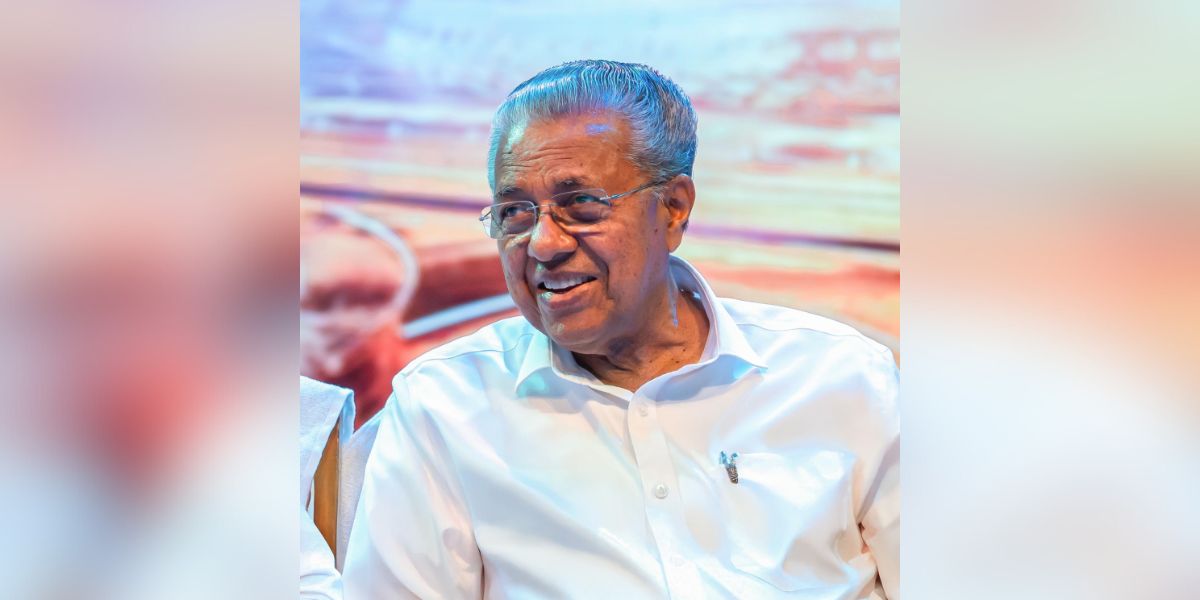
Kerala Chief Minister Pinarayi Vijayan.
Synopsis: The Kerala government approved the Nativity Card, a new photo-based identity document intended to replace the nativity certificates. While the state government frames the Nativity Card as a citizen-friendly reform aimed at reducing administrative hardship, critics see it as a duplication of identity infrastructure with unclear legal boundaries.
The Kerala government has approved, in principle, the issuance of a Nativity Card, a new photo-based identity document intended to replace the nativity certificates currently issued in the state.
The move, cleared by the Cabinet and formalised through a Revenue Department order dated 27 December 2025, is being pitched as a solution to the long-standing difficulties faced by residents in repeatedly proving their nativity for availing government services.
However, the proposed document has also sparked political controversy, with the BJP questioning both its necessity and legality, arguing that citizenship and identity-related matters fall within the Union government’s domain.
The Nativity Card is envisaged as a permanent, photo-bearing document that certifies a person as a native of Kerala.
Unlike the existing nativity certificate — which is issued as and when required — the card is intended to be a one-time, reusable document with social and legal backing.
According to the government order, the card will include the applicant’s photograph and key personal details and may, in future, incorporate advanced security features such as a chip and hologram.
A sample design of the proposed card has already been prepared.
The Tahsildar will be the issuing authority, and the card will be issued based on the same eligibility conditions currently applicable for nativity certificates.
Chief Minister Pinarayi Vijayan, while announcing the decision on 24 December, said the government was concerned about the “plight of people who find it difficult to prove their existence”.
“A person should be able to prove that he was born in this country and lives here, or is a permanent resident. No one should be thrown out. For that, there must be an authentic, legally backed document,” the Chief Minister said.
At present, residents are often required to obtain multiple nativity certificates for different purposes such as education, welfare schemes, or local body benefits. Each application involves documentation, affidavits, and verification by local officials, which the government acknowledges has become a recurring public grievance.
By replacing the certificate with a permanent card, the state says it aims to reduce bureaucratic repetition, improve ease of access to services, and offer citizens a secure identity document issued by the state government.
A Nativity Certificate is an official document issued by the Government certifying the Indian origin of an applicant and confirming that the applicant or their parents/grandparents have lived in a particular state.
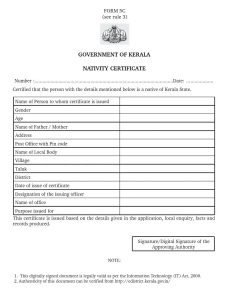
Nativity Certificate
It is primarily used to avail reservations and quotas in educational institutions, apply for government jobs, and access various scholarship schemes.
Applicants are required to upload supporting documents such as a birth certificate, a ration card, and the school certificates of their parents.
The certificate is issued with a validity for a specified minimum period.
The fee structure has been clearly split to reflect service and government charges.
General applicants will pay ₹25 — comprising ₹18 as Akshaya service charge and ₹7 as government service charge — in addition to ₹3 per page for scanning or printing. SC/ST families will be charged a concessional ₹10, with ₹2 per page for scanning or printing, while BPL families will have to pay a flat ₹20.
Currently, a nativity certificate in Kerala certifies that a person is a Keralite by birth.
It is typically issued in cases where a birth certificate is unavailable or insufficient.
Under existing norms, a person is considered a native if they:
For those born outside Kerala, eligibility depends on parental roots. A nativity certificate can be issued if:
The Nativity Card will follow these same criteria, with Village Officer certification remaining mandatory in certain cases.
One key admission in the government order is that neither the existing nativity certificate nor the proposed card currently has explicit legal backing under state or Union law.
To address this, the government has directed the Land Revenue Commissioner to draft a special law to give the Nativity Card statutory validity.
A detailed Standard Operating Procedure (SOP) will also be prepared.
The draft legislation will be placed before the Cabinet after consultation with the Law Department.
Until such a law is enacted, the Nativity Card remains an administrative initiative approved “in principle”.
The government lists multiple objectives behind the card:
The card, the government said, is designed to instil a sense of pride in being both Indian and Keralite, while also simplifying governance.
The initiative has drawn sharp criticism from the BJP.
Senior leader and former Union Minister V Muraleedharan questioned the rationale behind introducing another identity document, especially when Aadhaar already contains extensive personal information.
He argued that issues related to identity and citizenship fall under the jurisdiction of the Centre and alleged that the state government’s move was politically motivated.
Muraleedharan also accused the Left government of wasting public funds by announcing projects that burden the exchequer without delivering tangible benefits.
Calling the Nativity Card unnecessary, he urged the government to withdraw the proposal.
While the state government frames the Nativity Card as a citizen-friendly reform aimed at reducing administrative hardship, critics see it as a duplication of identity infrastructure with unclear legal boundaries.
The criticism largely centres on the chief minister’s remark that people should not struggle to prove their existence and that no one should be excluded if they possess an authentic, legally backed document — something the Kerala government proposes through a Nativity Card.
Legal experts and political leaders argue that this proposal blurs the line between a domicile document and a national identity card contemplated under Section 14A of the Citizenship Act.
They point out that citizenship is an exclusive Union subject, governed by the Citizenship Act, 1955, which is a complete code in itself.
Nativity certificates, they stress, have historically been limited to proving domicile for state-specific purposes such as reservations in education and public employment.
Extending this concept to include proof of citizenship, critics argue, is constitutionally untenable and beyond the legislative competence of states.
“Citizenship cannot be decided or even implied by a state-issued card,” a BJP leader said, adding that only Parliament and the Union government are empowered to determine, register, and certify Indian citizenship.
At the same time, it is being pointed out that much will depend on the proposed legislation — particularly how the government defines the card’s legal scope, safeguards it from misuse, and ensures that it does not conflict with existing central identity frameworks.
For now, the Nativity Card remains a proposal that reflects Kerala’s attempt to address documentation challenges — but one that also opens up a wider debate on identity, legality, and federal boundaries.
(Edited by Muhammed Fazil.)


