

Published May 25, 2026 | 9:27 PM ⚊ Updated May 25, 2026 | 9:27 PM

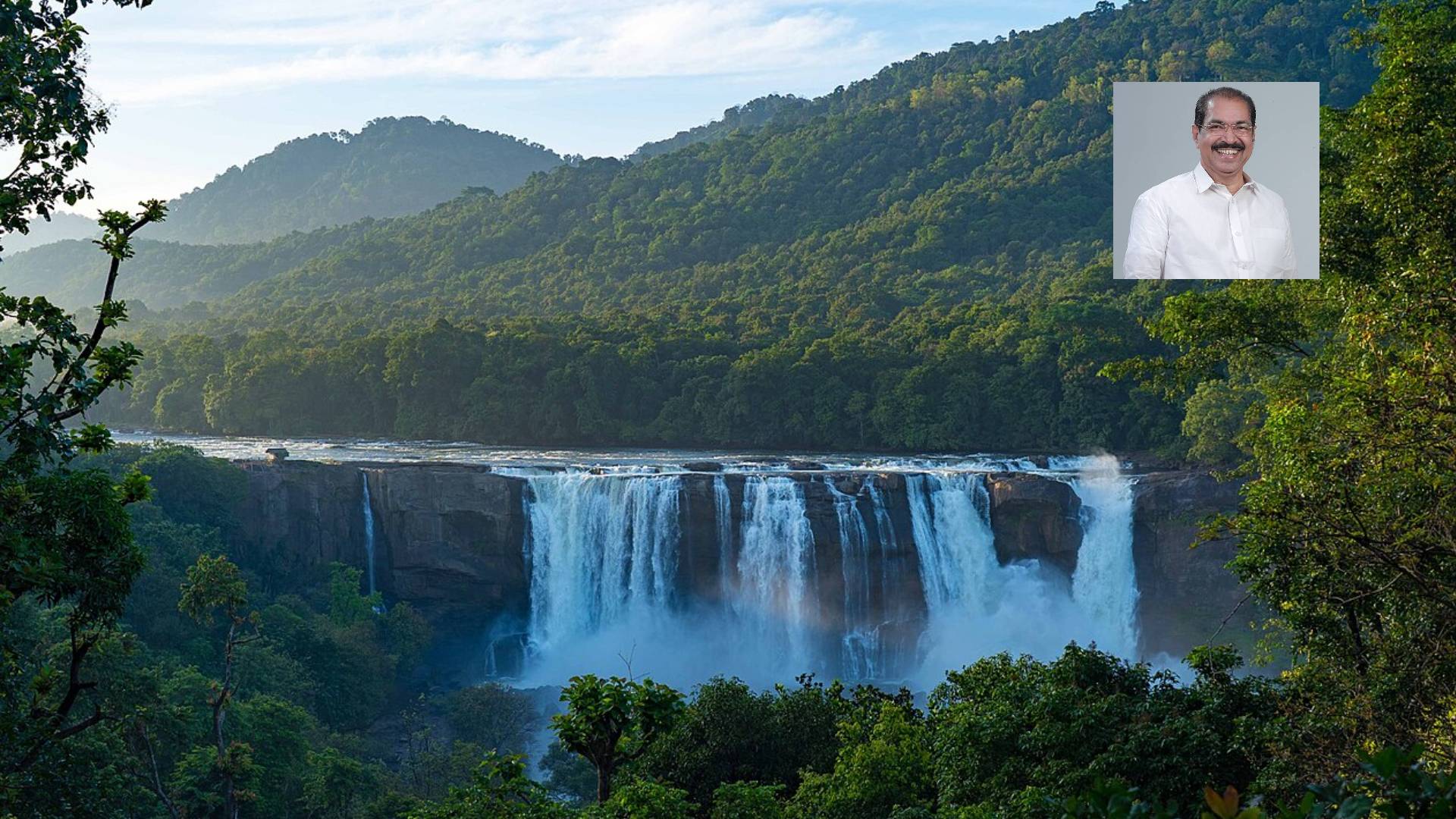
Athirippilly waterfalls and Minister Sunny Joseph ((Jan Joseph George/Wikimedia Commons)

Cabinets of ministers in Kerala have always had a flair for unusual combinations. But the latest portfolio pairing has produced a special kind of curiosity.
The new government under Chief Minister VD Satheesan has a minister who, many think, personifies the idiom, “running with the hare and hunting with the hounds.”
The minister of this contradiction is Sunny Joseph — Peravoor MLA, KPCC president and the man expected to simultaneously protect Kerala’s forests and push electricity production.
In other words, the same minister may soon have to sign files seeking permission to cut through the hills, and will have another file asking him to preserve.
The pairing of Electricity and Environment has already triggered animated conversations inside political corridors, environmental circles, and WhatsApp groups.
For environmentalists, the issue is not merely administrative. It is philosophical. One portfolio exists to generate power. The other exists to ask uncomfortable questions before power projects flatten forests, reroute rivers, or disturb wildlife corridors.
Asking one minister to handle both, critics say, created the political equivalent of asking the same person to run a timber shop and a tree protection campaign.
At the centre of this debate sits the Athirappilly Waterfalls hydroelectric project.
The proposed 163 MW Athirappilly project has survived governments, protests, committee reports, and changing political slogans with the persistence of a Malayalam serial character nobody can permanently write off.
Every few years, it returns, newly packaged and freshly optimistic.
In the latest, the pitch comes with eco-tourism language polished to perfection.
There is talk of ensuring uninterrupted waterfall flow using a small round-the-clock generator. Tourism possibilities are floated. Botanical parks. Adventure activities. Somewhere in the future, perhaps a visitor taking a zipline selfie while a confused hornbill silently questions human evolution.
But environmental groups are not amused.
Researchers and activists, including voices associated with the Chalakudy River Research Centre, continue to warn that the project would require the diversion of more than 137 hectares of forest land, including ecologically sensitive riparian stretches.
The region is home to rare hornbill habitats and also functions as a critical elephant corridor linking protected forest landscapes. The great hornbill is Kerala’s state bird.
The irony is impossible to miss.
Kerala’s modern environmental consciousness was itself shaped by resistance against large hydroelectric interventions. The famous Silent Valley movement did not emerge from nowhere; it emerged from precisely this collision between developmental ambition and ecological anxiety.
Now the same debate is back, only with sharper edges. Kerala is battling rising power demand, shortages during summer, and dependence on costly electricity purchases from outside the state. Inside the Electricity Department, the pressure is immediate and measurable. Megawatts matter.
The Environment Department operates differently.
Its job description sounds less dramatic but far more inconvenient. It is expected to protect biodiversity, oversee climate-related planning, coordinate conservation policies, regulate pollution, and defend ecological thresholds before irreversible damage occurs.
The department officially speaks the language of “sustainable development.”
KSEB files usually speak another dialect entirely.
That is where the discomfort begins.
As Electricity Minister, Joseph may soon find himself deliberating on hydroelectric projects. But every ambitious proposal he pushes across the table will also land right back before Joseph, the Environment Minister — the man expected to ask whether the forests, rivers and wildlife can survive the cure prescribed for the state’s energy headache.
The concerns extend beyond Athirappilly.
The long-discussed Pooyamkutty proposals in the Periyar basin continue to haunt environmental debates.
Supporters view such projects as essential for reducing Kerala’s expensive dependence on imported power. Opponents point to submerged reed forests, disrupted biodiversity zones, and the impact on traditional tribal livelihoods linked to these ecosystems.
Even smaller hydro projects now attract scrutiny.
Environmental researchers increasingly argue that cumulative intervention across mountain streams alters river temperatures, fish migration patterns, and downstream ecology in ways earlier assessments conveniently ignored.
Which brings Kerala back to its newest political puzzle: can one minister genuinely police both impulses without one side eventually overpowering the other?
Critics say the conflict is structural.
The Electricity portfolio rewards expansion, rapid clearances, and uninterrupted supply.
The Environment portfolio is supposed to slow things down, demand assessments, and occasionally say no.
One office counts megawatts. The other counts hectares of forest.
In practical terms, the fear is simple.
When public anger rises over power shortages, environmental clearance processes may slowly become formalities rather than safeguards.
State-level regulatory bodies ultimately function within the same political ecosystem, pushing these projects forward. Neutrality begins to look fragile.
That is why several environmentalists now argue that the Environment portfolio should either return to the Chief Minister’s office — as it was during the second Pinarayi Vijayan government — or be merged with Forest and Wildlife, where ecological concerns would carry greater institutional weight.
Kerala has another minister for Forest and Wildlife: Shibu Baby John.
The argument is not entirely ideological. Kerala’s recent history has been shaped by floods, landslides, erratic rainfall, and increasingly fragile climate patterns. Ecological warnings that once sounded academic now arrive with evacuation alerts.
Meanwhile, the new minister finds himself seated exactly at the intersection of development politics and environmental caution.



