

Published Mar 05, 2026 | 7:00 AM ⚊ Updated Mar 05, 2026 | 9:07 AM


Language remains a sensitive subject in India’s federal structure.
Synopsis: Kerala Governor Rajendra Vishwanath Arlekar has signed the Malayalam Language Bill, 2025, months after the bill was passed by the state legislature. The law mandates the use of Malayalam across government work, education and parts of the judiciary, while retaining English versions of documents and providing safeguards for linguistic minorities. The move follows years of legal hurdles and revisions and objections from Karnataka over its impact on Kannada-speaking minorities.
Kerala Governor Rajendra Vishwanath Arlekar on Wednesday, 4 March signed the Malayalam Language Bill, 2025, culminating a decades-long effort to make Malayalam the sole official language of the state for administrative purposes.
The assent comes days after the Union Cabinet approved the Kerala government’s proposal to officially change the state’s name to “Keralam”, just months before the Assembly elections.
The Bill replaces the existing system under the Kerala Official Languages Act, 1969, which recognised both English and Malayalam as official languages.
The new law makes Malayalam the primary language for government work but retains English versions of documents to ensure clarity and accessibility.
Crucially, the Act includes specific safeguards to avoid alienating non-Malayalam speakers. Linguistic minorities such as Kannada, Tamil, Tulu and Konkani speakers are guaranteed the right to communicate with government offices in their own languages in notified regions and to receive replies in the same language.
The bill designates Malayalam as the sole official language of Kerala and mandates its use across government administration, education, the judiciary, public communication, commerce and the digital domain, subject to constitutional provisions.
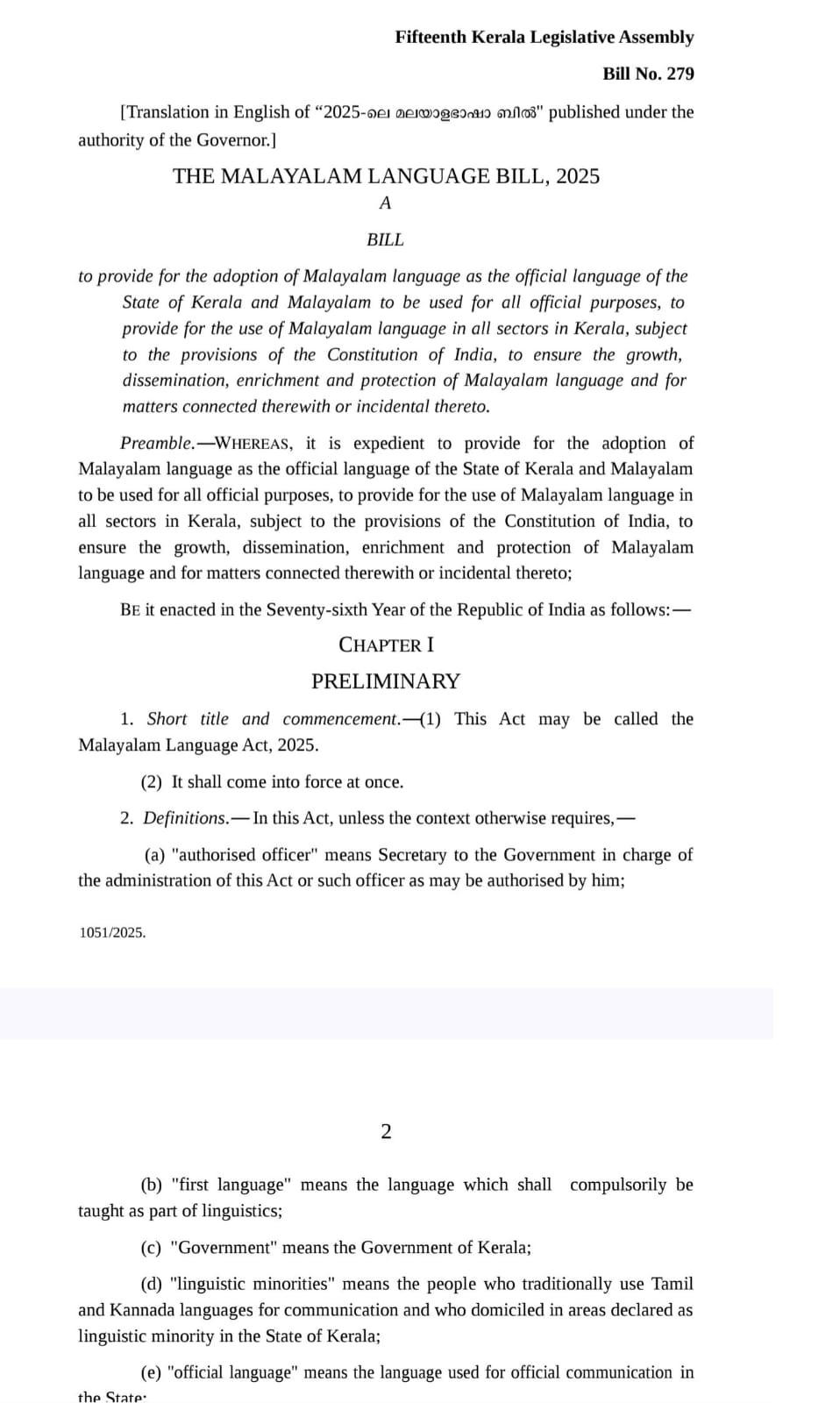
Malayalam Language Bill, 2025
All official communication, government orders and administrative work will be carried out in Malayalam.
Bills and Ordinances will be introduced in Malayalam, with English versions also provided. Important Central and State Acts published in English will be translated into Malayalam in a phased manner.
The law mandates the phased translation of court judgments and proceedings into Malayalam, particularly in lower courts, so legal processes become more accessible to the public.
Malayalam will also be compulsory as the first language in schools from Classes 1 to 10. Universities will be required to include Malayalam in their curriculum. Students whose mother tongue is not Malayalam will be allowed to opt for other languages permitted under the national curriculum.
Those migrating from other states or from abroad will be exempt from Malayalam examinations at the secondary and higher secondary levels.
Public Service Commission examinations will be conducted in Malayalam, though certain select examinations may continue in other languages.
The Information Technology department will develop open-source software, digital tools and accessories for the efficient use of Malayalam in the IT field. Government websites and digital platforms will increasingly function in Malayalam.
The existing Personnel and Administrative Reforms (Official Language) Department in the Government Secretariat will be renamed the Malayalam Language Development Department.
A Malayalam Language Development Directorate will be constituted under this department to manage, monitor and guide the shift to Malayalam in official use.
Language remains a sensitive subject in India’s federal structure. States have the power to adopt official languages for administration, but such measures must comply with fundamental rights, minority protections and Central laws such as the Official Language Act, 1963.
The Act culminates years of effort. A decade ago, Kerala passed the Malayalam Language (Dissemination and Enrichment) Bill, 2015 with similar objectives.
That Bill was reserved for the President’s consideration, but assent was withheld after objections on several grounds, including:
The second government led by Pinarayi Vijayan took up the issue again and passed a revised Bill during the Assembly session in October last year.
Prathapachandran, Additional Secretary in the Law Department, told South First that the 2025 Bill was introduced after removing or modifying the contentious provisions. He said constitutional safeguards and minority protections have now been addressed.
The Governor’s assent had remained pending until now.
Cultural leaders later met Prime Minister Narendra Modi and sought approval for the legislation. Rajeev Chandrasekhar, the Bharatiya Janata Party state president, also wrote to the Governor urging him to sign it.
With the Governor’s signature, the law now shifts the state away from the bilingual system established under the Kerala Official Languages Act, 1969, an official from the Personnel and Administrative Reforms (Official Language) Department told South First.
The Bill was not without opposition. The strongest objections came from Karnataka, particularly over its impact on Kannada-speaking minorities in Kasaragod.
The Kerala government rejected the charge that the Bill infringes minority rights and said explicit safeguards are built into the law. It said the Bill balances the promotion of Malayalam with constitutional guarantees under Articles 29 and 30, which protect the cultural and educational rights of minorities.
“Linguistic minorities will be permitted to use their own languages for official correspondence in relevant areas. Students whose mother tongue is not Malayalam can continue education in their preferred languages where such options exist, in line with national education policy,” a state government official told South First.
“Students from other States and foreign countries will be exempted from Malayalam examinations in Classes 9, 10 and higher secondary levels.”
(Edited by Dese Gowda)


