

Published Jan 08, 2026 | 3:21 PM ⚊ Updated Jan 08, 2026 | 3:21 PM


Antimicrobial resistance or AMR, is a growing global concern. Kerala has plans to combat it. (Representational image/Creative Commons)
Synopsis: The initiative aims to realise the state’s larger goal of becoming an Antibiotic Literate State, by involving stakeholders across levels — from people and grassroots local bodies to hospitals and health service providers in the public and private sectors.
In a first-of-its-kind, system-wide move to tackle the growing threat of antimicrobial resistance (AMR), the Kerala Department of Health and Family Welfare has rolled out a comprehensive, score-based accreditation and colour-coding system to transform hospitals and local self-governments (LSGs) into Antibiotic Smart and Antimicrobial Stewardship (AMS) compliant institutions.
AMR, often described as a “silent pandemic”, is responsible for thousands of preventable deaths globally every year, with misuse and overuse of antibiotics in humans, animals and agriculture accelerating the crisis.
Kerala’s new framework seeks to address this scientifically and systematically through a strong ‘One Health’ approach, integrating human health, animal husbandry, agriculture and local governance.
The initiative aims to realise the state’s larger goal of becoming an Antibiotic Literate State, by involving stakeholders across levels — from people and grassroots local bodies to hospitals and health service providers in the public and private sectors.
At the heart of the strategy is an innovative accreditation system developed with clearly defined key performance indicators and weighted scores.
Based on their performance, institutions will now be certified as:
“This is about changing behaviour and systems, not just issuing guidelines,” a senior health official said.
“The idea is to make every institution accountable for antibiotic use — whether it is a hospital, a medical shop, a farm or a local body,” the official added.
The Health Department has also revised the criteria for categorising hospitals as Antibiotic Smart Hospitals.
ASHs are defined as healthcare institutions that implement a pragmatic model of antimicrobial and diagnostic stewardship, while strictly complying with standard Infection Prevention and Control (IPC) practices.
Recognising differences in patient profiles and resource availability, the criteria vary across levels of care:
Primary care institutions (FHCs, CHCs, Block FHCs, UPHCs, UHWCs, UCHCs)
Secondary and tertiary hospitals
Significantly, Kerala has placed local self-governments at the core of community-level AMR containment.
To qualify as Antibiotic Literate or AMS-compliant LSGs, panchayats and municipalities must meet stringent benchmarks.
Among the mandatory parameters are:
Strict controls on antibiotic sales are also part of the framework:
Crucially, the cumulative antibiotic footprint of an LSG — across all sectors — must reduce by 10% every year from the baseline.
For LSGs, the score thresholds are:
To make compliance visible and measurable, the department has introduced a colour-coding system.
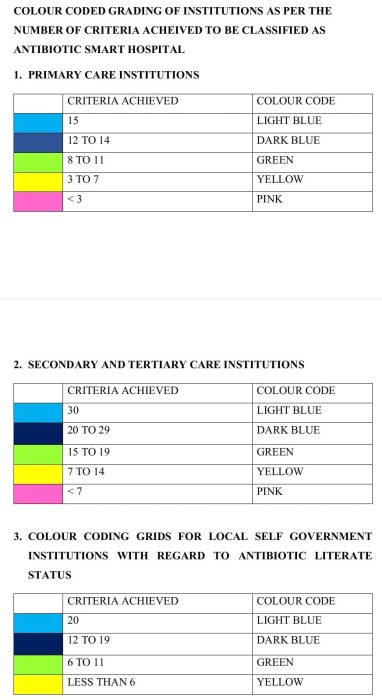
Colour coding for transparency and accountability. (Supplied)
Within three months of releasing the Standard Operating Procedures (SOPs), all institutions under the Directorate of Health Services (DHS) and the Directorate of Medical Education (DME) must be colour coded based on their performance.
District and Block AMR committees have been tasked with ensuring that private hospitals under their jurisdiction are also assessed and colour coded.
Except for the light blue category, colour coding assessments can be conducted by the institutions themselves, while six-monthly external assessments will be carried out by Block, District or DME committees.
Public health experts say the colour coding could play a crucial role in nudging institutions to improve practices.
“Once performance is visible, peer pressure and public accountability become powerful tools,” a health official noted.
Kerala’s integrated approach — combining hospital stewardship, community participation, agricultural reform and regulatory enforcement — is being seen as a potential national model in the fight against AMR.
“At a time when antimicrobial resistance threatens to undo decades of medical progress, Kerala is attempting to address the problem where it truly begins — at the prescription pad, the pharmacy counter, the farm and the household,” the official said.


