


Published Feb 07, 2026 | 8:00 AM ⚊ Updated Feb 07, 2026 | 8:00 AM

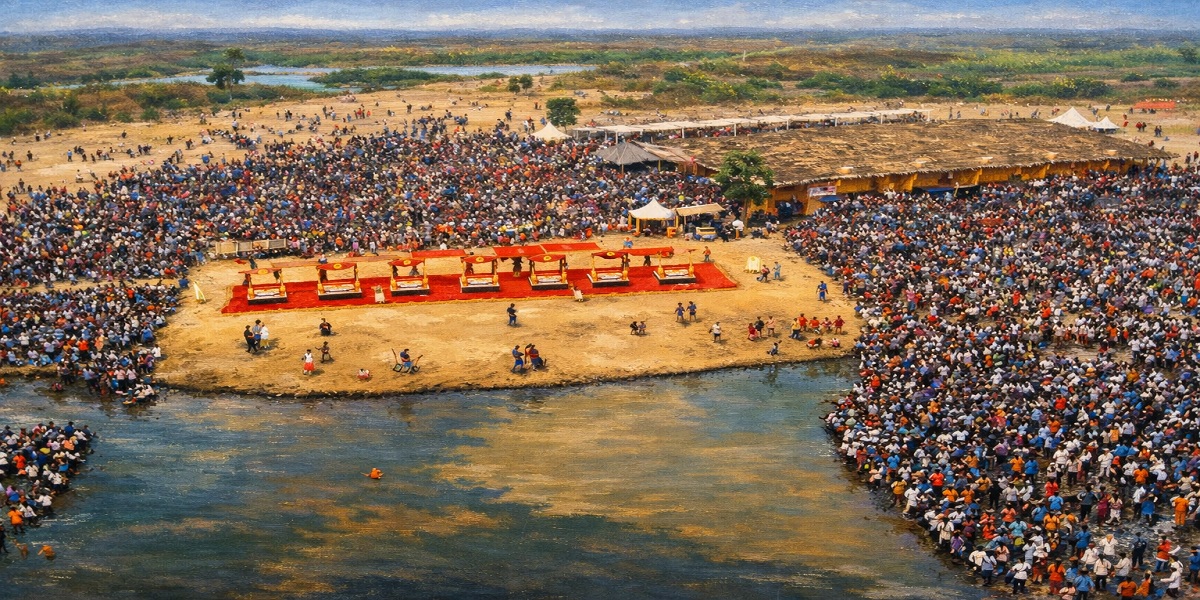
According to the organisers, more than 10 lakh people attended the Kerala Kumbha Mela
Synopsis: Questions have been raised over the plan to hold the Kerala Kumbha Mela regularly on the banks of the River Bharathapuzha. While the pro-Hindu outfits’ narrative, seen as a social engineering bid, gives a historical link to the initiative, there is no evidence to prove that the festival was held as claimed at Tirunavaya in the Muslim-dominated Malappuram district. Doubts have been raised about whether the plan is a bid to divide the population on religious lines.
The dust and din surrounding the Mahamagha Mahotsavam have settled. The invasive desho grass merrily danced in the breeze that swept across the naked riverbed as Bharathapuzha, which hosted the 15-day festival on its sandbanks at Tirunavaya, started shrinking, announcing the arrival of summer.
The river, which goes by several names, including Perar and the sobriquet, Nile of Kerala, now flows nonchalantly, oblivious to a debate over the recently concluded Hindu congregation.
Pro-Hindu outfits and akhadas — religious groupings of ascetics and saints who play a major role in spiritual matters — have been hyping the Mahamagha Mahotsavam as Kerala’s Kumbha Mela, and have grander plans for the future.
However, their argument that Kerala had celebrated Mahamagha Mahotsavam in the past lacked evidence and did not pass muster with experts on the state’s culture and history.
The name Salil, “water”, has its roots in Sanskrit, having connotations of fluidity, purity, and life.
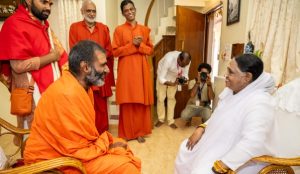
Swami Anandavanam Bharati Maharaj of the Juna Akhada with spiritual leader Mata Amritanandamayi.
Salil P was an SFI activist during his student days at the Sree Kerala Varma College in Thrissur, he told reporters during the Mahotsavam. He later joined Mathrubhumi, a major Malayalam media house, as a journalist, before finding his calling.
He was at the Mahotsavam, his saffron robes proudly announcing his identity. He is now Swami Anandavanam Bharati Maharaj of the Juna Akhada, the largest and one of the oldest and most influential Shaivite orders of Naga Sadhus in India.
Swami Anandavanam Bharati Maharaj was reportedly appointed Mahamandaleshwar for South India at the Prayagraj Kumbha Mela and was the key figure behind the recently concluded Kerala Kumbha Mela.
Speaking to the media, he said the event was not new but a revival of the centuries-old Mahamagha Mahotsavam, which has now come to be known as Kerala’s own Kumbha Mela.
The Swami’s claim is now being fiercely contested. His followers, however, are undeterred.
”In 2027, we will organise a 45-day utsav (festival) on the banks of the Nila River,” he said.
“Nila”, meaning “dark blue” or “sapphire,” representing the colour of the sky or the ocean, is the Sanskritised name of Bharathapuzha.
“A Kumbh Mela similar to the one in Prayagraj will be conducted in Kerala with the participation of more akhadas in 2028. Preparatory and organisational activities for the event will begin in April 2026,” he added. He used the Hindi phrase Kumbh Mela, rather than Kumbha Mela, as it is said in Malayalam.
The Maghamasam Mahotsavam saw ascetics from different mutts and spiritual centres across South India in Malappuram, a district with a predominantly Muslim population.
According to the 2011 Census, Muslims formed 70.24% of the total population in Malappuram, while Hindus and Christians comprised 27.60% and 1.98%, respectively.
Swami Anandavanam Bharati Maharaj’s claim of the past Mahamagha Mahotsavam celebrations has baffled experts.
G Priyadarsanan, former research head at Malayala Manorama and a historian, said he knew only about Mamankam, not Mahamagha Mahotsavam.
”I have never heard of Mahamagha Mahotsavam from my parents or grandparents, nor from any history books in my 92 years of life,” he told South First.
Mamankam was a duodecennial medieval fair held at Tirunavaya upon the River Bharathapuzha.
He added that the late KP Kesava Menon, a freedom fighter and the founding editor of Mathrubhumi, had written about Mamankam in the weekly.
“It is the most reliable modern account of the festival,” the nonagenarian added.
Mamankam was organised by the Zamorins of Calicut (Kozhikode) and functioned as a major political and cultural gathering. The fair was not only a religious festival for the Zamorins, but also an occasion for displaying their pomp and power.
It is often remembered for the ‘chaver‘ (mercenary) warriors who undertook suicide missions for the Zamorins.
Priyasarsanan said Mamankam has no similarity with North Indian customs or festivals like the Kumbha Mela.
According to the late Professor KV Krishna Iyer, an authority on the history of Kerala, the last Mamankom was held in 1755 CE.
Dr Cheravally Sasi, former head of the Malayalam Department at CMS College, Kottayam, and a cultural activist, told South First that the recent Mahamagha Mahotsavam had no connection with Mamankam.
”Mamankam remains familiar even to the present generation through history, as well as films and songs based on it. Poet Bichu Thirumala’s line, ‘Mamankam palakuri kondadi Nilayude theerangal Naavayil’ (Mamankan was held several times at [Tiru]Navayi on the banks of Nila) is the most famous song associated with Mamankam,” he said.
Dr Sasi said most sages who coordinated the event came from North India, and the customs followed had no links with Kerala’s traditions. He warned that it would cause long-term irreparable damage to the state’s culture.
Historian Pallikonam Rajeev told South First that the history of Mamankam, as popularly known today, relates only to the period after the 12th century. Before that, Mamankam was primarily a ritual to elevate the Perumal to power by showering rice on his head, known as Ariyittu Vazhikkal.
“The ritual was held on the Makam star in the Malayalam month of Magha. Hence, the correct pronunciation is ‘Magha Makam‘ and not ‘Mahamagha Mahotsavam,‘ a term coined by the Sangh Parivar to project it as a Kerala version of the Maha Kumbha Mela at Prayagraj,” he said.
He explained that there were four thalis in Kerala, which were essentially Shiva temples and centres of power under the authority of the Thaliyarmar (feudal lords, mainly from Brahmin and Bhattathiri communities).
These bodies framed the laws of the land based on the Manusmriti and the Neethi Saram, and used the Perumal as an authority to implement them. The Perumal was a position, similar to that of the Indian President, chosen from among those associated with the Chera dynasty.
The Perumal served as the executive authority over 18 local princely states of Kerala, but did not hold supreme powers. The constitution used for governance was the Moozhikkalam Kacham, framed by the Thaliyarmar.
For the entire region of Kerala, the Ariyittu Vazhikkal ritual was conducted at Tirunavaya.
However, in AD 1103, the last Perumal was impeached, and power was decentralised to 18.5 thalis instead of four. During this period, Shiva temples functioned not only as places of worship but also as centres of administration, similar to legislative assemblies.
This transition coincided with the rise of the Zamorins, who became more powerful than other rulers in Kerala. Their dominance was aided by the economic growth of the Calicut port. Economic strength translated into political and military power, with forces such as the Chavers on land and the Marakkars at sea.
Support from the Muslim community also helped the Zamorins expand their influence to neighbouring states such as Parappanad and Tanur.
Subsequently, Zamorins took over the Ariyittu Vazhikkal ritual at Tirunavaya, and thus became the Mamankam tradition known today through songs and legends, Rajeev said.
“While it is true that large gatherings had taken place, Mamankam has no connection with the Kumbh Mela,” he stated.
He further said that the Sangh Parivar did not revive Mamankam, as claimed.
For over a decade, the panchayats of Tavanur, Tirunavaya, etc., had been organising events to commemorate Mamankam, mainly as cultural festivals accompanied by historical seminars.
Since Malappuram is a Muslim-majority district, the organisers were largely from that community, with active participation of Hindus who performed kalaripayattu, thalapoli and other rituals. This created a harmonious and secular platform for commemorating Mamankam.
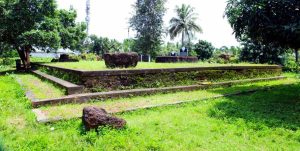
A prominent Mamankam monument, Nilapaduthara, has been restored under the Nila Tourism Project with the support of the Kerala Archaeology Department.
However, Rajeev claimed that some local Sangh Parivar outfits, “frustrated by this inclusive tradition”, attempted to rewrite their history.
He further stated that a writer and local historian with apparent Sangh Parivar leanings, Dinesh Tirur, produced a new narrative linking Mamankam with Hindu mythology and the stories of Brahma and Vishnu, focusing only on temples while ignoring social history.
Rajeev termed it an attempt to polarise Hindus.
He further alleged that the Sangh Parivar was now portraying the Nilapaduthara as a Shiva temple destroyed by Tipu Sultan, a narrative he described as a recurring theme in pro-Hindutva discourse in Kerala. He said such efforts aimed at erasing the Muslim identity of Malappuram.
When contacted, Tirur refused to respond to South First‘s questions.
Ummar Chirakkal, a local historian from Tirunavaya, told South First that the last Mamankam was held in AD 1755.
”The Sangh Parivar is spreading a story here that Tipu Sultan destroyed the Mamankam event. But Tipu was only five years old then. How can a five-year-old child destroy an event? Even his father, Hyder Ali, never came to Tirunavaya. There is evidence that he visited Ponnani, Chelakkara, and some coastal areas, not Tirunavaya.
The Basel Evangelical Mission, a prominent German Protestant missionary group, came to Tirunavaya only in AD 1857, not the British or the Portuguese. So how can the British be blamed for destroying Mamankam, as claimed by the Sangh Parivar?” he asked.
Tirur MLA Kurukkoli Moideen told South First that he attended the event.
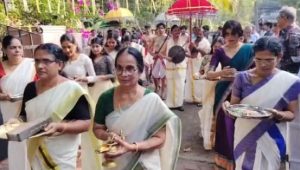
The Mamankam Ankaval ritual was organised by the Tirunavaya panchayat in 2025.
”Those who came were devotees and had no political intentions,” the Indian Union Muslim League leader said. “Maybe the organisers have a political agenda, but the people do not.”
Moideen added that even the Kerala government conducted programmes like the Global Ayyappa Sangamam to mobilise devotees.
”Organisers behind such events may have political interests, but participants come with pure devotion. The event concluded without any conflict. Muslims fully cooperated — they provided food for devotees, arranged parking facilities at their homes and offered shelter for rest. That is the spirit of this land. Polarisation will not work here” he said.
He also stated that there is no historical evidence of a Kumbha Mela being held in Kerala, though there are records of Mamankam.
”We still preserve those roots and cultural traditions of Mamankam. In the future, organisers may attempt political gains, but under the current political situation, no attempts at dividing Hindus and Muslims will succeed in Malappuram” he added.
Meanwhile, IUML Rajya Sabha MP from Malappuram, PV Abdul Wahab, told South First that the organisers were free to conduct the event anywhere, but declined further comment.
BJP Malappuram district president Deepa Puzhakkal said the Kerala Kumbha Mela was not organised by the BJP, but the party supported it.
”It has no connection with politics. It is a revival of history and culture linked with the spirituality of Bharat. Muslims go to Mecca and Medina for spiritual needs; this is a similar one,” she told South First.
Responding to criticism that northern customs were being imposed on Kerala, she said: ”Why divide north and south? India has one spirituality and one ideology — Akhand Bharat. The Nila Aarti was performed by pandits from Varanasi, renowned for performing the Ganga Aarti. We never expected such a large turnout.”
Puzhakkal added that the BJP was hopeful of a “good good performance in Malappuram in the upcoming Assembly elections, and the groundwork is on.”
While the CPI(M) and the Congress formally refrained from participating in the event, Congress MP Shashi Tharoor conveyed his wishes.
(Edited by Majnu Babu).


