


Published Jan 20, 2026 | 2:50 PM ⚊ Updated Jan 20, 2026 | 3:29 PM

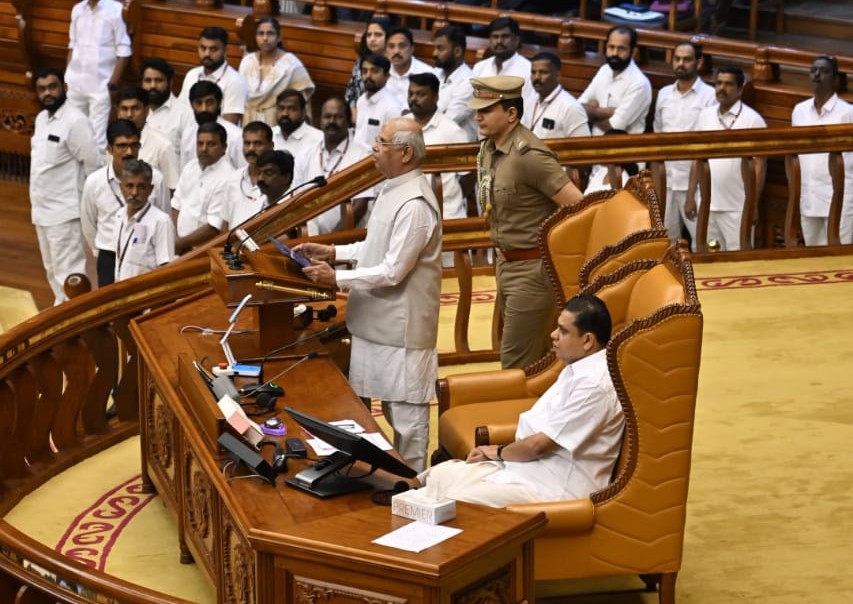
Governor Rajendra Vishwanath Arlekar at the Assembly.
Synopsis: Adding to the ongoing friction between the Assembly and Lok Bhavan (previously Raj Bhavan), Governor Rajendra Vishawanath Arlekar omitted certain passages from the Cabinet-approved policy speech. Soon after he had left the Assembly, Chief Minister Pinarayi Vijayan raised it in the House, and the Opposition closed ranks with the Treasury benches to condemn the Governor’s act. The Speaker said only the approved version will be put on record.
The final session of the 15th Kerala Legislative Assembly commenced in Thiruvananthapuram on Tuesday, 20 January, with more than the usual ritual of a Governor’s Address.
What began as a routine policy speech quickly turned dramatic when Chief Minister Pinarayi Vijayan accused Governor Rajendra Vishwanath Arlekar of deviating from the Cabinet-approved text by omitting passages critical of the Union Government and subtly qualifying others.
The dispute — backed by the Speaker and cutting across party lines on procedure — placed questions of constitutional convention, federalism and gubernatorial authority centre stage.
Yet, even as the controversy simmered, the address itself laid bare the LDF government’s broader political and economic narrative: a state under acute fiscal strain, which it squarely attributed to Union Government decisions, and a government seeking to pivot that crisis into an argument for deeper reforms, welfare expansion and long-term transformation.
From alleging denial of funds, shrinking borrowing space and revenue shocks, to laying out an ambitious vision of infrastructure-led growth, innovation-driven industry, a “silver economy” and climate action, the policy address doubled as both an indictment of the Centre and a manifesto-in-the-making.
The drama in Kerala Assembly came close on the heels of Tamil Nadu Governor RN Ravi had walked out of the House in that state without delivering the customary address. Both states are ruled by non-BJP parties.
The last session of the 15th Kerala Legislative Assembly opened on a note of drama, with confrontation between the Governor and the state government over the policy address.
Governor Rajendra Vishwanath Arlekar being welcomed by Chief Minister Pinarayi Vijayan at the Assembly main entrance on 20 January.
Soon after Governor Arlekar concluded his address and left the House, Chief Minister Vijayan rose to flag what he described as serious deviations from the policy statement approved by the Cabinet.
He pointed out that the Governor had omitted key portions critical of the Union Government and had also introduced a qualifying phrase of his own, actions that the government said violated established constitutional conventions.
Reading out the omitted passages, the Chief Minister said the deletions were not innocuous. They included references to Kerala’s fiscal stress allegedly caused by “adverse Union Government actions” undermining fiscal federalism, concerns over Bills passed by the state legislature remaining pending with the Governor for long periods, and a strong assertion that tax devolution and Finance Commission grants were constitutional entitlements, not acts of charity.
The omissions were the first sentence of 12th paragraph of the policy address: “Despite these social and institutional achievements, Kerala continues to face severe fiscal stress arising from a series of adverse Union Government actions that undermine the constitutional principles of fiscal federalism”, and the last two sentences of 15th paragraph: “Bills passed by State legislatures have remained pending for prolonged periods. My Government has approached the Supreme Court on these issues, which have been referred to a Constitution Bench.”
In paragraph 16, he noted, the Governor had additionally inserted the words “My Government believes” to the last sentence, subtly recasting the tone of the Cabinet-approved text.
And the sentence was, “Tax devolution and Finance Commission grants are constitutional entitlements of States and not acts of charity, and any pressure on constitutional bodies entrusted with this task undermines federal principles.”
Speaker AN Shamseer backed the government’s position, ruling that only the version finalised and passed by the Cabinet would be treated as the authentic policy address of the House, in line with Article 176 of the Constitution and past rulings from the Chair.
The Opposition, while dismissing the policy claims, closed ranks on the procedural issue.
Leader of the Opposition VD Satheesan said the Governor had no right to alter the Cabinet-approved speech.
Citing earlier precedents where similar gubernatorial changes were rejected, the Speaker made it clear: the Legislature would proceed on the basis of the government’s original text.
Despite the omissions and amendments later flagged by the government in the policy speech, the Governor, earlier went on to read out several passages that sharply criticised the Union Government for what were described as actions undermining Kerala’s financial stability and the constitutional principles of fiscal federalism.
The address highlighted that Kerala continues to face severe fiscal stress arising from a series of adverse decisions taken by the Centre.
In the crucial final quarter of the current financial year, from January to March 2026, the state was expected to have around ₹12,000 crore to meet expenditure commitments, but more than half of this amount was curtailed, with ₹5,944 crore denied without what the speech termed proper justification.
At the same time, dues pending from the Union Government under various Central schemes up to September 2025, including arrears from previous years, stood at ₹5,650.45 crore, further tightening the state’s cash position.
The speech also pointed to multiple revenue-side shocks.
The recent mid-year rationalisation of GST rates was estimated to cause an annual loss of ₹8,000 crore in 2026–27.
Export-oriented sectors such as marine products, spices, cashew, coir and rubber were said to be hit by reciprocal tariff measures imposed by the United States, leading to an estimated annual loss of ₹2,500 crore.
Kerala was also denied ₹17,000 crore this year due to curtailment of its borrowing limit and IGST adjustment, besides a further ₹4,250 crore loss attributed to changes in GSDP methodology.
The Governor noted that the state had borne a disproportionate share of national infrastructure costs, including ₹6,000 crore for land acquisition for National Highway projects adjusted against borrowing limits.
These constraints, the address said, have strained spending on health, education, welfare, agriculture and employment, even as Kerala raised concerns over growing centralisation and changes to schemes such as MGNREGS that reduced Union assistance and diluted its demand-driven nature.
As Kerala inches closer to the 2026 Assembly elections, the Left Democratic Front (LDF) government has fired what appears to be its opening salvo for an unprecedented third consecutive term through the policy address.
In a sweeping articulation of achievements and aspirations, the government has stitched together a narrative of economic revival, structural reform and future-facing development, drawing heavily on what it describes as a decade of sustained progress.
At the heart of this pitch is a strong claim on economic performance.
Kerala’s economy, the government said, has entered a phase of accelerated and broad-based growth, clocking an average annual growth rate of around 12 per cent over the past decade.
The Gross State Domestic Product is projected to have more than doubled — from ₹5.26 lakh crore in 2015–16 to ₹12.49 lakh crore in 2024–25 — while per capita income has risen sharply from ₹1.66 lakh to over ₹3.08 lakh in the same period.
This, the government argued, provides the foundation for the next phase of development.
The LDF’s forward strategy is anchored on three interlinked pillars.
The first is infrastructure-led growth, aimed at integrating Kerala into what it describes as the “largest city in the world” — a seamlessly connected, state-wide urban region.
The second is innovation-driven industrialisation to deepen value creation and improve global competitiveness.
The third is the creation of a world-class higher education ecosystem rooted in skills, entrepreneurship and diaspora engagement.
Acknowledging Kerala’s ageing population, the government has outlined plans to build a new “Silver Economy”.
By positioning the state as a global destination for graceful ageing, the LDF hopes to create new jobs, boost high-end eco-tourism and strengthen social security systems.
Parallelly, the government says it will continue to push entrepreneurship and investment at the grassroots level to expand employment opportunities for educated youth.
A major policy announcement concerns paddy procurement. Following an Expert Committee review, the Governor said, the government plans to implement comprehensive procurement reforms in 2026–27 to ensure farmers are paid within one week of procurement, at an enhanced rate of ₹30 per kilogram — among the highest in the country.
With the United Nations declaring 2026 as the International Year of the Woman Farmer, Kerala plans to launch a dedicated ‘Woman in Agriculture’ project.
The government also intends to explore carbon credit monetisation for farmers, in collaboration with Kerala Agricultural University and international partners.
For expatriate women, a dedicated Women’s Cell under the NORKA Department is being conceptualised to offer support and counselling.
On the infrastructure front, the government has promised to upgrade 1,200 km of major district roads to BM&BC standards and widen State Highways in the coming year. Tourism policy will also be recalibrated, with Gen Z Tourism Hubs focusing on experiential travel.
Climate action forms another major plank. The government plans to chart a pathway to carbon neutrality by 2050, launch an online climate literacy platform and propose four additional wetlands for Ramsar designation. A World Bank-backed climate dialogue series and the “Every Child a Scientist and Artist” programme are also on the anvil.
The Governor through his policy address gave indication that forest and wildlife conservation, particularly human–wildlife conflict mitigation, will see landscape-level macro plans and Panchayat micro-plans rolled out in 2026–27.
To tackle substance abuse, the government is implementing a three-pronged strategy covering enforcement, prevention through the Vimukthi Mission, and rehabilitation, including the creation of a State Narcotic Enforcement Bureau and a specialised Cyber Cell.
Youth engagement will be addressed through targeted initiatives, including a Youth Startup Festival aimed at innovation, mentoring, pitching and placement.
Against the backdrop of mounting Centre–State friction and an impending Assembly election, the opening day of the session captured the dual thrust of the LDF’s strategy: defend Kerala’s federal rights while projecting a confident, future-facing roadmap.
Opposition leaders launched a scathing attack on the government’s policy statement, alleging it was a document “filled with false claims and half-truths” that exposed the administration’s failures over the past decade.
Addressing a press conference, they said the statement itself admitted the state’s severe financial crisis while avoiding earlier claims about large dues from the Centre.
The Opposition accused the government of making hollow claims on secularism, poverty eradication, health, education, law and order, welfare of SC/ST communities, agriculture and wildlife management.
They alleged that sectors once considered Kerala’s strengths had collapsed due to mismanagement.
Leaders also said the controversy with the Governor was election-driven theatrics, adding that people would no longer believe promises that remained unfulfilled for ten years.
(Edited by Majnu Babu).


