

Published Dec 30, 2025 | 8:00 AM ⚊ Updated Dec 30, 2025 | 8:00 AM

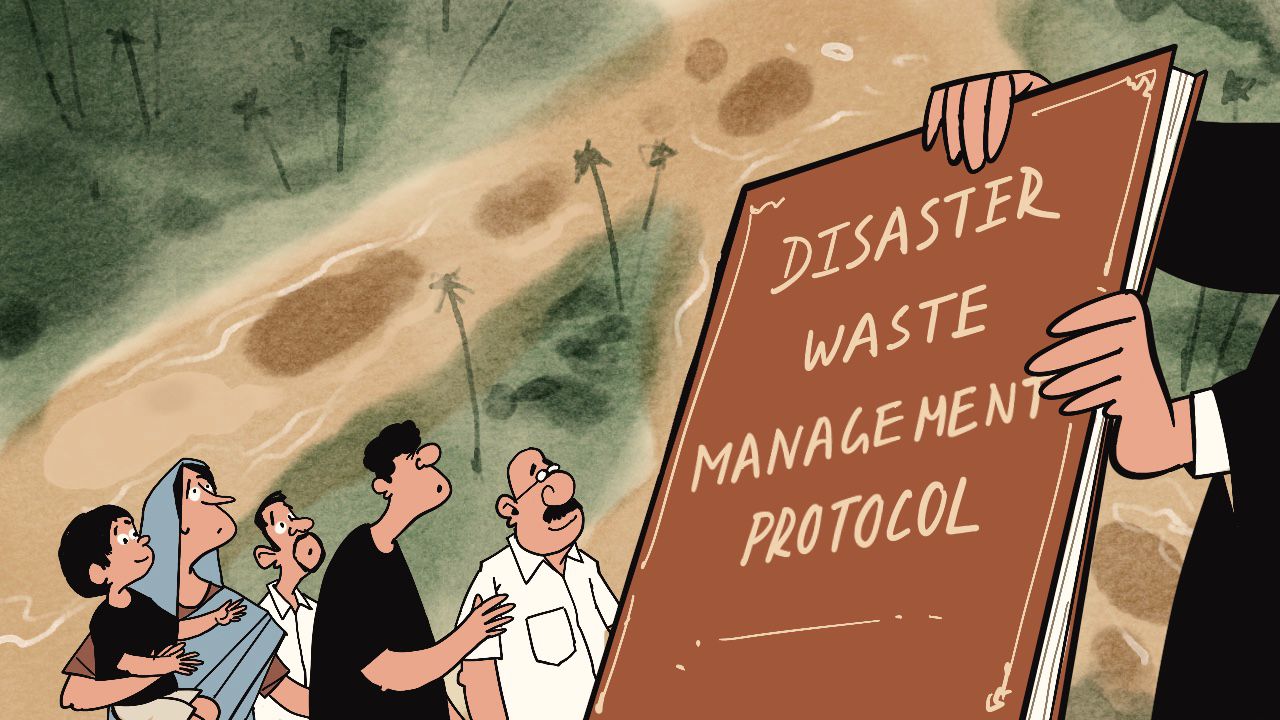
The Kerala government has approved a Disaster Waste Management Protocol, a structured roadmap that defines responsibilities, ensures worker safety, and standardises how waste generated during both natural and man-made disasters is collected, treated and disposed of.
Synopsis: In Kerala, a state grappling with recurring floods, landslides, drought-like summers and a growing list of climate-induced hazards, disaster-generated waste can quickly turn a natural calamity into a prolonged public health and environmental crisis. To address the issue, the state government has come up with the country’s first dedicated Disaster Waste Management Protocol to collect, treat and dispose of waste.
The mountains of debris left behind by the devastating landslides at Meppadi Grama Panchayat in Wayanad on 30 July 2024 posed a quieter but equally dangerous threat.
In Kerala, a state grappling with recurring floods, landslides, drought-like summers and a growing list of climate-induced hazards, disaster-generated waste can quickly turn a natural calamity into a prolonged public health and environmental crisis.
The initial chaos in waste handling at Meppadi, caused by the absence of a clear disaster-specific protocol, laid bare a long-ignored gap in Kerala’s disaster preparedness framework.
Drawing lessons from that experience, the Kerala government has now approved what officials described as the country’s first dedicated Disaster Waste Management Protocol—a structured roadmap that defines responsibilities, ensures worker safety, and standardises how waste generated during both natural and man-made disasters is collected, treated and disposed of.
The protocol marks a significant shift in how the state plans to deal with the aftermath of climate shocks.
According to Disaster Management Department officials, Kerala’s unique geography—a long coastline and the steep terrain of the Western Ghats—made it vulnerable to a wide range of natural disasters.
Floods are the most frequent natural hazard, the most recent in 2018 and 2019, affecting nearly 14.5% of the state’s land area and up to 50% in certain districts.
Landslides along the Western Ghats, seasonal drought-like conditions, summer water scarcity, lightning strikes, forest fires, coastal erosion, soil piping, high winds, and the state’s location in seismic zone III further compound the risks.
Alongside these natural threats, Kerala also faces man-made disasters such as fires and industrial accidents, each generating significant volumes of waste.
In the aftermath of disasters, managing the waste produced—from debris and hazardous materials to sewage and biomedical waste—emerges as a critical challenge.
Improper handling can escalate public health risks, delay community recovery and trigger secondary environmental disasters.
Officials stated that this reality was starkly evident during the Wayanad landslides.
While Suchitwa Mission, in coordination with the district administration, local self-government institutions (LSGIs), Haritha Karma Sena members, empanelled agencies and volunteers, eventually managed waste efficiently from collection to disposal, the initial response exposed a major gap.
The local body — Meppadi grama panchayat — struggled due to the absence of a pre-framed disaster waste management action plan, leading to confusion in the early hours.
The experience underlined how existing state and national policies, designed largely for routine waste management, fall short when confronted with disaster-scale waste generation.
Building on lessons from the Wayanad landslides, Suchitwa Mission, the nodal agency for sanitation in Kerala, drafted a dedicated Disaster Waste Management protocol to standardise preparedness and response across the state.
The proposed framework seeks to clearly define the roles and responsibilities of stakeholder departments, LSGIs and agencies, while also enabling coordination with the private sector and civil society organisations.
It emphasises scientific disposal of disaster waste in a time-bound manner, safe recycling, efficient resource use and worker safety through preventive medicine, vaccines, safety gear and personal protective equipment.
“Kerala’s current disaster management and waste management policies are not specifically designed to handle disaster-generated waste. The chaos witnessed initially in Wayanad showed why a standardised, scientific protocol is essential,” a Suchitwa Mission official said.
The protocol is envisaged as applicable across all districts and covers both natural and human-induced disasters, addressing solid, liquid and soiled or mixed waste generated at disaster sites and relief camps.
Disaster waste, as defined in the draft, includes biodegradable and non-biodegradable waste, collapsed structure debris, natural waste, hazardous waste, e-waste, animal carcasses, sewage, grey water and contaminated mixed waste, especially prevalent during the initial response phase.
Officials associated with the rollout of Kerala’s Disaster Waste Management Protocol said the document has been drafted by strictly aligning it with existing national and state waste management rules.
It also included international best practices of bodies such as UNEP, OCHA, WHO and SPREP.
Emphasising pre-disaster preparedness, the protocol mandates district-level mapping of waste management facilities under local self-government institutions (LSGIs), along with capacity building and training of stakeholders to handle waste during calamities.
Risk assessment and waste forecasting form a key pillar, with the Kerala State Disaster Management Authority (KSDMA) identifying disaster-prone areas and forecasting the types of waste likely to be generated.
GIS-based system maps are to be prepared to aid both risk assessment and planning.
“Preparedness is not limited to post-disaster response; it starts much earlier with mapping, training and forecasting so that chaos can be minimised when a disaster strikes,” an official of Suchitwa Mission said, underlining that the protocol aims to strengthen systematic and coordinated waste management across districts.
Officials said the protocol adopts a phased approach to pre- as well as post-disaster waste management, clearly demarcating responsibilities during the emergency phase (0–72 hours) and the streamlined recovery phase thereafter.
In the emergency phase, immediate removal of mixed and soiled waste from rescue sites and camps is prioritised, without interfering with rescue or healthcare operations, using pre-shortlisted agencies.
An initial planning framework requires LSGIs to coordinate with district authorities to move waste to identified interim storage facilities and set up help desks at relief camps.
After 72 hours, systematic segregation and disposal begin, with Haritha Karma Sena members handling non-biodegradable waste and other streams following pre-planned processing chains.
Regular monitoring by Suchitwa Mission, officials said, will ensure flexibility and context-specific strategies rather than a rigid approach.
“Waste characteristics differ with each disaster, so adaptability is crucial,” the Suchitwa Mission official said, adding that strengthening systems, promoting climate-adaptive technologies, and community participation are central to improving Kerala’s disaster resilience.
The rationale, officials noted, is to move beyond “peacetime” waste policies and institutionalise best practices proven on the ground.
By formalising these measures, the state aims to minimise environmental pollution, prevent public health crises and strengthen Kerala’s disaster resilience through a coordinated and sustainable waste management approach.
(Edited by Majnu Babu).


