

Published Dec 12, 2025 | 4:50 PM ⚊ Updated Dec 12, 2025 | 6:07 PM

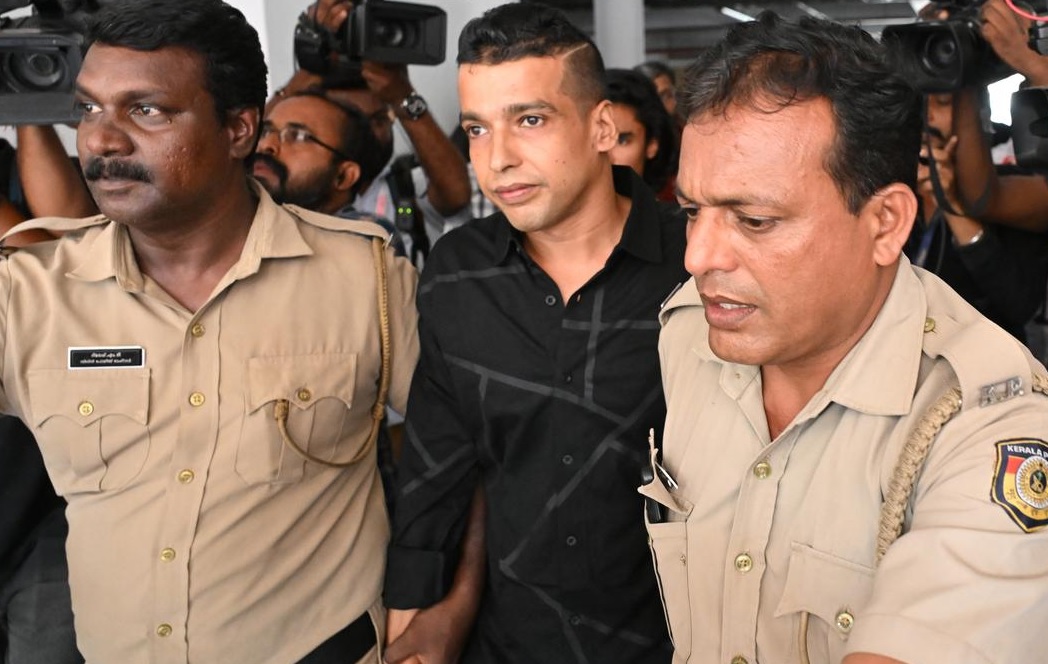
Pulsar Suni
Synopsis: Prosecution had argued that all the convicts should be brought under Section 376D of the IPC. Although Pulsar Suni conducted the act, the others provided him with the opportunity and help to commit the heinous act. Thus, all committed the same crime, the prosecution argued.
Judge Honey M Varghese of the Principal Sessions Court in Ernakulam, Kerala, awarded rigorous imprisonment of 20 years each to six people, convicted in the sensational 2017 actor assault case.
Besides sentencing to rigorous imprisonment, on Friday, 12 December, the court also imposed a fine of ₹2.75 lakh on the first accused, Pulsar Suni, ₹1 lakh on the second accused, Martin Antony, and ₹75,000 each on the remaining people found guilty.
Failing to pay the fine will invite an additional six months’ rigorous imprisonment. Of the fine amount collected, the ordered to give ₹5 lakh to the survivor.
Earlier, on 8 December, the court had acquitted three accused, including P Gopalakrishnan, popularly known by his screen name Dileep.
Six convicts sentenced are NS Sunil Kumar alias Pulsar Suni, Martin Antony, B Manikandan, VP Vijeesh, H Salim alias Vadiwal Salim, and Pradeep. They will be lodged at the Central Prison in Viyyur, Thrissur.
While sentencing the accused, Judge Varghese said the court would not be carried away with any sort of sensation or bias, but instead has to balance justice for society and the offender by considering the crimes, aggravated history, reform potential of the accused, aggravating and mitigating factors and the aims of punishment.
“At the very same time, this court has to consider the fact that the acts of the accused persons amount to the supreme dignity of women. The act violated her right to safety and created fear, humiliation, pushing her into shame and helplessness. It also caused psychological trauma, causing mental distress, the judge noted.
The court said the survivor was attacked while she was travelling to her friend’s house without anticipating any uncharted incident.
“This fact is also to be considered, but at the very same time, the court has to consider the circumstances, including the age of the accused, their family condition and also the fact that no criminal antecedents are pending against them,” the judge said.
All six accused sentenced were aged below 40.
The court referred to the Supreme Court judgement in Mukesh and others vs State of Delhi and others, popularly known as the Nirbhaya case, that crime against women intentionally affected women’s self esteem dignity but also degraded the pace of societal development.
No separate sentence has been imposed on accused A2 to A6 for the offence punishable under section 109 read with section 342, 354, 354B, 357, 366 and 376B of the Indian Penal Code
“A1 to A6 are sentenced to undergo simple imprisonment for a time of one year for the offence punishable under Section 342 (wrongful confinement),” the judge ruled.
Earlier in the forenoon, the judge was expected to pronounce the quantum of sentence at 3:30 pm, but the sentencing was delayed by more than an hour.
The court clarified that the accused need not undergo the full 20-year imprisonment, as their period in pre-trial detention will also be considered.
The ruling meant that the sentence can be limited to the period beyond pre-trial custody already served.
With this clarification, Suni — who has spent around seven-and-a-half years in prison — will now have to serve only an additional eight to nine years of rigorous imprisonment.
The final duration will be further reduced by accounting for parole days and other eligible remissions.
The court’s decision has come as a major setback to the prosecution, which had strongly argued for life imprisonment for the convicts.
Special Public Prosecutor V Ajay Kumar expressed disappointment with the sentence, calling it the minimum punishment permissible under the law.
He said the prosecution will propose that the state government move an appeal, as the team had sought the maximum sentence for all six men convicted of gang rape and criminal conspiracy.
Law Minister P Rajeev said the sentencing must be viewed in the context of the investigation and charges presented by the probe team.
He noted that both public prosecutors were chosen in consultation with the survivor and that the prosecution team had carried out its responsibilities diligently.
Rajeev added that while people may disagree with the outcome, the court’s decision should not be assessed before examining the full judgement. He condemned the “unwarranted” criticism of the judge.
Earlier, the prosecution had sought life imprisonment for the six accused, who were pronounced guilty on 8 December.
Judge Varghese had found them guilty under multiple sections of the Indian Penal Code (IPC) and Information Technology (IT) Act offences, including conspiracy, wrongful confinement, gang rape and abetment.
Before the court pronounced the sentence, the convicts were allowed to speak.
Pulsar Suni said he has to take care of his elderly mother. Manikandan appealed to the court, stating he is the sole support for his wife, nine-year-old son, and his 2.5-year-old daughter. Salim also cited family responsibilities, while Pradeep broke down in tears in court.
Martin pleaded that he had no prior involvement in any crime. While seeking a lenient punishment, Vijeesh requested the court that he be lodged at the Kannur Central Prison.
Arguments in the court primarily revolved around Section 376D of the Indian Penal Code (IPC), which addresses the offence and punishment for gang rape. The question was whether convicts should be brought under this ambit.
The prosecution had argued that all the convicts should be charged under this provision. “Although Pulsar Suni conducted the act, the others provided him with the opportunity and help to commit the heinous act. Thus, all committed the same crime,” said the prosecution.
The court also inquired about the rehabilitation of the convicts, as it is required to consider an offender’s potential for rehabilitation before finalising the quantum of punishment.
The argument mainly surrounded whether the quantum of punishment given to the first convict should be extended to the other five.
While hearing the arguments court stated that the dignity of a woman is supreme, and the court will have to consider the mental and physical trauma that the survivor went through.
In the case of Suni, the first convict, the court said that his case is different from others. Comments on Suni had pointed out that no leniency could be expected from the court.
The defence representing Suni stated that the case at hand is not a Nirbhaya-like one, trying to establish that no gruesome rape occurred.
However, the court relied on the Justice Verma Committee report and subsequent apex court rulings that non-penetrative forms of sexual contact should be regarded as sexual assault. In 2012, the Supreme Court stated that penetration is not necessary for establishing the offence of rape.
The court reminded the convicts about the joint liability involved in the case. According to this principle, the convicts may be involved in “constructive criminality” where everyone acting in furtherance of the shared purpose is accountable.
The prosecution stated that they have a shared goal (common intention), group participation (not necessarily active involvement by all), and shared liability for the whole act.
During the hearing, the court also considered a couple of other petitions.
One is a contempt petition moved by actor Dileep’s counsel, one by Suni’s mother, to lift the freeze on her bank account, and another by Dileep’s counsel to release the passport, which the prosecution vehemently opposed.
All these petitions will be considered on 18 December.
Before pronouncing the quantum of punishment, Judge Varghese issued a stern warning to the media and lawyers, cautioning them against publishing misleading or distorted accounts of the trial.
The judge made it clear that any attempt to twist court proceedings or malign the court could invite contempt action.
She also prohibited recording or transmitting the ongoing proceedings, stressing that the trial must adhere strictly to the apex court guidelines, which mandate absolute protection of a sexual-assault survivor’s identity.
She noted with concern that several reports had already failed to follow these norms.
Advocate TB Mini, the survivor’s counsel, met the media and raised concerns about the cyberattacks directed at her. She noted that with the 8 December verdict, the court had already clarified who was guilty and who was not connected to the crime.
On the day the shocking assault took place — 17 February 2017 — whispers of a conspiracy began circulating within the Malayalam film industry, which eventually spilt out and got amplified by the media.
These murmurs were further fuelled by long-standing gossip: Dileep harboured a grudge against the survivor because he believed she had played a role in exposing to his then wife, Manju Warrier, his relationship with actor Kavya Madhavan.
The case took a decisive turn two days later.
On 19 February 2017, members of the Malayalam film fraternity gathered in Kochi for a solidarity meeting to condemn the assault and express support for the survivor.
Warrier then made a statement that dramatically shifted the public discourse.
“I met her yesterday after I came to know about the incident. I am proud of her as she is fighting back despite going through such an ordeal. I pray to god that it doesn’t happen to any other girl,” she said.
She added a line that instantly escalated the narrative:
“Many a time, car drivers have taken us home safely during late hours of the night. But this is a case of criminal conspiracy,” she added in her calm but firm voice.
Among the audience were Dileep and other artistes.
Warrier’s remark triggered a storm — and in the public imagination, the conspiracy angle solidified.
Dileep, however, struck a different note at the event. “There is immense fear. What is most tragic and upsetting is that this happened not just in cinema but in our own land,” he said.
“The police are investigating sincerely… Let us take this as something that happened in the house of an ordinary citizen,” he told the gathering.
A few days later, Dileep found himself at the centre of the allegations he had commented on.
According to the prosecution, Dileep had orchestrated and funded the crime as an act of personal revenge — allegedly believing that the survivor had informed Warrier about his relationship with Madhavan. This accusation shaped the trajectory of the case for years.
Judge Varghese, however, on Monday, concluded that the prosecution had failed to prove the conspiracy charge.
The court found that the evidence did not establish any concrete link between Dileep and the alleged plot to abduct and assault the survivor.
Emerging from the courtroom, Dileep underscored exactly this point. He alleged that the “entire narrative” portraying him as the mastermind was fabricated.
“It all started when Manju [Warrier] alleged a criminal conspiracy. Following that, a senior woman police officer, along with some criminal police officers, created this narrative. For that, they roped in the main accused and the other accused,” he said.
He accused the investigators of constructing a “false storyline” — one he claimed was bolstered by sections of the media.
“The police then created a false narrative. They also roped in some media and journalists to campaign against me. Today, that fake narrative has been exposed in court,” he said, adding that years of personal and professional trauma “could not be undone.
Dileep asserted that the “real conspiracy” was not the one alleged by investigators, but the one against him, intended to “frame charges, malign, and destroy his career and goodwill.


