


Published Mar 20, 2026 | 8:00 AM ⚊ Updated Mar 20, 2026 | 8:00 AM

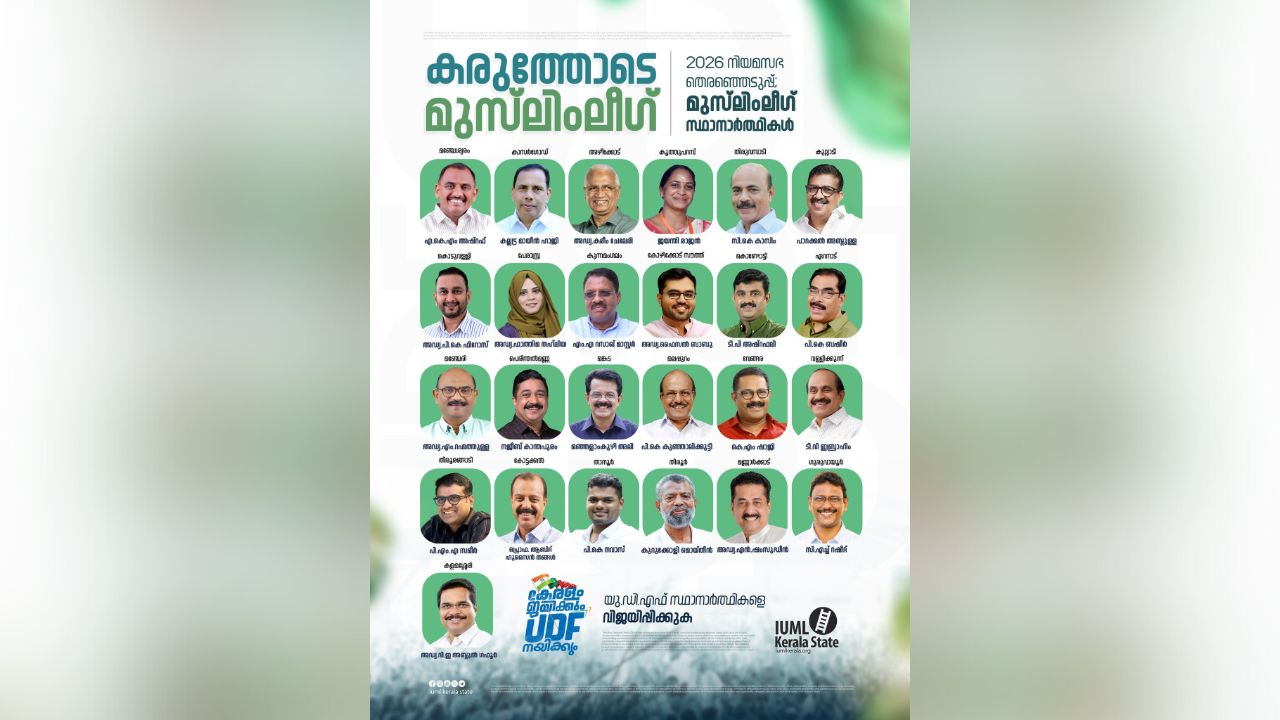
IUML candidates.
Synopsis: The IUML unveiled a candidate list that attempts to balance generational transition, social messaging and electoral pragmatism — while simultaneously exposing fault lines within the party. It has also fielded two women candidates, marking a symbolic departure from its traditionally male-dominated electoral slate.
In a notable recalibration ahead of the Kerala Assembly elections, the Indian Union Muslim League (IUML) unveiled a candidate list that attempts to balance generational transition, social messaging and electoral pragmatism — while simultaneously exposing fault lines within the party.
For the first time in its history in Kerala Assembly elections, the IUML has fielded two women candidates, marking a symbolic departure from its traditionally male-dominated electoral slate.
The move, coupled with the induction of younger leaders and the sidelining of several veterans, signals a conscious effort by the party leadership to reshape its public image and organisational future.
The IUML has nominated Jayanthi Rajan from Koothuparamba and Fathima Thahiliya from Perambra, doubling its female representation compared to previous elections.
This comes after the party fielded its first-ever woman candidate, Noorbeena Rasheed, in the 2021 Assembly elections — an experiment that appears to have paved the way for a broader, though still cautious, inclusion of women.
Jayanthi, projected as a secular and socially representative face of the party, expressed confidence about securing victory, while Fathima thanked the leadership and voiced optimism about opening the party’s account in Perambra.
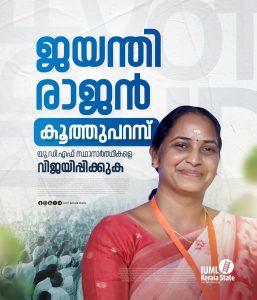
Jayanthi Rajan
Meanwhile, it has to be noted that the IUML carries the weight of a contentious chapter when it dissolved the state committee of Haritha — the women’s wing of the Muslim Students’ Federation (MSF), its student outfit in September 2021.
The move came weeks after the party had already frozen the activities of Haritha in August, triggering widespread criticism and a debate on its stance toward women within the organisation.
The controversy erupted after several Haritha leaders went public with allegations of sexual harassment against senior MSF functionaries.
They claimed that their decision to approach the media was driven by the party’s inaction on their internal complaints. Around ten office-bearers, including the state president, secretary, joint secretary and treasurer, accused MSF leaders of using abusive language and attempting to silence women within the organisation.
The allegations were directed at former MSF state president PK Navas and Malappuram district general secretary V Abdul Vahab.
According to the complaint later taken to the State Women’s Commission, the incident occurred during an MSF state leadership meeting in Kozhikode in June 2021. Haritha members alleged they were insulted with derogatory remarks, including being labelled “infertile feminists,” and were told that “even prostitutes have opinions” when they attempted to voice their views.
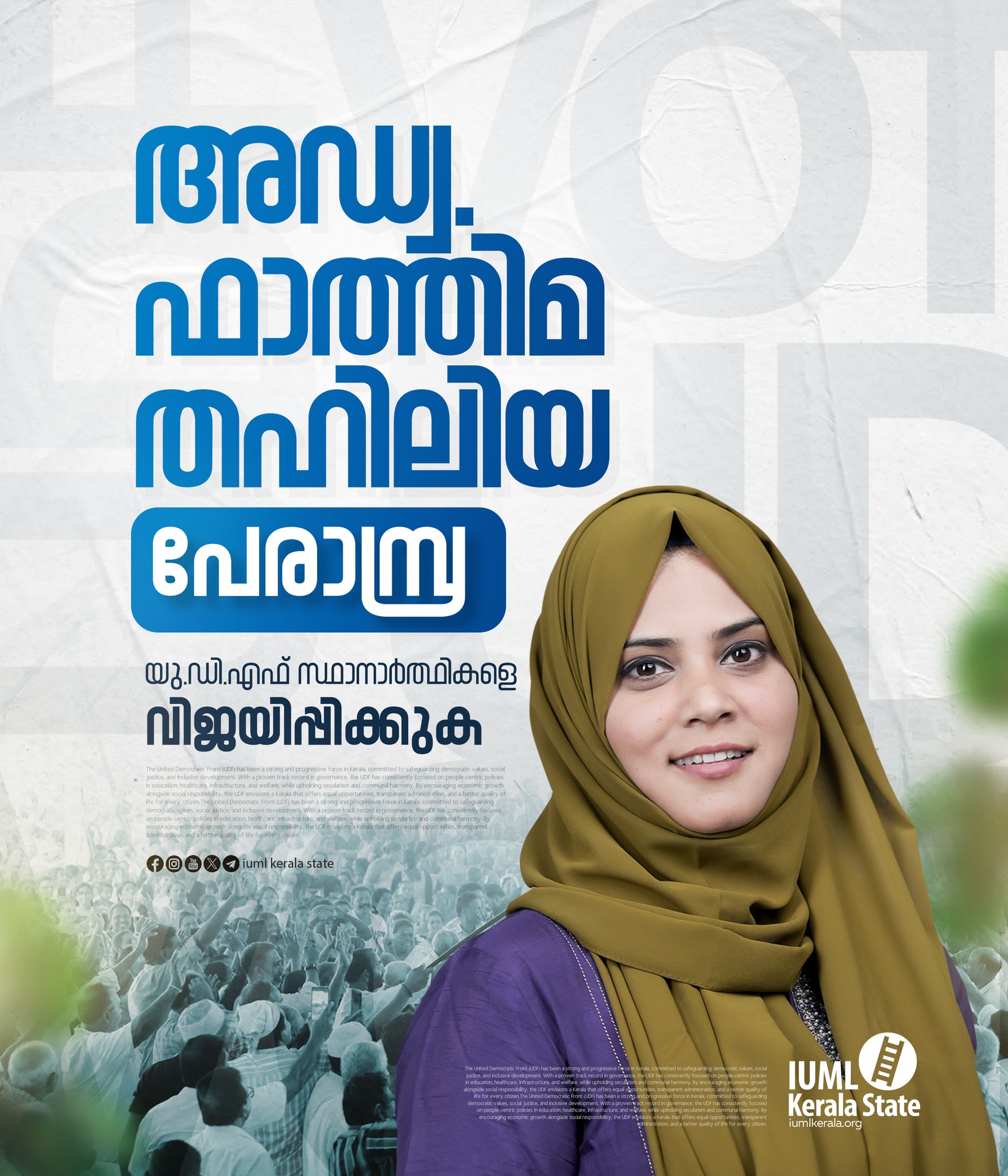
Fathima Thahiliya
At the time, the IUML’s decision to act against Haritha — rather than addressing the complaints — was widely seen as punitive and sparked criticism from various quarters.
However, the political narrative has since taken an unexpected turn.
By November 2025, the very leaders who were once sidelined had re-emerged at the forefront of the party’s renewed image. Three former Haritha leaders—Fathima Tahiliya, Mufeeda Thesni and T. Najma Tabsheera—were fielded by the IUML in key wards during the local body elections, marking a striking reversal of fortunes.
Their rehabilitation had begun earlier.
In 2024, Haritha members were brought back into the organisational fold and entrusted with significant responsibilities. Fathima Tahiliya was appointed as Youth League state secretary, Mufeeda Thesni became national vice-president, and Najma Tabsheera was named national secretary.
In a twist that underscores the party’s evolving internal dynamics, both Fathima Tahiliya and P.K. Navas now feature in the IUML’s candidate list for the Assembly elections, with Navas contesting from Tanur—placing former adversaries on the same political platform.
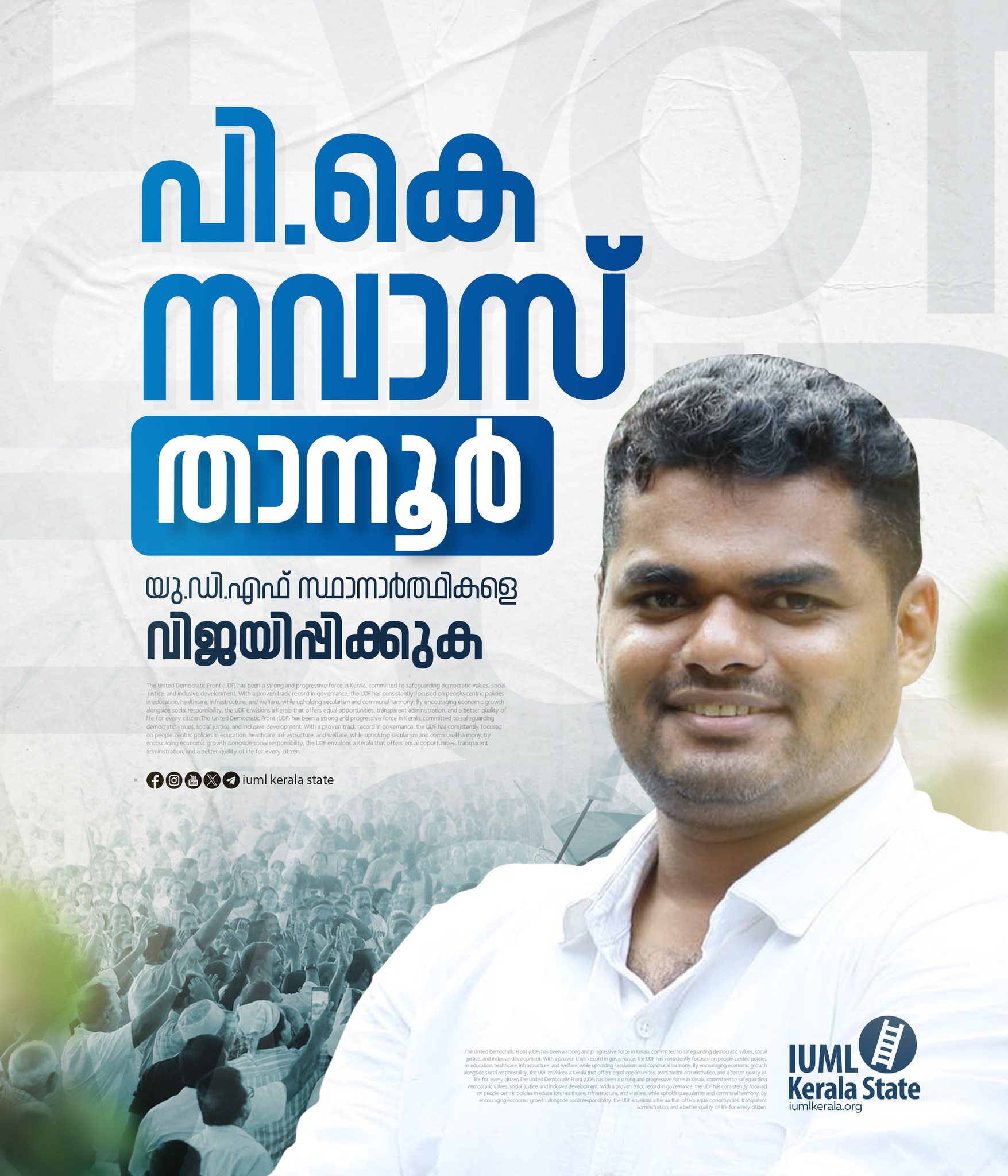
PK Navas.
The party on 17 March unveiled a notably reshaped candidate list for the upcoming Assembly elections, signalling both strategic recalibration and a clear generational shift within the party.
Of the 27 seats allotted to it in the UDF, candidates have been announced for 25 constituencies by state president Panakkad Syed Sadiq Ali Shihab Thangal.
The list stands out for the exclusion of senior leader MK Muneer, while national general secretary PK Kunhalikutty is set to contest from Malappuram.
After internal deliberations, KM Shaji has been fielded in Vengara.
At the same time, the party has opened the door wider for younger leaders, with names like PK Firoz, Faisal Babu and PK Navas finding a place; Navas, notably, is slated to take on Minister V Abdurahiman in Tanur.
In a move that underlines this shift, several sitting MLAs, including UA Latheef, KPA Majeed, Hameed Master and NA Nellikunnu, have been left out.
The party, which had withheld candidates for Punalur and Chelakkara when it released its first list on 17 March, has now completed the picture.
Ending the wait, it announced on 19 March that Noushad Yonus will be its candidate from Punalur, while Sivan Veetikunnu has been fielded in Chelakkara.
With this, the IUML has wrapped up its list of candidates.
Despite reported resistance during internal discussions, Muneer publicly backed the leadership’s decision to exclude him.
Reflecting on his three-decade-long political career, he said the party had given him opportunities at a young age and that it was now time for a new generation to step forward. He also made it clear that he would stand firmly with the party’s decision, dismissing criticism on social media.
Party insiders indicate that persuading Muneer to step aside was a sensitive process, with reports suggesting he had sought to contest from Kozhikode South.
Even as the leadership projected unity, sharp dissent emerged from within.
The party’s state secretary, Abdurahiman Randathani, publicly criticised the selection of PMA Sameer as the candidate for Tirurangadi.
In a strongly worded social media post, Randathani alleged that Sameer — a relative newcomer — had been “imposed” on the constituency, bypassing grassroots opinion and sidelining more deserving leaders. He pointed out that local party committees had not demanded Sameer’s candidature and suggested that vested interests influenced the decision.
Invoking the legacy of leaders who previously represented Tirurangadi, he argued that the constituency deserved a candidate with deeper organisational roots.
While praising the inclusion of youth leaders and backing KM Shaji’s candidature, Randathani maintained that raising such concerns should not be viewed as indiscipline. He emphasised that committed party workers have the right to question leadership decisions.
His remarks have intensified speculation about possible political realignments, with indications that the Left Democratic Front (LDF) may attempt to field him as an independent candidate.
Though he has not confirmed any such move, his statements have added to the uncertainty.
Sensing discontent within the IUML, leaders of the Left Front have reportedly initiated informal outreach to dissatisfied figures, including Randathani.
Senior CPI(M) leader A Vijayaraghavan acknowledged that the situation within the IUML could work to the LDF’s advantage, hinting that the front would adopt strategies to capitalise on emerging opportunities.
There are also unconfirmed reports of approaches to other IUML leaders, though responses appear mixed.
Even the party’s attempt to project inclusivity through women candidates has not been free from criticism.
Leaders of the Vanitha League, the IUML’s women’s wing, have expressed dissatisfaction, arguing that the selection process overlooked experienced women leaders and lacked consultation.
Noorbeena Rasheed, who made history as the party’s first woman candidate in 2021, criticised the choice of Fathima Thahiliya, calling it unjust to long-serving members of the women’s wing. Other leaders, including KP Mariyumma and Suhara Mampad, echoed similar concerns.
They contend that while the party has symbolically increased women’s representation, it has failed to recognise the sustained grassroots contributions of the Vanitha League. The absence of institutional consultation, they argue, reflects a deeper issue of organisational marginalisation.
Some leaders also pointed to the continuing influence of traditional religious bodies within the IUML’s ecosystem, suggesting that their historical reservations about women’s electoral participation still shape decision-making.
Despite all these, the general perception is that the IUML’s latest candidate list underscores a party attempting to modernise its image by embracing youth and cautiously expanding women’s representation.
However, the simultaneous eruption of internal dissent — from senior leaders to grassroots workers and the women’s wing — reveals the complexities, containing internal fractures that could influence its performance on the ground.
(Edited by Muhammed Fazil.)


