

Published Mar 27, 2026 | 8:00 AM ⚊ Updated Mar 27, 2026 | 8:00 AM


Kerala State Film Policy.
Synopsis: The Kerala State Film Policy, which the LDF has been touting as a major achievement in the cultural space, was drawn up after prolonged discussions with all stakeholders, but the final leg before announcing it missed many departments, leaving wide gaps.
One of the cultural “achievements” the LDF has been highlighting in its Assembly election campaign is the Kerala State Film Policy.
But the story of how it came into being is less tidy than the government would have it.
The Cabinet cleared the policy on 13 March, one of the final decisions of the second Pinarayi Vijayan government before the election was notified.
Officially, the line is that this came after months of deliberation, including a two-day Kerala Film Policy Conclave held in August 2025, pitched as a serious exercise to shape a comprehensive framework for the industry.
However, South First has found that the paperwork carried a slightly different story.
For something being projected as comprehensive, the usual circuit of consultations appeared thin.
Departments that would typically have a say—Law, Industry, Power, Finance, Taxes, Labour, Tourism, even General Education—didn’t seem to have engaged with it in any substantive way. At least, not in a manner that would leave a clear imprint on the final text.
There was a hurry. The approaching election notification—and the inevitable onset of the model code—seems to have compressed timelines. What has now been presented as a thought-through policy looks, in parts, like something that had to be pushed through before the window closed.
Still, the Cabinet cleared it. It was announced, packaged, and has now found its way into campaign talking points.
The road to Kerala’s long-awaited film policy has been anything but hurried.
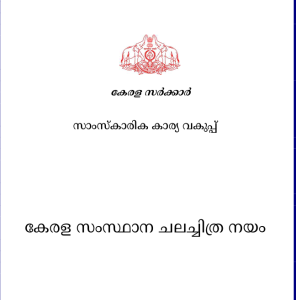
The cover page of the Kerala State Film Policy.
It took multiple rounds of consultations, reworks, and a fair bit of back-and-forth before finally landing where it matters — the Cabinet.
It began in July 2023, when the State government first set up a committee to prepare a draft framework for a film policy.
That committee didn’t remain static for long. It was reconstituted twice — first in September 2024 and then again in January 2025 — a sign, perhaps, of the shifting expectations around what such a policy should contain.
Chaired by veteran filmmaker Shaji N Karun, the panel went into what officials described as an unusually extensive consultation process.
Around 75 organisations from across the film sector were brought into the discussions.
Separately, nearly 500 individuals — technicians, artists, producers, distributors — were met in person over multiple sittings.
Those conversations eventually fed into a larger exercise.
By 2 and 3 August 2025, the government convened the Kerala Film Policy Conclave in Thiruvananthapuram.
The notes placed there were not abstract ideas; they were drawn directly from those earlier rounds of engagement.
The conclave itself saw participation from roughly 600 representatives from the film field.
There was also a parallel pressure building. In proceedings linked to the Hema Committee report, the government had informed the High Court that a film policy would be framed within two months of the conclave. That deadline, at least on paper, added urgency.
From there, the process moved into drafting mode.
The Policy Formulation Committee put together an approach document, incorporating what had emerged from the conclave discussions as well as feedback subsequently collected from the public.
The draft film policy, built on this layered input, was eventually submitted to the government by the Secretary of the Kerala State Chalachitra Academy on 31 January 2026.
What followed was a quieter phase. The government examined the draft in detail. When it was finally placed before the Chief Minister, the direction was clear: the matter should go to the Cabinet.
There was a clear divergence inside the Cabinet when the draft Kerala State Film Policy came up—less about the policy itself, more about how it got there.
What had begun as a routine submission turned into a quiet but pointed pushback against the bureaucracy’s insistence on wider consultations.
The draft policy, along with detailed notes in English and Malayalam, had been placed before the Cabinet following instructions from the Chief Minister to list it for consideration at the 10 February 2026 meeting.
But not before a detour.
Earlier, the Chief Secretary had returned the file with a firm direction: revise the Cabinet note and resubmit it only after consulting a long list of departments—Law, Industry, Power, Finance, Taxes, Labour, Tourism and General Education—and incorporate their views.
That is where Cultural Affairs Minister Saji Cheriyan drew the line.
In his note, appended directly to the Cabinet papers, Cheriyan argued that such an exercise would be impractical at this stage.
It would, he said, delay the policy indefinitely.
Most provisions, he pointed out, fall squarely within the Culture Department’s remit.
Only a handful touch other departments—and those, he suggested, could be sorted politically, at the level of ministers, when required.
There was also a hint of impatience. The policy, he reminded the Cabinet, wasn’t put together overnight. It had already gone through what he described as “lengthy procedures”—multiple rounds of discussions, a cinema conclave, and public feedback. Departments, he insisted, had been consulted earlier in the process.
So why go back again?
The question, in effect, was placed before the Cabinet in stark terms.
Buried in the “points for decision” circulated among ministers was a striking line: whether the draft policy could be approved bypassing the earlier direction to resubmit it after fresh consultations with all concerned departments.
That framing mattered.
Because the timeline suggests a certain urgency—or at least, a decision to move fast.
In just under a week, the file moved from directive to reconsider the process… to final approval, without that process being revisited in full.
On the face of it, Cheriyan’s stance of pushing back against wider inter-departmental consultation has some weight.

LDF Government projecting the Cabinet clearance of Film Policy as an achievement
Much of the proposed film policy—workplace safety, POSH compliance, contracts, welfare measures—sits naturally within the Culture Department’s domain.
The emphasis on women’s safety, worker registration, and basic working conditions doesn’t require deep technical vetting from departments concerned.
In that sense, insisting on exhaustive consultation could slow things to a crawl.
But the policy itself complicates Cheriyan’s case.
Several provisions clearly spill beyond Culture.
Electricity tariff reform directly concerns the Power and Finance departments. Worker databases, wage enforcement, and social security linkages need Labour and IT inputs.
Insurance schemes and institutional financing—especially through KSFDC—inevitably touch Finance and Industry.
Even policing arrangements at shooting sites require Home Department coordination, though that’s not explicitly mentioned in the file trail.
It has to be noted that one of the key provisions in the policy was to strengthen the safety mechanisms at film and serial shooting locations.
If required, the policy suggested that the presence of both a female Civil Police Officer (CPO) and a male CPO at shooting sites will be ensured under the supervision of the Station House Officer (SHO) of the local police station.
Reports submitted by the SHO based on these inspections will be given official legitimacy to help curb violations of law and workplace misconduct.
The policy also mandated that every film production unit must establish an Internal Committee as per the provisions of the POSH Act to address complaints related to sexual harassment.
The policy also proposed a model employment contract specifying working hours, overtime pay, minimum wages, maternity leave, rest periods and basic facilities such as toilets and changing rooms at shooting locations will be formulated at the government level and made mandatory for all producers.
To streamline employment practices in the sector, the government plans to introduce a centralised online registration system covering all workers in the film industry, including technicians, junior artists and drivers.
A senior police officer, speaking on condition of anonymity, didn’t quite hide the scepticism.
“We are already stretched thin. Law and order duties, VIP security, and other duties—it’s all running simultaneously. Now if you’re saying every shooting location may require deployment of both male and female officers, where is that manpower coming from?”
Another officer pointed to the procedural gap.
“There is also a question of consultation. If the policy envisages regular inspections by the SHO and formal reporting mechanisms, the Home Department should have been part of that conversation early on. Otherwise, implementation becomes guesswork.”
A film activist who was part of the consultation process, however, looked at a different gap altogether. For them, the problem wasn’t just who were not consulted, but what the policy had left unclear.
“There has been a lot of time taken to get to this stage, so naturally, expectations were high. But when you read it closely, it still feels uneven. Some areas are very detailed—like safety committees and contracts—but others are left hanging. Financing structures, enforcement clarity, even grievance redressal beyond POSH… It’s not fully thought through.”
The activist also added, “Consultation is not just about ticking departments. It’s also about coherence. Right now, it reads like parts of different conversations stitched together.”
When asked if the policy was rushed through, the activist asked, “Was speed the priority here, or completeness?”
(Edited by Majnu Babu.)


