

Published Sep 19, 2024 | 6:41 PM ⚊ Updated Sep 19, 2024 | 6:41 PM

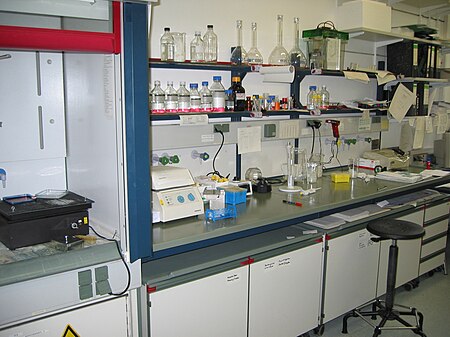
As of 31 March 2024, 1,69,188 samples related to 62,558 cases are pending with the labs. (Representational image/Creative Commons)

An often-overlooked bottleneck is silently eroding the foundation of timely justice in Kerala: a mounting backlog of samples awaiting tests at the Chemical Examiner’s Laboratory (CEL).
As of 31 March 2024, 1,69,188 samples related to 62,558 cases are awaiting crucial chemical examination, according to a report prepared by the Personnel and Administrative Reforms Department in August.
The implications of the delays are far-reaching. It allows criminals to potentially evade the law while victims and their families languish in uncertainty.
The massive backlog in the state’s three laboratories at Thiruvananthapuram, Ernakulam, and Kozhikode highlights a crisis as scientific analysis holds the key to justice but an overwhelmed system hinders its timely delivery.
The CEL, established in 1890 in the erstwhile princely state of Travancore, serves the judiciary by providing critical forensic analysis for crime prosecution.
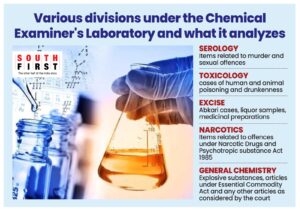
Various divisions of CEL.
Headed by the Chief Chemical Examiner, the laboratory operates under the Home Department, helping various investigating agencies by conducting chemical analyses of material objects and offering scientific evidence.
There are three laboratories under CEL: the headquarters in Thiruvananthapuram, covering five southern districts (Thiruvananthapuram, Kollam, Pathanamthitta, Kottayam and Alappuzha) and regional labs in Ernakulam (catering to the central districts of Ernakulam, Idukki, Thrissur, and Palakkad) and Kozhikode (northern districts — Malappuram, Kozhikode, Kannur, Wayanad and Kasaragod).
These labs, under the divisions of Toxicology, Excise, Narcotics, Serology, and General Chemistry, analyse crime-related samples under various laws, including the Bharatiya Nyaya Sanhita, NDPS Act, and Explosives Act. The regional lab at Ernakulam has an additional Distillery Division.
The findings of these divisions are admissible as evidence in the prosecution of crime cases.
The CEL’s workload has surged in recent years, largely due to a spike in crime rates and the increasing complexity of cases.
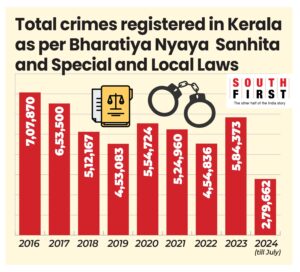
Crime data (Source: Kerala Police)
The influx of samples, coupled with the existing backlog, has created a perfect storm that has overwhelmed the CEL’s capacity.
As of 31 March 2024, a staggering 1,69,188 samples in 62,558 cases are awaiting tests at the Thiruvananthapuram, Ernakulam, and Kozhikode laboratories. This backlog has seen a significant rise over the last decade.
In the financial year 2012-13, there were 31,257 pending cases awaiting disposal.
Over the years, the backlog steadily climbed, and by 2023-24, it more than doubled to 62,558 cases. This sharp increase has been driven by a surge in the number of samples received for examination in recent years.
Despite the growing backlog, the department has managed to dispose of over 30,000 cases in specific years—2012-13, 2015-16, and 2021-22.
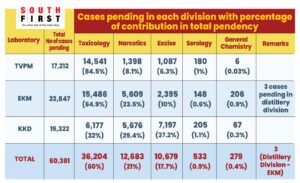
Cases received and pending.
However, in most other years, the number of settled cases remained significantly lower.
For instance, during 2020-21, only 19,585 cases were disposed of, likely due to the restrictions imposed by the Covid-19 pandemic. Similarly, in 2017-18 and 2023-24, 25,363 and 26,630 cases were resolved, respectively.
The year 2012-13 stands out as a peak performance year, with 31,008 cases tested.
If the department had maintained this level of efficiency over the past 12 years, it could have potentially settled 3,72,000 cases (31,008 cases x 12 years). However, the actual number of disposed cases over this period was 3,32,809, leaving a shortfall of about 40,000 cases.
Had these additional 40,000 cases been cleared, the pending caseload as of March 2024 would have dropped significantly from 62,558 to just 22,558.
These delays do not just reflect a logistical problem but also strike at the heart of justice.
Criminal cases drag on indefinitely, allowing accused persons to exploit the legal system’s loopholes. Victims, their families, and even law enforcement agencies are frustrated as scientific test results—essential for proving cases in court—are delayed by months or even years.
Earlier, the Chief Chemical Examiner informed the Home Department that the backlog could be cleared only by appointing more analysts, providing advanced technical equipment, and allocating new laboratories.
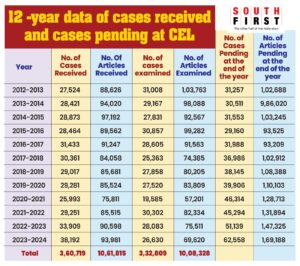
Data over the past 12 years.
The department currently operates with just 207 posts, spread thin across its three laboratories.
However, it is also being pointed out that despite having high-end equipment like gas chromatographs, which could expedite the analysis process, these remain largely underutilised.
Unscientific deployment of analysts across the various divisions—narcotics, serology, toxicology, excise, and general chemistry—has further exacerbated the situation. Analysts in some divisions face unreasonable monthly targets, while others fall short of utilising advanced tools that could speed up their work.
To resolve this issue, a multifaceted approach is being suggested by the Personnel and Administrative Reforms Department, which examined the issues plagued by the CEL. It includes adequate staffing, modernisation of laboratory infrastructure, and better utilisation of existing technology.
An official from the Personnel & Administrative Reforms Department said staff shortage was not the issue. The problem was with underperforming officials.
“Staff shortage isn’t the primary concern. The real issue lies in certain officials underperforming and the underutilisation of advanced technology at CEL’s disposal,” he told South First on condition of anonymity.
The official added that his department had probed the reasons for the backlog, “as it directly impacts the timely delivery of justice”.
“After conducting a thorough analysis, we submitted our findings to the Home Department for its consideration and corrective action,” he added.
Police officers remain tight-lipped about whether the backlog of cases at the laboratories has hindered the prosecution process.
Without immediate intervention, the backlog will continue to grow, further delaying justice and undermining public confidence in the state’s judicial system.
(Edited by Majnu Babu).



