

Published Dec 25, 2025 | 9:00 AM ⚊ Updated Jan 26, 2026 | 8:54 AM

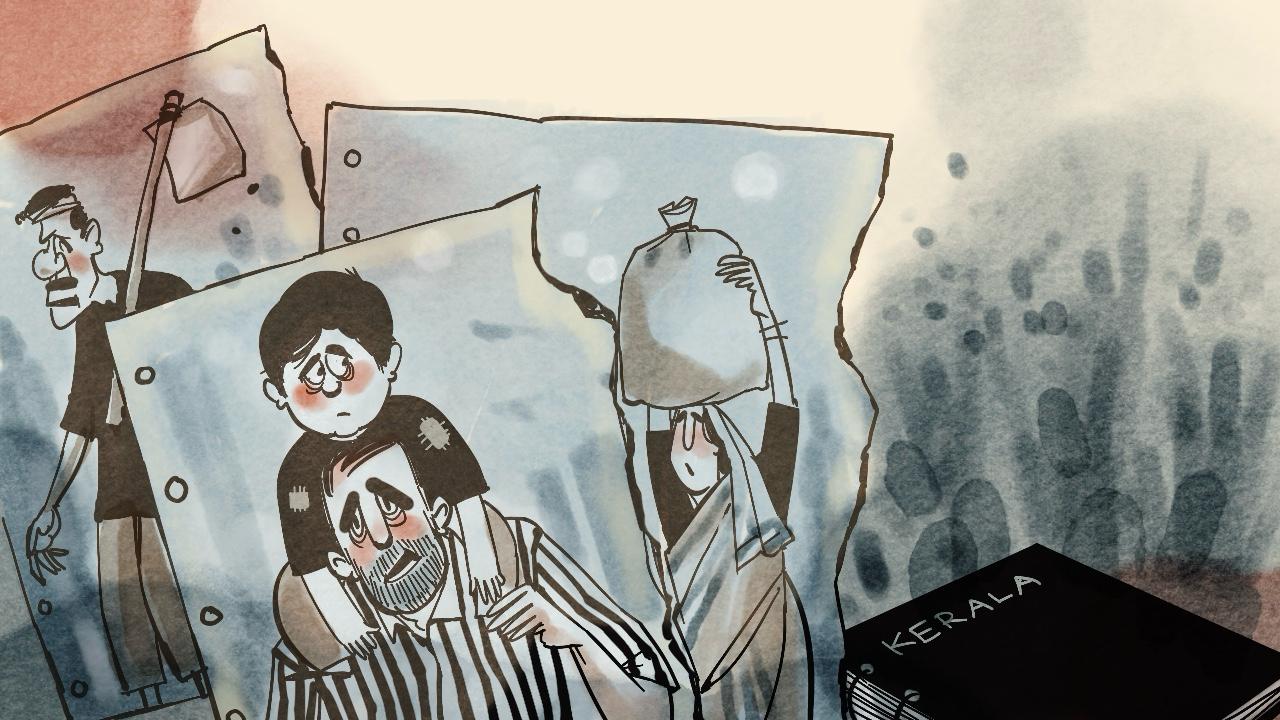
Migrant workers in Kerala.
Synopsis: Kerala, a state that harbours around three million migrant workers, lacks official data on their well-being. The issue came into sharp focus after the alleged mob lynching of a Chhattisgarh native in Palakkad. What is particularly troubling is the xenophobia underlying the incident. The lynching, which occurred in a village shaped more by local narratives than by global or national news, where the victim was reportedly asked whether he was a Bangladeshi, reveals a deep rot in society — one nurtured by local political narratives.
Sunitha Walayar, an activist and local politician in the Palakkad district of Kerala, has not slept properly for days. The reason is not fear, but a haunting memory. She witnessed a brutal murder unfold right in front of her eyes. When the violence erupted, Sunitha tried desperately to stop it. But she was a lone woman surrounded by a mob of intoxicated men.
She could do little physically. Still, she did what she could; she called the police and the ambulance, hoping help would arrive in time. It did not.
For the past week, Sunitha said, her ears still echo with the cries of a man who came to Kerala only to earn a livelihood to take care of his family.
On 17 December, Ram Narayan Baghel, a migrant worker from Chhattisgarh, was allegedly lynched in Walayar after a mob accused him of theft.
The circulating videos of the assault reveal a dark truth — the attackers are repeatedly heard asking the question ”Are you Bangladeshi?” That single question lays bare a disturbing truth — racial profiling and xenophobia are now fusing dangerously with mob violence.
In Kerala, migrant labourers are officially termed guest workers. However, what kind of hospitality ends in suspicion, humiliation, and death? What has changed so deeply that ordinary villagers now feel emboldened to ask racial questions, to turn strangers into enemies, and to justify violence?
As Sunitha struggles to sleep, Kerala must confront a far more disturbing wake-up call.
Reports from various NGOs estimate that between 2.5 and 3.5 million workers from other states are employed in Kerala. Yet, the state lacks official data on migrant workers’ well-being, including information on deaths or workplace incidents.
Migrant labourers in Kerala face numerous risks. Many lose their lives due to workplace accidents, illnesses, suicides, murders and road accidents. Despite this, neither the government, labour unions, nor NGOs maintain comprehensive records of fatalities among this population.

Mob assaults in Kerala. (CMID)
The first week of June 2025 alone saw five migrant workers die in separate incidents across the state. In June, Rupesh, Rahul, and Ali from West Bengal were killed when an old building collapsed in Kodakara, Thrissur. In July, Mahadev and Ajay Rai from Odisha died in a quarry accident in Konni.
Reports suggest many deaths during national highway construction projects go unreported, according to labour agents in Ernakulam.
Ramnarayan’s case is not the first mob lynching targeting migrant workers in Kerala. Data from the Centre for Migration and Inclusive Development (CMID) show multiple incidents between 2016 and 24 December 2025.
Benoy Peter, chief of the CMID, told South First that a few years ago, an incident in Kozhikode’s SM Street escalated tensions between locals and migrant workers, leading many migrants to leave Kerala.
“At that time, numerous businesses in Kozhikode, including restaurants, faced severe labour shortages and some even had to shut down. The then-DGP intervened, circulated a video in the migrants’ language, and requested them to return. This clearly shows how much we rely on migrant workers,” he said.
He added that migration in Kerala is also influenced by caste factors.
“Most migrants in the state belong to minority communities and Dalits, who view Kerala as a sanctuary. Migrant workers contribute significantly to the local economy, spending around ₹200 billion across the state. In Ernakulam’s Perumbavoor alone, their yearly spending amounts to ₹60 crore.”
Commenting on terminology, Benoy Peter noted: “The term ‘guest worker’ implies that the worker is temporary, not permanent. The correct and standard terminology is always ‘migrant worker.”
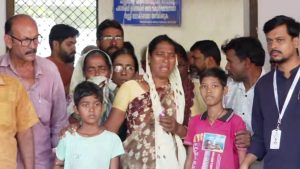
Family of Ram Narayan.
Speaking to South First, activist CR Neelakandan, who has been closely involved in the case, criticised the initial handling of the case, calling it ”deeply inadequate.” He said the police had initially registered the incident as an unnatural death despite clear indications that it was a case of mob lynching.
”The police knew from the beginning that this was not a simple death. Yet, they avoided invoking serious sections at the outset” Neelakandan alleged.
He pointed to the video of the assault that later surfaced, noting that the attackers were repeatedly heard asking the victim, Ramnarayan Baghel, whether he was from Bangladesh.
”That single question exposes the mindset behind the attack. It shows how political polarisation and hate narratives have seeped into even rural Kerala. The hate speeches delivered in the state play a crucial role in triggering such violence” he said.
When South First contacted police officials regarding the video, they said the footage had been sent for detailed forensic examination. Only after this process, officials said, would the police be able to probe the communal and xenophobic elements evident in the assault.
While political accusations have focused largely on the Sangh Parivar, the investigation has complicated such narratives. Police findings indicate that among the arrested accused is an activist of the CITU, the trade union affiliated to the ruling CPI(M), alongside others with alleged links to the BJP, all hailing from a rural background.
This has underscored that the hatred culminating in the lynching cannot be attributed to one political ideology alone but reflects a broader social and political radicalisation cutting across affiliations.
Minister K. Rajan
After mounting pressure, government authorities said that police invoked stringent provisions in the case on the seventh day, adding sections of the SC/ST (Prevention of Atrocities) Act and Section 103(2) of the Bharatiya Nyaya Sanhita (mob murder). Two more accused were arrested, taking the total to seven, while eight others identified by the Special Investigation Team (SIT) remain absconding.
The delay in invoking serious sections has drawn criticism, with allegations that police failed to arrest all suspects and collect mobile phone footage in the initial days. The Director General of Police (DGP) said strict action will be taken against all those responsible.
The SIT has also decided to seek custodial interrogation of five accused and will move the court on Wednesday, 24 December.
Meanwhile, Ram Narayan’s body has been transported to Chhattisgarh. Chief Minister Vishnu Dev Sai expressed grief and announced ₹5 lakh in financial assistance to the family.
However, conflicting versions have emerged within the administration.
While the Revenue Minister and Palakkad Collector said additional charges have been added, Palakkad SP Ajith Kumar, who is heading the probe, told South First that invoking SC/ST Act provisions without a caste certificate was procedurally impossible, calling the controversy a result of ”ignorance.”
Vellappally Natesan
Hate speech in Kerala has increasingly shaped public attitudes, with its impact now visible at the grassroots. The repeated questioning of ”Are you Bangladeshi?” is not an isolated act but a reflection of narratives pushed from above, argued Neelakandan, who has called for a state-level law against hate speech on the lines of Karnataka.
In recent years, communal remarks have emerged across the political spectrum, from Chief Minister Pinarayi Vijayan to SNDP Yogam general secretary Vellappally Natesan and former MLA PC George.
George has been repeatedly booked for hate speech targeting Muslims, with the Kerala High Court rejecting his anticipatory bail in February 2025, citing his tendency to make religion-based statements that violate constitutional values.

PC George. (Wikimedia Commons)
While the Vijayan government claims a ”zero tolerance” policy towards communal forces, controversy followed the chief minister’s interview to The Hindu on alleged gold smuggling and hawala transactions in Malappuram.
Subsequent corrections and disclosures by the newspaper’s editor revealed the role of a PR agency in inserting statements, raising questions about accountability.
At the same time, Vellappally Natesan’s remarks, like warning of demographic change, alleging Muslim political dominance, and portraying Malappuram as hostile to the Ezhava community, added to the charged atmosphere and results of the 2025 local body polls.
Taken together, such statements, made by influential leaders, legitimise suspicion, deepen Islamophobia, and trickle down into everyday interactions, reinforcing prejudice at a time when communal polarisation is already intensifying at the national level.
Across India’s major cities, protests have erupted over violence against Hindus in Bangladesh, triggered by a lynching in Mymensingh. Bangladesh, too, is reeling from unrest following the killing of political activist Sharif Osman Hadi. These debates are shaped by national and international political discourse.
In Kerala, even in its rural corners, people are not isolated from these conversations. With widespread digital literacy and access to news, the voices of global and national events reach villages alongside those of local leaders.
Yet, it is here, in a land built on migration and labour, that a question like “Are you Bangladeshi?” —asked with suspicion still cuts deep.
Despite awareness of the wider world, fear can travel close to home, turning neighbours into strangers and workers into outsiders. In a state that has thrived on inclusion, such moments of doubt wound far deeper than any slogan shouted in a city square.
(Edited by Muhammed Fazil.)


