

Published Feb 04, 2026 | 11:45 AM ⚊ Updated Feb 04, 2026 | 11:45 AM

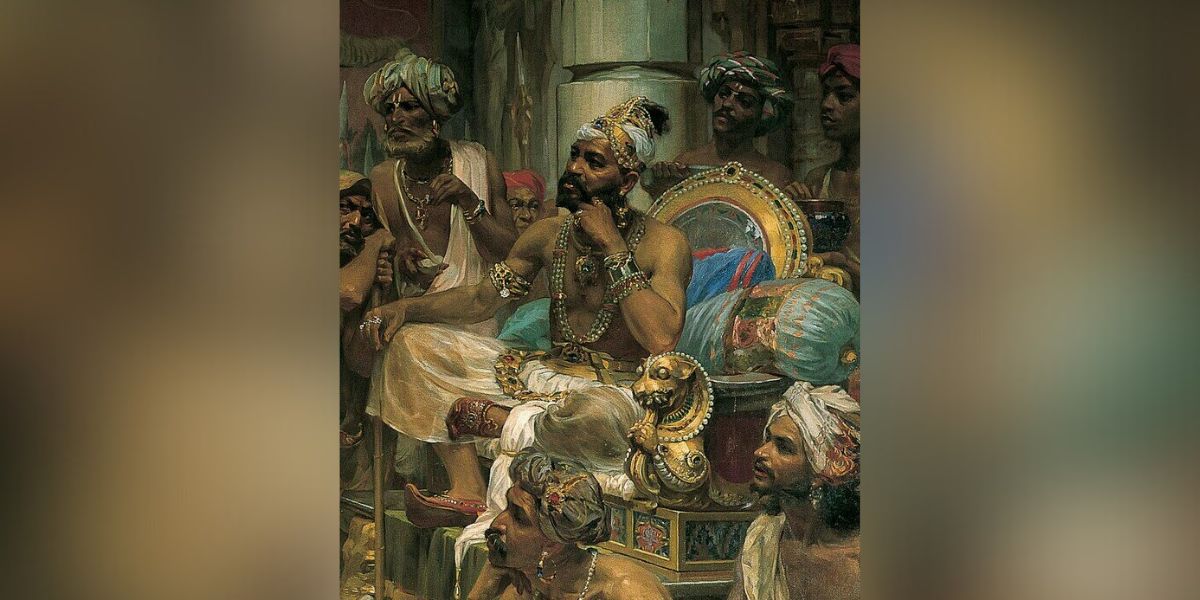
The Zamorin of Calicut (1495–1500) on his throne as painted by Veloso Salgado in 1898. (Creative Commons)
Synopsis: The Kerala High Court recently ruled on a challenge against the continued payment of Malabar Malikhana, the allowance historically granted to the Zamorin Raja of Calicut. The High Court dismissed the writ petition primarily on the ground that it lacked jurisdiction to entertain the dispute.
More than two centuries after the East India Company set its seal on Malabar, a forgotten colonial covenant has returned to the courtroom in Kerala — and the headlines.
The centuries-old Malabar Malikhana, an allowance born out of an 1806 agreement between the British and the Zamorin of Calicut, has once again stirred legal and constitutional debate in Kerala, forcing a relook at how colonial-era promises sit within modern India’s constitutional framework.
At the centre of the controversy is a question that refuses to fade with time: Is Malikhana merely a defunct royal pension abolished with privy purses in 1971, or a binding contractual obligation flowing from a pre-Constitution covenant that the state is still bound to honour?
The Kerala High Court’s recent ruling has not only pushed this obscure allowance back into public discussion but also peeled back layers of colonial history, raising uncomfortable questions about royal pensions and privy purses, and why such historical arrangements continue to survive in modern India.
A centuries-old agreement, dating back to 1806, came under sharp legal scrutiny when the Kerala High Court recently ruled on a challenge against the continued payment of Malabar Malikhana, the allowance historically granted to the Zamorin Raja of Calicut.
The agreement in question is a ‘Kararnamah‘ dated 15 November 1806, executed between the East India Company and Korikorte Mauna Wickama Samoory Rajah of Nedyeruppu Suruwum (Nediyirippu Swaroopam) in respect of Malikhana, a sum promised by the East India Company. The ruler of the Nediyirippu Swaroopam is popularly known as Zamorin or Samoothiri.
The Agreement of 1806 was a pivotal arrangement that redefined the financial relationship between the East India Company and the Zamorin family of Malabar, centring on the payment of Malikhana, an allowance meant for distribution among the Raja and his extended family.
While earlier agreements had granted the Zamorin a share of the net revenue collected from the district for a fixed period of five years, the 1806 Agreement clarified that those earlier conditions had lapsed.
Even so, the company continued Malikhana payments at its discretion, amid growing concern that some junior branches of the Kovilakoms had failed in their allegiance to company rule and had even engaged in rebellion.
To address this, the 1806 Agreement consolidated all prior stipulations into a single, binding document comprising five articles.
It fixed Malikhana at 20 percent of the gross land revenue, payable quarterly through the Principal Collector, and made the allowance a security for good and dutiful behaviour.
Payments were routed through the senior member of each Kovilakom to ensure discipline and subordination among junior members, while allowing internal division of shares enforceable in civil courts.
The agreement also formalised additional entitlements from customs duties and the Calicut Mint and emphasised the perpetual nature of the allowance, subject only to good conduct.
As per the agreement, the family was then paid an annual sum of ₹1,32,168.25.
This framework governed relations for decades, later passing from the Company to the British Crown and, after Independence, to the Government of India, which reviewed such political pensions in 1952.
The Ministry of Home Affairs in 1952 defines Malabar Malikhana as “fixed about the year 1800 as compensation for the territories of Malabar Rajas
and the chieftains taken over by the East India Company for direct management of the revenue administration”.
The present case originated from a writ petition filed by Sanoop VV of Kozhikode in October 2025, who challenged an order of the District Collector granting Malikhana to the late KC Ramachandran Raja.
The petitioner argued that Malikhana was a hereditary political pension introduced by the British as compensation for the loss of sovereign authority and stood abolished under the Constitution (26th Amendment) Act, 1971, which did away with privy purses and similar allowances.
He further objected to PK Kerala Varma of the Zamorin family staking a claim to the allowance, alleging his conduct and financial background, and sought a declaration that no individual could legally claim Malikhana after 1971.
Kerala Varma, however, strongly contested these claims.
He maintained that Malikhana was not a privy purse or hereditary political pension but an allowance arising out of a specific covenant executed on 15 November 1806, between the East India Company and the Zamorin Raja.
He pointed out that payments had continued uninterrupted for more than five decades after the 26th Constitutional Amendment and were being made by the Union of India, with the Kozhikode District Collector acting as the Malikhana Disbursement Officer.
The allowance, he said, also covered payments to other beneficiaries such as Kuthiravattom Nair, Valiya Nambidi, Punnathur Raja and included college contributions.
The high court dismissed the writ petition primarily on the ground that it lacked jurisdiction to entertain the dispute.
The division bench comprising Justices Raja Vijayaraghavan and K V Jayakumar, in its order on 9 January, examined the nature of Malikhana and found that the petitioner’s central argument—that it was akin to a privy purse abolished by the Constitution (Twenty-Sixth Amendment) Act, 1971—was legally flawed.
The court held that a privy purse and the Zamorin’s Malikhana are distinct in origin and character.
While privy purses arose out of constitutional arrangements made at the time of the integration of princely states, Malikhana flowed from a much earlier covenant executed in 1806 between the East India Company and the Zamorin Raja.
As such, the allowance did not owe its existence to constitutional recognition later withdrawn in 1971.
More significantly, the Bench relied on Article 363 of the Constitution, which expressly bars courts from adjudicating disputes arising from treaties, covenants or agreements entered into before the commencement of the Constitution between Indian rulers and the Government or its predecessors.
Since the right to receive Malikhana clearly stemmed from such a pre-Constitution agreement and had continued in operation even after independence, the court held that judicial interference was constitutionally prohibited.
The long and uninterrupted payment of Malikhana for decades after the 26th Amendment further weakened the petitioner’s case.
On these grounds, the court concluded that the writ petition was not maintainable and deserved outright dismissal, leading to the imposition of costs of ₹10,000 on the petitioner.
It is learnt that currently an annual payment of ₹15,000 is made by the Union of India towards certain family members of the Zamorin family under the head Malabar Malikhana.
This was not the first occasion on which the issue of Malabar Malikhana came up before the courts.
As early as 25 November 2002, PK. Kerala Varma had made a representation to the Government of India seeking revision of the Malikhana, pointing out that the payment had not been reviewed since 1806.
The representation traced the origin of Malikhana to an agreement dated 15 November 1806, under which the Zamorin Raja of Calicut and other family members surrendered their properties to the East India Company and, in return, were assured perpetual compensation.
The amount was fixed at ₹1,32,168.25 per year based on the value of the rupee, cost of living and consideration for services rendered at that time.
It was contended that Malikhana was compensation for surrendered property, payable in equal shares to family members, and not a grant or pension under the Pensions Act.
Even after the British Crown assumed control and later after Indian independence and abolition of privy purses, the obligation continued. The appellants sought revision of the payment to ₹6,000 per month per member.
However, the Union of India rejected the request in 2012 and again in 2015, treating Malabar Malikhana as a political pension not liable for revision.
In 2024, the Kerala High Court directed the Union to reconsider the appellants’ plea by examining the true nature and character of the Malabar Malikhana compensation.
At the same time, the Kerala government significantly enhanced the family and political pension paid to members of the erstwhile royal families.
In 2013, the pension was increased from ₹600 to ₹1,000, and this was further raised to ₹3,000 in 2017.
In Kerala, matters relating to family and political pensions and other allowances for erstwhile royal families and local kingdoms are handled by the P3 wing of the Political Section under the General Administration Department.
This wing also deals with records connected to the Malikhana pension granted to royal families of the Malabar region, among other related matters.
(Edited by Muhammed Fazil.)


