

Published Feb 01, 2026 | 3:59 PM ⚊ Updated Feb 01, 2026 | 3:59 PM

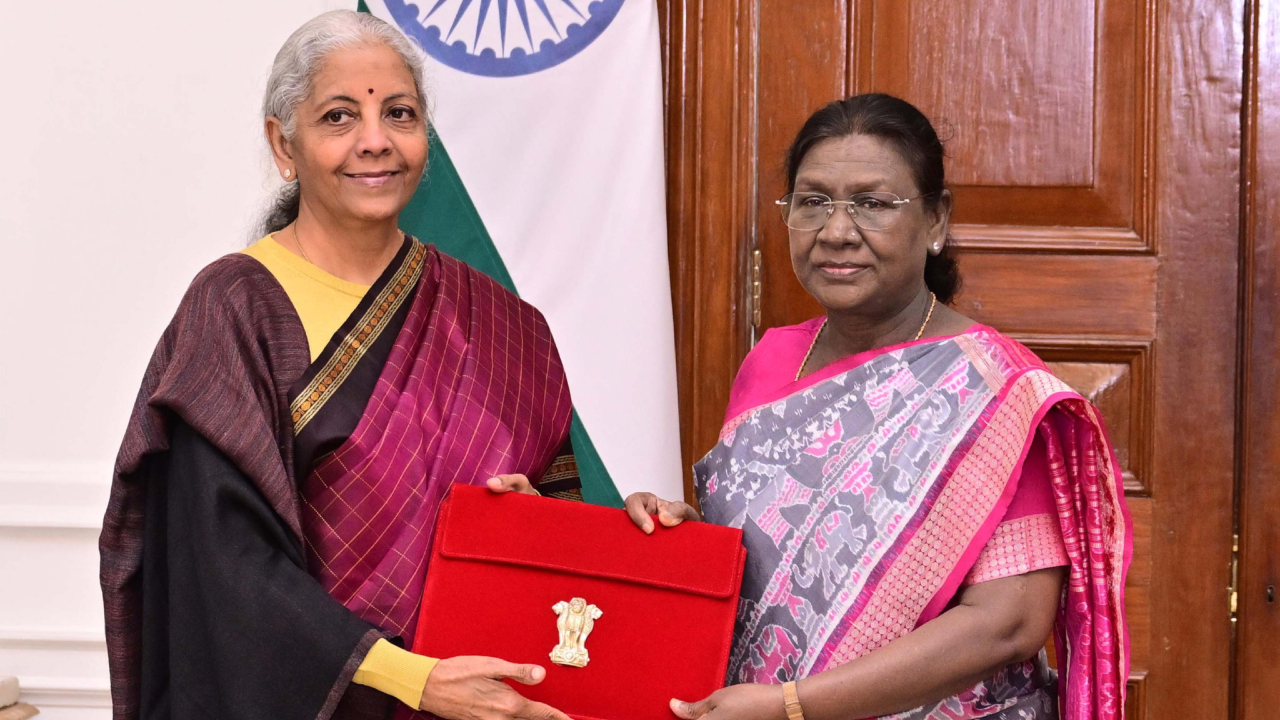
Finance Minister Nirmala Sitharaman with President Droupadi Murmu. Credit: x.com/rashtrapatibhvn
Synopsis: Union Budget 2026 disappointed poll-bound Kerala, offering only token mentions like Rare Earth Corridors and Turtle Trails amid high expectations for major projects. Key demands—an AIIMS, high-speed rail, Vizhinjam port support, and a ₹21,000-crore fiscal package—went unmet. Kerala gains indirectly from national schemes in coconut, cashew, fisheries, and rural livelihoods, but misses targeted relief for plantations, marking a missed political opportunity for BJP.
The Union Budget 2026 has left poll-bound Kerala nursing a familiar sense of disappointment, with the state finding little beyond token inclusions amid grand national announcements.
Despite high expectations that the BJP-led Centre would roll out big-ticket projects ahead of the Assembly elections, Kerala figured only marginally in the Union Finance Minister’s speech—limited to a share in broad sectoral initiatives and a handful of location-specific mentions that fell far short of the state’s wishlist.
While the Budget did announce Rare Earth Corridors covering Kerala along with Odisha, Andhra Pradesh and Tamil Nadu, and proposed “Turtle Trails” in select coastal stretches of Kerala, Karnataka and Odisha, these were the only direct references to the state.
Crucially, long-pending demands such as an AIIMS for Kerala and a rapid rail connectivity project found no place, even as the State had earlier submitted an expansive memorandum seeking a special fiscal correction package, enhanced borrowing space and targeted central investments to offset what it terms an increasingly centralised fiscal regime.
For Kerala, the cheer was confined largely to indirect gains from nationwide schemes in coconut, cashew, fisheries and general assurances on boosting farmer incomes.
Earlier, ahead of the Union Budget 2026–27, Kerala placed before the Centre a wide-ranging memorandum seeking what it called a course correction in India’s increasingly centralised fiscal framework, with its core demand being urgent relief for a deepening resource crunch.
Formally, the state had sought a Special Fiscal Correction Package to bridge a revenue gap estimated at over ₹21,000 crore, along with enhanced borrowing flexibility, including an additional 0.5 percent of GSDP exclusively for capital expenditure and permission to borrow for state-funded land acquisition for National Highway projects.
It also asked that 25 percent of the Union’s 50-year interest-free capex loans be earmarked as an Asset Renewal Fund for developed states.
On the GST front, Kerala pressed for a “GST 2.0” revenue protection mechanism, rule-based compensation for losses due to rate rationalisation and stricter e-commerce protocols to curb tax leakage.
The memorandum outlined ambitious sectoral expectations — Central backing to position Kerala as a hub for advanced manufacturing and defence technology through a Defence Research and Development Corridor anchored by institutions such as the Indian Naval Academy, DRDO labs, Cochin Shipyard and BrahMos Aerospace; support for MSME modernisation, rubber-based engineering, food processing and marine value chains; and blended finance for green transitions.
Citing demographic shifts, Kerala sought policy support for geriatric healthcare systems, assisted living, dual-track skilling and a National Skilled Mobility Framework to reintegrate returning NRIs, especially from the Gulf.
Major infrastructure expectations included stronger Central investment in Vizhinjam port connectivity, logistics parks, metros, electric buses, coastal shipping and resilient bridges, alongside climate-focused initiatives like a Coastal Resilience Fund and catastrophic bonds.
The state also reiterated long-pending demands such as an AIIMS in Kerala, early execution of the Sabari Rail project, clearance of FCI paddy dues, plantation sector assistance, a Rubber Price Stabilisation Fund and targeted support for cashew, coir and handloom industries.
For Kerala, the Union Budget turned out to be a largely forgettable exercise, with the state figuring only in passing references and few concrete takeaways at a time when expectations were high.
Despite repeated projections of Kerala as a critical player in India’s future growth story, especially with Assembly elections around the corner, the Budget stopped short of announcing any flagship project that could help BJP build political momentum in the state.
Perhaps the most glaring omission was Vizhinjam seaport.
Once pitched as a gateway of development and a strategic boost to India’s marine and logistics sector, Vizhinjam found no mention in terms of fresh projects, investments, or policy support.
This was despite sustained demands from the state that the Centre leverage Vizhinjam’s transshipment potential as part of a broader maritime and port-led growth strategy.
The silence was particularly striking given the port’s national strategic relevance and its operationalisation.
Equally surprising was the absence of any special push for Thiruvananthapuram Corporation, where BJP registered a historic electoral breakthrough.
With Assembly elections looming, there was widespread expectation that Centre would announce at least one marquee project for the capital city to consolidate its political gains.
Despite the state being represented by two Union Ministers—Suresh Gopi and George Kurian—the Budget failed to offer any headline-grabbing announcement for Kerala.
Suresh Gopi, notably BJP’s lone Lok Sabha MP from the state after his victory in Thrissur, along with party’s state leadership, was unable to secure or project any major allocation or project that could resonate with voters.
The absence of Kerala-specific initiatives is being seen as a missed political opportunity for the saffron party, especially at a time when it is looking to strengthen its footing ahead of the upcoming Assembly elections.
The only notable area of convergence between the Centre and the state emerged around rare earth and critical minerals.
The Union Budget proposed support for mineral-rich states — Odisha, Kerala, Andhra Pradesh and Tamil Nadu — to establish dedicated Rare Earth Corridors aimed at promoting mining, processing, research, and manufacturing.
This aligns closely with Kerala’s own Budget 2026 proposal for a Rare Earth Corridor connecting Vizhinjam port to Chavara and onward to Kochi, with a dedicated centre adjacent to KMML, Chavara.
The state has projected investments of ₹42,000 crore and employment potential of around 50,000 jobs, besides earmarking ₹100 crore for a Rare Earth Critical Minerals Mission in partnership with KMML, KELTRON, and NFTDC.
Notably, Kerala had earlier sought central backing for this very corridor, citing the state’s rich monazite-bearing mineral sand reserves.
Beyond this shared vision on rare earths, however, the Union Budget offered little that Kerala could count as a significant gain — a muted outcome in a politically sensitive year.
The most glaring omission is the proposed high-speed rail corridor.
Earlier, Metro Man E Sreedharan — who is seen as close to BJP camp — had said that assurances from Union Railway Minister Ashwini Vaishnaw about a centrally funded high-speed rail project for Kerala had prompted his involvement. He had also expressed confidence that the state government would extend full cooperation to the initiative and went on to suggest that the Union Budget could carry an announcement in this regard.
However, the Budget has come and gone, and there is no mention whatsoever of the much-talked-about project, raising fresh questions about the Centre’s intentions and the future of high-speed rail plans in Kerala.
While the Union Budget stopped short of making Kerala-specific announcements, a closer reading shows that several proposals could significantly benefit the state, particularly across agriculture, fisheries, education and rural livelihoods.
For a coconut-growing state like Kerala, the proposed Coconut Promotion Scheme holds clear promise.
By focusing on replacing old and non-productive coconut trees with high-yielding varieties and improving productivity through targeted interventions, the scheme could strengthen farmer incomes and revive a crop that sustains large sections of Kerala’s agrarian economy.
Fisheries, another backbone sector, also figures prominently.
The decision to make fish caught by Indian vessels in the Exclusive Economic Zone and on the high seas duty-free, and to treat landings in foreign ports as exports, could directly aid Kerala’s deep-sea fishing community, which has been seeking policy support to expand operations beyond territorial waters.
In addition, initiatives for the integrated development of 500 reservoirs and Amrit Sarovars, along with efforts to strengthen fisheries value chains in coastal areas through start-ups, women-led groups and Fish Farmer Producer Organisations, align closely with Kerala’s strengths in cooperative models and community-led enterprises.
Agriculture diversification measures outlined in the Budget also resonate with Kerala’s coastal profile.
Support for high-value crops such as coconut, cocoa, cashew and sandalwood could provide a boost to farmers looking to move beyond traditional cultivation and tap premium markets.
The emphasis on animal husbandry entrepreneurship—through credit-linked subsidies, modernisation of livestock enterprises, integrated dairy and poultry value chains, and the promotion of Livestock Farmer Producer Organisations—could help create quality employment in rural and peri-urban areas, addressing a long-standing concern in the state.
Kerala, widely recognised as a hub of traditional medicine, could also reasonably hope to benefit from the proposal to set up three new All India Institutes of Ayurveda, even though locations have not yet been specified.
Similarly, the plan to establish five university townships near major industrial and logistic corridors, while broad in scope, opens up possibilities for Kerala given its skilled workforce and educational ecosystem.
The Budget’s thrust on rural livelihoods is also expected to benefit the state.
Proposals to promote animal husbandry entrepreneurship through credit-linked subsidies, modernisation of livestock enterprises and the creation of integrated dairy and poultry value chains may help generate quality employment in rural and peri-urban areas.
The Mahatma Gandhi Gram Swaraj initiative, aimed at strengthening khadi, handloom and handicrafts through better training, skilling, quality processes, branding and global market linkages, could give a fresh push to Kerala’s weavers, village industries and the One District–One Product programme, while creating opportunities for rural youth.
The proposed ₹10,000-crore SME Growth Fund, designed to nurture future champions by incentivising promising enterprises, could also offer much-needed capital support to Kerala’s vibrant small and medium enterprises.
Finally, the proposal to set up Self-Help Entrepreneur (SHE) Marts as community-owned retail outlets could strengthen women-led self-help groups, a sector where Kerala already has a strong institutional base.
However, the absence of targeted measures for coffee, rubber, cardamom and pepper has come as a setback.
These plantation crops remain the backbone of Kerala’s high-range economy, already under strain from price volatility, rising costs and climate stress.
For growers who were expecting targeted relief or support measures, the silence in the Budget is hard to miss.
(Edited by Amit Vasudev)


