

Published Mar 28, 2026 | 8:00 AM ⚊ Updated Mar 28, 2026 | 10:57 AM

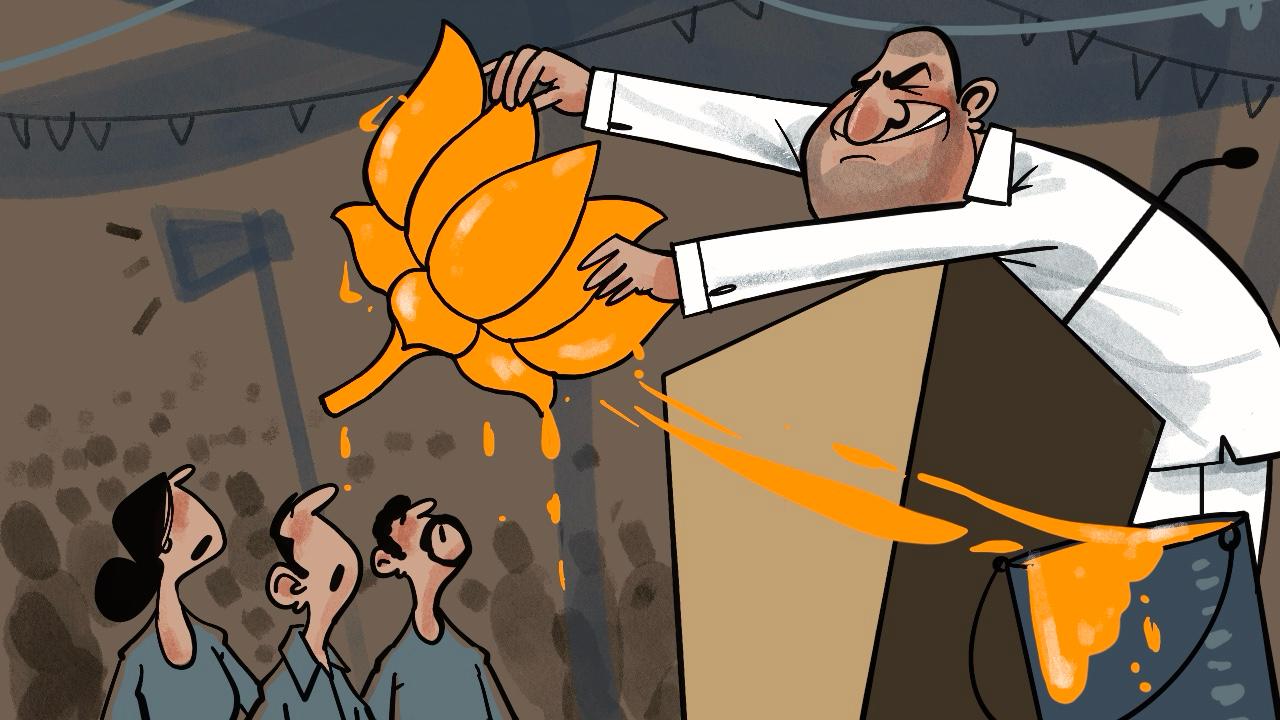
Guruvayur Assembly constituency.
Synopsis: Recently, the BJP candidate in the Guruvayur Assembly constituency made a communally coloured remark questioning why the constituency elects only Muslim representatives, although it houses one of the most popular temples in Kerala. However, the reality in the constituency — with a majority Muslim population — is quite different from what the BJP leader is trying to portray. Ironically, at the temple, the lotus used for rituals — also the election symbol of the BJP — is supplied by Muslim farmers.
As the afternoon light softens over the paddy fields of Thirunavaya in the Malappuram district, Musthaq Moideen rises after his Asr namaz and heads straight to his lotus farm. Across 16 acres of still water, thousands of half-awake buds await careful harvesting.
With four workers, he moves through the fields in a quiet rhythm — bend, pick, place — ensuring each bud is plucked at the perfect stage, its petals untouched and symmetry intact. By evening, the flowers are sorted and packed, their gentle fragrance filling the air as they begin their overnight journey to Guruvayur in Thrissur.
At dawn, as devotees gather at the Guruvayur Temple in the Thrissur district, many hope to see ‘Guruvayurappan‘ adorned in lotus garlands. The flower is sacred there, offered with devotion, believed to be dear to the deity.
For Musthaq, this is more than livelihood — it is a legacy. His late father, Moideen Haji was part of the same tradition.
Like many Muslim farmers across Thirunavaya, he continues to cultivate the ”Thirunavaya chenthamara”— large, deep pink lotuses cherished in temple rituals — quietly embodying a harmony that transcends faith.
Yet, in recent days, this very land has found itself at the centre of a different conversation.
The Guruvayur Assembly constituency, which surrounds the temple town, has been drawn into political debate following remarks by BJP candidate B Gopalakrishnan. He questioned why Guruvayur had not elected a Hindu MLA in decades, asking whether a place so closely associated with a major Hindu pilgrimage centre should not be represented by a Hindu legislator.
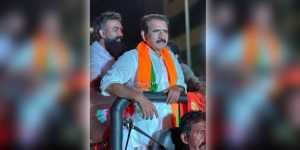
B Gopalakrishnan, NDA candidate in Guruvayur
Speaking to South First, CPI(M) Guruvayur constituency secretary C Sumeesh said the remarks breached the Model Code of Conduct (MCC) and appeared aimed at influencing voters.
The party also alleged that the Sangh Parivar had no role in Guruvayur’s social reform movements and accused it of misleading the public.
Gopalakrishnan, initially left out of the BJP’s first list, was later included in its second list of 39 candidates and fielded from Guruvayur after reportedly seeking a seat in Kodungallur.
Defending him, BJP Kerala President Rajeev Chandrasekhar said there was nothing wrong in asking whether Guruvayur should have a Hindu MLA. He argued it was a legitimate question to voters, adding that one would not expect a non-Christian representative in the Vatican or a non-Muslim in Mecca.
Acting on a complaint, Chief Electoral Officer Rathan U Kelkar directed the Thrissur District Collector to register a case under Section 123(3) of the Representation of the People Act, 1951, Section 192 of the Bharatiya Nyaya Sanhita, along with MCC provisions. Authorities said a circulated video violated norms against seeking votes on religious grounds.
The video was removed, and an FIR was registered at Guruvayur Temple Police Station.
On Friday, 27 March, the Kerala High Court instructed the Election Commission of India (ECI) to consider the complaint against Gopalakrishnan. Justice Bechu Kurian Thomas directed the ECI to decide on the representation within two months.
The petition was filed by Gokul Guruvayoor, a leader of the Kerala Students Union (KSU), the students’ wing of the Congress.
The court noted that the petitioner must first pursue remedies with the ECI and, as the election process is ongoing, avoided any remarks that could influence polling.
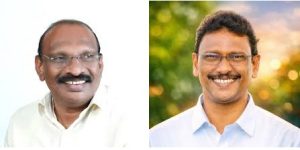
NK Akbar and CH Rasheed.
The Guruvayur Assembly constituency, widely known for the Krishna Temple, lies within Chavakkad taluk and presents a unique blend of religious prominence and distinct electoral behaviour.
According to the 2011 Census, Chavakkad taluk (Coastal region) has a Muslim-majority population at 53.58 percent, followed by Hindus at 41.87 percent and Christians at 4.25 percent. This demographic composition has consistently influenced the constituency’s political trajectory.
In the current election, the LDF has fielded sitting MLA NK Akbar, while the UDF candidate is CH Rasheed of the Indian Union Muslim League (IUML). Both candidates have remained silent on the MCC violation controversy.
In the 2021 Assembly elections, Guruvayur returned Akbar to the Assembly, continuing a long-standing political pattern. Despite being home to one of Kerala’s most prominent Hindu pilgrimage centres, the constituency has, over the decades, frequently elected representatives from the Muslim community.
Since its formation in 1957, Guruvayur has witnessed shifts between the UDF and LDF, but the social composition of the electorate has remained a defining factor.
Early representatives included Koru Kooliyat and KG Karunakara Menon. From the late 1960s onwards, leaders such as BVS Thangal, PM Abubacker, PKK Bava, and KV Abdul Khader shaped a prolonged phase of Muslim representation.
This trend continued with figures such as PT Kunju Muhammed and, more recently, Akbar.
The current contest between Akbar and Rasheed reflects this historical continuity, where community demographics and political alignments remain closely intertwined in shaping electoral outcomes.
Notably, in the recent local body elections, the CPI(M), despite facing setbacks in other parts of the state, managed to retain a strong foothold in Thrissur district, including areas within this constituency.
According to AP Ahammed, a senior journalist from Kerala, although Guruvayur is widely known as one of the largest Hindu pilgrimage centres in India, every panchayat in the Guruvayur Assembly constituency has a Muslim majority.
This layered social reality has long shaped the region’s history. During the devastating fire of 30 November 1970, which severely damaged the Guruvayur Temple — destroying the Chuttambalam and the Vilakkumatam on its western, southern and northern sides — people from all communities came together to respond.
Despite the temple’s long-standing restriction on entry for non-Hindus, Muslim shopkeepers from the surrounding areas actively joined the rescue efforts, helping to douse the flames.
The spirit of coexistence goes further back in history.
During the rule of the Zamorins, a Muslim figure, Ambalathuveetil Hydros Kutty Moopan, served on the temple’s trustee body — an instance that remains rare among major Hindu temples in India.
This shared cultural fabric continues even today.
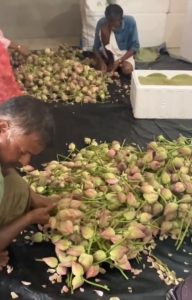
Lotus flowers for temples are grown by Muslim farmers in Thirunavaya.
Speaking to South First, lotus farmer Musthaq Moideen highlighted the quiet interdependence between communities. “Muslims supply Lotus flowers used in many temples, including Guruvayur,” he said.
“At the Tali Shiva Temple, I still supply lotus buds at a rate of ₹3 per piece. Earlier, my father, Moideen Haji used to supply them at ₹2, and I have continued the same tradition.”
“We never bargain with temple authorities. Sometimes, understanding our costs and losses, they voluntarily offer a higher price. We handle the flowers with the same care and cleanliness as we prepare ourselves for namaz, because they are meant to adorn the deity and devotees consider the lotus sacred,” he added.
Like his father, Musthaq hires men to pluck and pack the lotus, respecting the belief among Hindu devotees that the flowers are sacred and should not be handled by women during menstruation, as it is considered ritually ‘impure’.
In the 2011 Assembly election in Guruvayur, CPI(M)’s KV Abdul Khader led with 62,246 votes (48.53%), followed by IUML’s Ashraf Kokkur with 52,278 (40.75%).
The BJP–NDA candidate Dayanandan Mampully polled 9,306 votes (7.25%), while SDPI’s Ashraf Vadakoot secured 2,187 (1.70%).
In the 2016 election, CPI(M)’s KV Abdul Khader increased his tally to 66,088 votes (44.76%) despite a slight dip in vote share, while IUML’s PM Sadiqali received 50,990 (34.53%), also seeing a decline.
The BJP–NDA, however, registered a major surge with Advocate Nivedita Subramanian securing 25,490 votes (17.26%), a sharp rise of over 10 percentage points, significantly strengthening its position.
SDPI’s PR Siyad dropped to 1,406 votes (0.95%).
By the 2021 Assembly election, CPI(M) candidate NK Akbar won decisively with 77,072 votes (52.52%), while IUML’s KNA Khader secured 58,804 (40.07%), both improving their vote shares.
Notably, the BJP–NDA and SDPI did not field candidates in this election, leaving the contest primarily between the LDF and UDF.
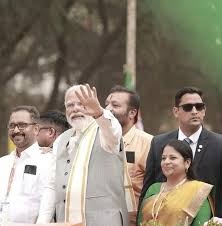
Adv. Nivedita Subramanian with PM Modi
Speaking to South First, IUML leader KNA Khader alleged that in the 2021 Guruvayur Assembly election, the BJP candidate’s nomination was rejected under questionable circumstances, hinting at a possible understanding between the CPI(M) and the BJP.
He pointed out that in the 2016 election, BJP’s Nivedita Subramanian had secured 25,490 votes (17.26%), a substantial figure that established the party as a strong third force in the constituency.
Khader noted that Subramanian, being an advocate, was well aware of the legal procedures involved in filing nominations.
However, her nomination in 2021 was rejected on the grounds that it did not carry the signature of the then-BJP state president K Surendran.
“Normally, when a nomination is rejected, the party intervenes strongly. But in this case, no BJP leader came forward to respond or challenge the decision,” he said, adding that this silence raised serious doubts and fueled speculation about a tacit deal between the CPI(M) and the BJP.
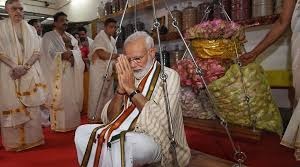
In 2019, Modi performed ‘Thulabharam’ at the Guruvayur Temple using 111 kg of lotus flowers.
In 2019, Prime Minister Narendra Modi visited the Guruvayur temple and performed the ritual ‘Thulabharam‘ using 111 kg of lotus flowers.
In this ceremony, devotees are weighed against offerings, which are then dedicated to Lord Krishna. The lotus flowers, too, were sourced from local farmers like Musthaq.
South First spoke to several voters in Guruvayur, many of whom said that B Gopalakrishnan’s remarks felt jarring.
In Guruvayur, long before politics began raising such questions, everyday life had already answered them in its own quiet way.
In the still waters of Thirunavaya, Muslim farmers carefully nurture lotus buds for a Hindu deity. Here, harmony is neither a slogan nor a subject of debate — it is a lived reality, unfolding every single day.
(Edited by Muhammed Fazil.)


