


Published Mar 21, 2026 | 12:54 PM ⚊ Updated Mar 21, 2026 | 12:54 PM

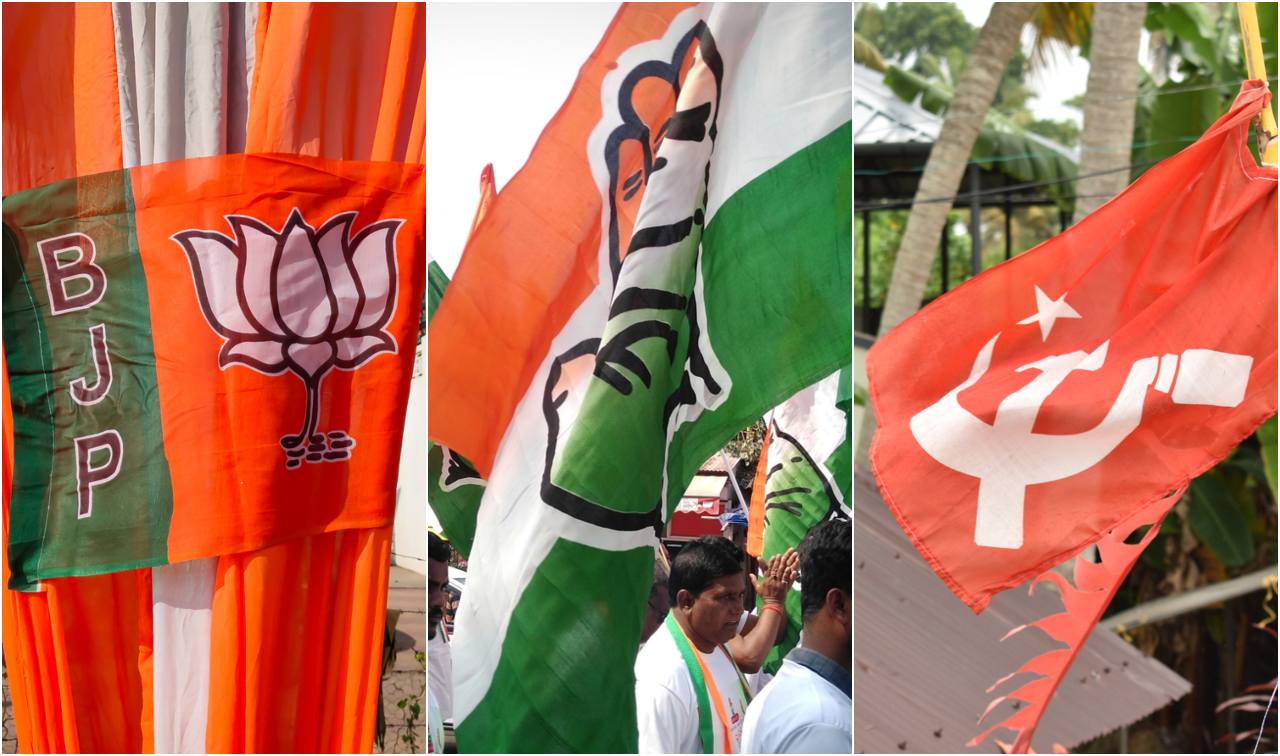
Nemom's electoral arithmetic is heavily shaped by its social composition. Credit: iStock
Synopsis: Nemom’s 2026 Assembly battle epitomises Kerala’s shifting political currents. Once a Congress bastion, later BJP’s breakthrough seat, it now hosts a triangular clash: Rajeev Chandrasekhar (BJP), V. Sivankutty (CPI(M)), and K.S. Sabarinathan (Congress). With layered caste-community equations and historic organisational groundwork, Nemom’s verdict could reshape careers and signal Kerala’s evolving political landscape.
Before the “Modi wave” in Indian politics and well before the formation of INDIA bloc, Kerala had already hinted at a shifting political undercurrent. The Nemom Assembly constituency in Thiruvananthapuram long showed a latent inclination towards BJP, though it translated into a victory only in 2016.
That year, former Union Minister O Rajagopal defeated sitting MLA V. Sivankutty by 8,671 votes. However, in 2011, he had come close to winning but finished second securing 43,661 votes, while Sivankutty polled 50,076 votes.
The win was neither accidental nor purely issue driven. Nemom had for decades witnessed sustained organisational work by RSS and VHP, well before BJP’s electoral ambitions took shape in Kerala.
Thus, Nemom represents more than a single electoral gain—it reflects the cumulative impact of cadre-building and ideological consolidation.
Its significance lies in its predictive value – outcomes here often signal which political force is gaining ground as another weakens, making it a microcosm of Kerala’s future political landscape.
In the 2026 Assembly election, Nemom is set for a high-stakes triangular contest between BJP state chief Rajeev Chandrasekhar, Education Minister V. Sivankutty (CPI(M)), and Congress’ promising leader K. S. Sabarinathan. For all three, the result could shape not just the constituency but their political careers as well. In many ways, the contest is both political and personal.
In this analysis, South First examines the key factors that could influence the outcome.
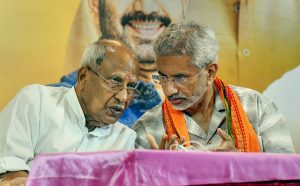
External Affairs Minister S Jaishankar interacts with senior BJP leader O Rajagopal
In the 2016 Kerala Legislative Assembly election, BJP made a historic breakthrough in Nemom, with O. Rajagopal securing 67,813 votes. V. Sivankutty of CPI(M) followed with 59,142 votes, while Congress veteran V. Surendran Pillai managed 13,860.
For long, political observers expected Nemom to remain a bipolar contest between BJP and CPI(M) in upcoming election.
However, that assumption shifted when Congress announced K.S. Sabarinathan as its candidate—marking a strategic and high-stakes intervention.
Sabarinathan, son of Congress veteran G. Karthikeyan, built his political base in the neighbouring Aruvikkara constituency. He first rose to prominence by winning the 2015 by-election following his father’s passing, securing a margin of 10,128 votes. In the 2016 Assembly polls, he consolidated his position by defeating A.A. Rasheed with a margin of 21,134 votes.
However, his trajectory saw a setback in the 2021 Kerala Legislative Assembly election, where he lost to G. Steephen by a narrow margin of 5,046 votes. He later regained some ground in the 2025 local body elections, winning from Kowdiar ward in the Thiruvananthapuram Corporation as UDF’s mayoral face, defeating S. Madhusoodhanan Nair by 1,119 votes. Yet, despite his personal victory, UDF failed to capture the Corporation, with the NDA securing a majority.
Now, heading into the 2026 Assembly elections, the stakes are significantly higher.
With senior leader V.S. Sivakumar shifting to contest from Aruvikkara after seat negotiations, both the party and Sabarinathan are making a calculated and risky move by fielding him in Nemom—a constituency where victory is far from assured, but the political rewards could be transformative.

K.S Sabarinathan
For Sabarinathan, the contest is as much about revival as it is about survival. A win could re-establish him as a key face in Congress, while a defeat may raise serious questions about his political future and influence within the party.
He carries a significant burden, as Congress attempts to reclaim what was once its stronghold by projecting a young face. Even amid sustained activity by RSS and VHP, it was Congress that historically reaped electoral gains in Nemom.
Before 2011, the constituency had a clear Congress tilt.
N. Sakthan won the seat in both 2001 and 2006, polling 56,648 and 60,884 votes respectively. During the same period, BJP remained a distant third, managing 16,872 votes in 2001 and slipping to just 6,705 in 2006.
A major structural shift followed the 2008 delimitation. The reconfigured constituency for the 2011 election absorbed large portions of the erstwhile Thiruvananthapuram East segment, while significant parts of the old Nemom were carved out into the newly created Kattakada seat- reshaping the electoral dynamics of the region.
Nemom’s electoral arithmetic is heavily shaped by its social composition. Nearly 80 percent of the voters are Hindus, with the Nair community forming the single largest bloc at around 35 percent. Alongside them, significant sections of Nadar community and Ezhava community (OBC) voters add further weight to the Hindu vote base.
However, the constituency is far from being a straightforward consolidation story.
Out of roughly 1.92 lakh voters about 30,000–33,000 are Muslims accounting for nearly 15 percent of the electorate. The Nadar population, cutting across both Hindu and Christian segments also forms a decisive chunk, especially in the larger Thiruvananthapuram district where their influence is estimated to be substantial.
This layered demography is precisely why Nemom has resisted becoming a secure stronghold for any one political formation, even after BJP’s breakthrough in 2016.
While upper-caste Hindu consolidation, particularly among Nairs remains a key electoral strategy, it is consistently counterbalanced by Muslim voters and the fluid political preferences of the Nadar community.
A critical variable in this mix is institutional and community backing—especially from the CSI Church and Muslim groups. Their support often tilts the balance in close contests.
In this context, Congress continues to play a pivotal role – even when it is not in a winning position, its vote share can decisively influence the final outcome by determining which rival gains the upper hand.
(Edited by Amit Vasudev)


