


Published Mar 31, 2026 | 5:47 PM ⚊ Updated Mar 31, 2026 | 5:47 PM

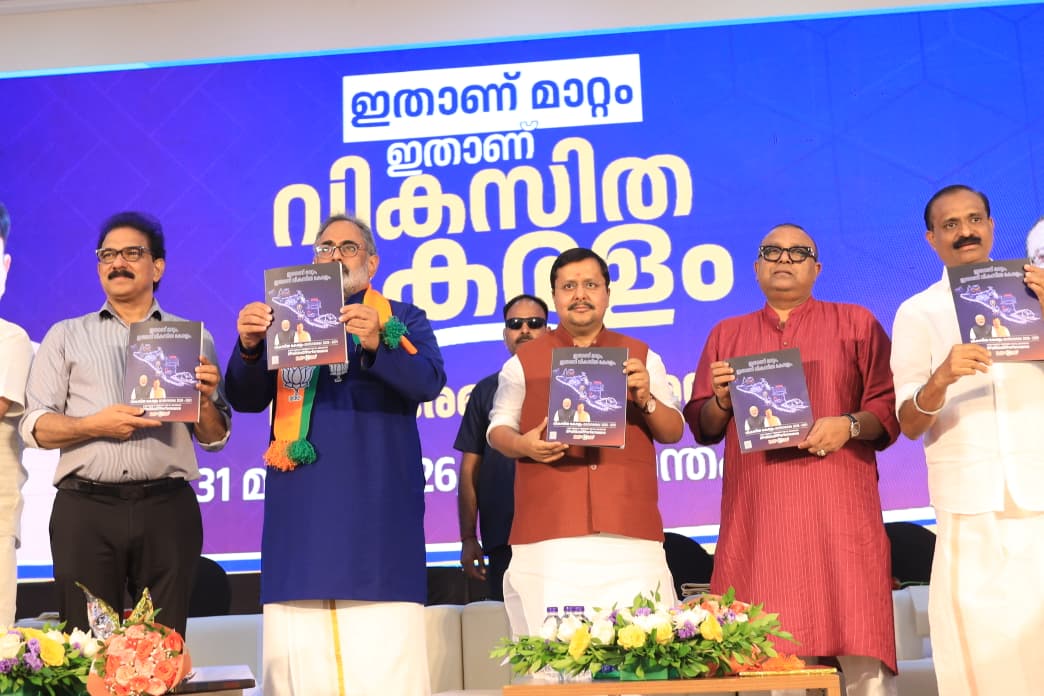
BJP national president Nitin Nabin along with NDA leaders releasing the manifesto
Synopsis: At the heart of the roadmap lies a cluster of welfare measures aimed at economically vulnerable households. The NDA has promised a ‘Food Health Security Card’ that would provide ₹2,500 per month to women from poor families, intended to cover groceries and medicines.
With nine days left for Kerala’s Assembly elections, the BJP-led NDA has stepped up its pitch with a string of promises—packaged not as a conventional manifesto, but as a “roadmap” for a “developed Kerala.”
Unveiled in Thiruvananthapuram by BJP national president Nitin Nabin on Tuesday, 31 March, the document sought to position the NDA as a governance alternative, offering a mix of welfare assurances, infrastructure ambitions and politically resonant interventions.
At the heart of the roadmap was a cluster of welfare measures aimed at economically vulnerable households. The NDA has promised a ‘Food Health Security Card’ that would provide ₹2,500 per month to women from poor families, intended to cover groceries and medicines.
In a State where rising living costs have become a persistent concern, the proposal has been framed as a direct cushion for household budgets.
The party has also leaned into the LPG affordability and availability debate.
Against the backdrop of an escalating global crisis triggered by the US-Israel war on Iran, the ripple effects of supply chain disruptions were now being felt in Kerala’s kitchens.
Talk of LPG scarcity and unpredictable availability has begun to surface alongside rising prices, turning cooking gas into a point of everyday anxiety for many households. Against this backdrop, the NDA promised two free LPG cylinders a year—timed around high-consumption festive seasons such as Onam and Christmas.
Alongside this, it promised 20,000 litres of free drinking water per household every month and a ₹3,000 welfare pension for senior citizens above 70, widows and heads of poor families.
Healthcare, too, featured prominently.
The roadmap pledged universal access to the Ayushman Bharat scheme for all Malayalis and reiterates the long-pending promise of establishing an All India Institute of Medical Sciences (AIIMS) in Kerala, positioning it as a critical upgrade to the state’s medical infrastructure.
Attempting to address unemployment concerns, the NDA proposed an “Employment Linked Incentive Scheme,” offering low-interest loans of up to ₹1 lakh to enterprises for every new job created for Keralites.
In agriculture, it promised to ensure Minimum Support Price (MSP) for all crops requiring support and to relax plantation and forest rules to enable intercropping—an idea pitched as a way to boost farmer incomes through diversified cultivation.
The roadmap also leant heavily on infrastructure, with ambitious proposals that include a high-speed rail corridor linking Thiruvananthapuram to Kannur and the completion of all phases of the Kochi Metro. Going further, it promised new metro systems in Thiruvananthapuram and Kozhikode—projects that, if realised, would significantly reshape the State’s urban mobility.
The Vizhinjam port in Thiruvananthapuram has been envisioned as a major industrial engine, with plans for a ship repair and marine engineering cluster, a dedicated rail link from Thiruvananthapuram South (Nemom) Yard and an industrial corridor around the port.
The broader idea is to turn Kerala into a logistics and maritime hub.
One of the more politically sensitive sections of the roadmap dealt with temple administration.
The NDA proposed restructuring Devaswom boards to increase devotee participation—a long-standing demand from sections aligned with the party.
It also called for a time-bound CBI probe into alleged gold misappropriation linked to Sabarimala temple, tapping into allegations of temple asset mismanagement.
A dedicated “Sabarimala Infrastructure Development Mission” was promised, alongside assurances to protect major temples including Guruvayur Temple. These proposals signalled a clear attempt to consolidate support among devotees while keeping temple governance in the political spotlight.
On the sensitive Mullaperiyar dam issue, the roadmap adopted a balancing tone—promising water security for Tamil Nadu while ensuring safety for Kerala, in coordination with both the State and central governments.
Education reforms also found mention, with a proposal to make English-medium instruction optional in government schools within five years, indicating a shift towards flexibility in the public education system.
The BJP’s roadmap outlined tailored development plans for each major city—pitching Thiruvananthapuram as an IT and innovation capital, Kochi as a shipbuilding hub, Kozhikode as a healthcare innovation centre, and Thrissur as a cultural tourism capital.
Kollam has been earmarked for a ‘Blue Economy’ cluster focused on seafood exports, while Kannur was projected as a defence innovation hub.
Framed with slogans like “Let’s Start the Change” and “Developed Kerala is the Birthright of Every Malayali,” the document was as much a political statement as it was a policy outline. By branding it a “roadmap” rather than a manifesto, the BJP appeared to be signalling intent—trying to project these promises as actionable steps rather than electoral rhetoric.
Earlier, the Congress had come out with its electoral promise under the heading ‘Indira Guarantees’.
While the NDA leant into a broad, almost technocratic vision—mixing household-level relief like cash support for women and free LPG cylinders with big infrastructure bets and institutional reforms, the UDF pitch, articulated by Rahul Gandhi, was rooted in targeted welfare assurances: higher pensions, a high-value health insurance cover, free bus travel for women, student stipends and concessional loans for youth.
Where the NDA attempted to balance welfare with structural change and ideological cues—temple governance, national schemes, large projects—the Congress message was more focused on predictable, tangible benefits.
In essence, one is selling a blueprint for change; the other, a set of guarantees meant to feel immediate and personal.
(Edited by Majnu Babu).


