

Published Dec 07, 2025 | 9:00 AM ⚊ Updated Dec 07, 2025 | 9:05 AM

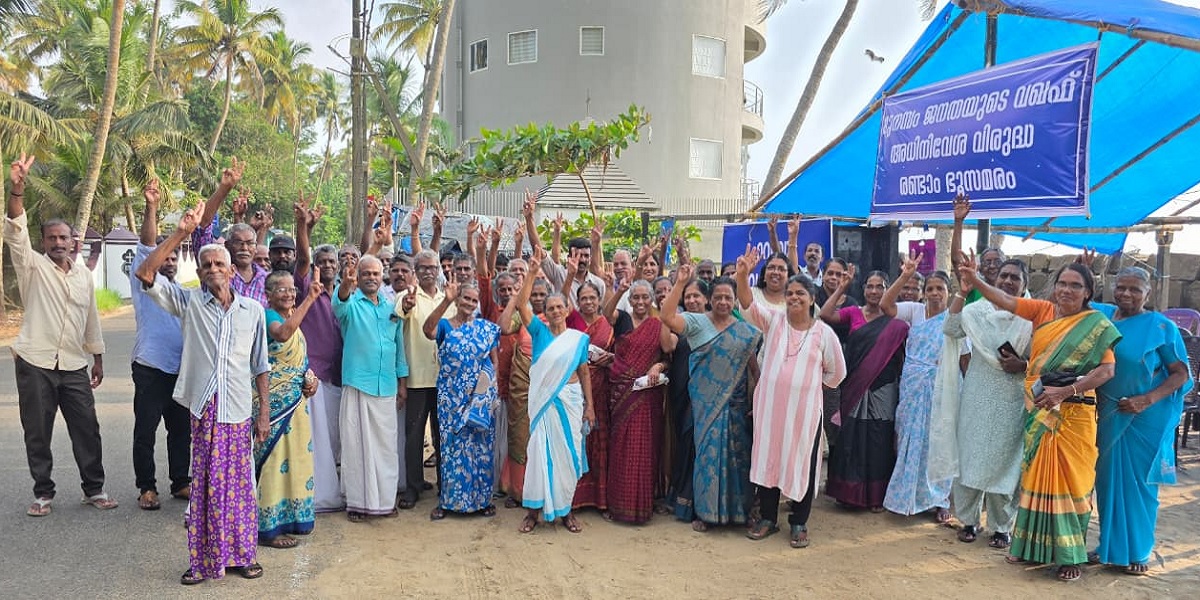
Another group led by parish priest Fr Francis Thaniyath from Kottapuram diocese resumed the agitation outside the same church.
Synopsis: A section of residents insisted that the temporary restoration of revenue rights was inadequate, deepening the divide in the long-running Munambam land dispute involving the Kerala State Waqf Board. They said the right to pay land tax alone does not amount to full restoration of revenue rights.
An eerie quietness enveloped the Velankanni Matha Church in Munambam, even as other churches in Kerala began decking themselves out to welcome Christmas.
The courtyard that should have been glowing with festive colours is instead lined with posters, placards and clusters of people refusing to leave — a reminder that not everyone is ready to celebrate.
Here, where a 414-day relay hunger strike recently ended, a new round of agitation has begun.
A section of residents insisted that the temporary restoration of revenue rights was inadequate, deepening the divide in the long-running Munambam land dispute involving the Kerala State Waqf Board.
The Munambam land protection council had called off its extended relay hunger strike last week after the Kerala High Court’s 26 November order permitted the State to accept land tax from residents.
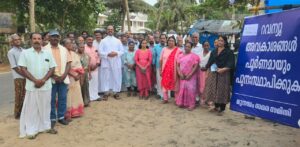
The group led by parish priest Fr Francis Thaniyath from Kottapuram diocese.
Ministers K Rajan and P Rajeeve attended the event at Velankanni Matha Church and assured families that the government stood firmly with them.
But within hours, another group led by parish priest Fr Francis Thaniyath from Kottapuram diocese resumed the agitation outside the same church. Their argument: the right to pay land tax alone does not amount to full restoration of revenue rights.
Speaking to South First, Philip Joseph, Minority Morcha leader and a key figure in the renewed stir, said, ‘’Tax collection is only the first step. People need the right to sell, buy or transfer their land. That is possible only if residential properties are removed from the Waqf Board’s asset list.”
This group insisted on continuing the protest until complete mutation rights have been secured and the land officially freed from the Waqf registry.
The dispute is decades old. The Waqf Board claimed that 404 acres along the Munambam coast constituted waqf property based on a 1950 deed executed by trader Mohammed Siddique Sait in favour of Farook College.

Residents of Munambam gathered in front of Velankanni Church.
But the land has been the home of nearly 600 families for generations — most belonging to the Latin Catholic and backward Hindu communities. Over the years, Farook College sold land to residents without mentioning the waqf link. Courts upheld the college’s authority in the 1970s. Commercial activities also commenced and thrived on the land.
The conflict reignited in 2019 when the Waqf Board declared the area as waqf property following the recommendations of a state inquiry commission. Since then, multiple petitions, commissions, and political interventions have shaped the narrative.
The issue gained national attention during the debate around the Waqf Amendment Bill earlier this year.
The turning point came on 26 November 2025, when the High Court permitted the Revenue Department to accept land tax until the dispute is fully adjudicated. This interim relief was crucial for hundreds of families who were unable to carry out even basic transactions because their revenue rights were frozen.
Copy of directive by Ernakulam District Collector G Priyanka
The Munambam Land Protection Council viewed it as a significant victory. Convenor Joseph Benny said the order brought the much-needed breathing space to the affected families, many of whom had been denied revenue rights for four years.
Subsequently, the Ernakulam District Collector G Priyanka issued a directive on 2 December instructing the Tahsildar and Village Officer to ensure proper surveying, prevent unlawful possession, and strictly follow legal procedures.
The order, based on existing land records and ongoing court matters, was intended to ensure compliance with the High Court ruling.
However, those continuing the protest argued that the Collector’s directive had not clarified the pathway to full mutation or the removal of the land from the Waqf registry.
Amid the renewed agitation, former Munambam land protection council chief Joseph Rockey Palakkal said that several claims circulating among residents were ”being distorted to create fear.
*The High Court’s 26 November order correctly allows temporary land tax collection, benefitting over 600 families. The District Collector’s 2 December order is not an act of defiance but an administrative step to implement the court directive,” he said.
The High Court’s Division Bench judgement of 10 October had clearly stated that Munambam land was not waqf property.
Meanwhile, the Advocate General had sought the court’s permission to resume land tax collection. The next crucial hearing has been scheduled for 17 December, and the Waqf Protection Forum has already moved the Supreme Court.
Palakkal emphasised that the interim relief was genuine and substantial, sufficient to end the 414-day protest. He dismissed allegations that the State acted with political motives or in violation of legal procedure.
The core disagreement now centres on the demand for full revenue rights.
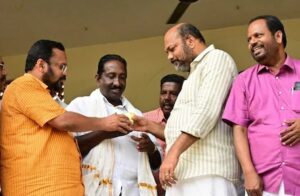
Ministers K Rajan and P Rajeev attended the event at Velankanni Matha Church and assured families that the government stood firmly with them.
One group, which ended the protest, expressed belief that the High Court’s interim order offered sufficient stability for families until the final verdict, arguing that the government had already taken steps—such as approving the Ramachandran Nair Commission report—to secure residents’ future, and that prolonging the agitation may even weaken their legal position.
The group that restarted the protest, however, argued that without land mutation, property transactions would remain frozen and families could not sell land, access bank loans, or legally transfer property to their heirs. As long as the land stayed under the Waqf registry, the threat of renewed litigation persisted, they said.
To them, the temporary order was not a settlement but a pause, and the struggle must continue. The disagreement has created deep emotional tension within a community that once stood united behind a single cause.
Meanwhile, Revenue Minister Rajan reiterated that the High Court had not issued any directive preventing land mutation and that the process could proceed smoothly.
Law Minister Rajeeve pledged the State’s support to residents and said that the Chief Minister had already assured the protest committee of full cooperation.
The Cabinet approval of the Ramachandran Nair Commission report — which recommended acquisition in favour of residents if needed — has been viewed as a major commitment.
But until the courts delivered a final judgment, ambiguity would continue to fuel anxiety.
At Velankanni Matha Church, preparations for Christmas have been replaced by meetings, loudspeakers, and protest camps.
Elderly residents sat on mats with placards. Youngsters distributed leaflets instead of hanging stars. The community, which once celebrated the season together, has been divided over strategy and trust.
The festive silence at the church has become a symbol of a larger truth: temporary relief has not brought lasting peace.
Munambam finds itself at a delicate crossroads. The High Court’s interim relief has eased immediate pressure, but the future of revenue rights — and the question of whether these lands will ever be removed from the Waqf registry — remains unresolved.
With a Supreme Court petition pending and the next High Court hearing on 17 December, the legal battle is far from over.
Meanwhile, residents face a fractured social landscape just as the rest of Kochi lights up for Christmas.
For the people of Munambam, the season of hope arrives with uncertainty — and for now, the lights at Velankanni Matha Church will have to wait.
(Edited by Majnu Babu).


