

Published Aug 11, 2026 | 11:04 AM ⚊ Updated Sep 15, 2026 | 11:43 AM

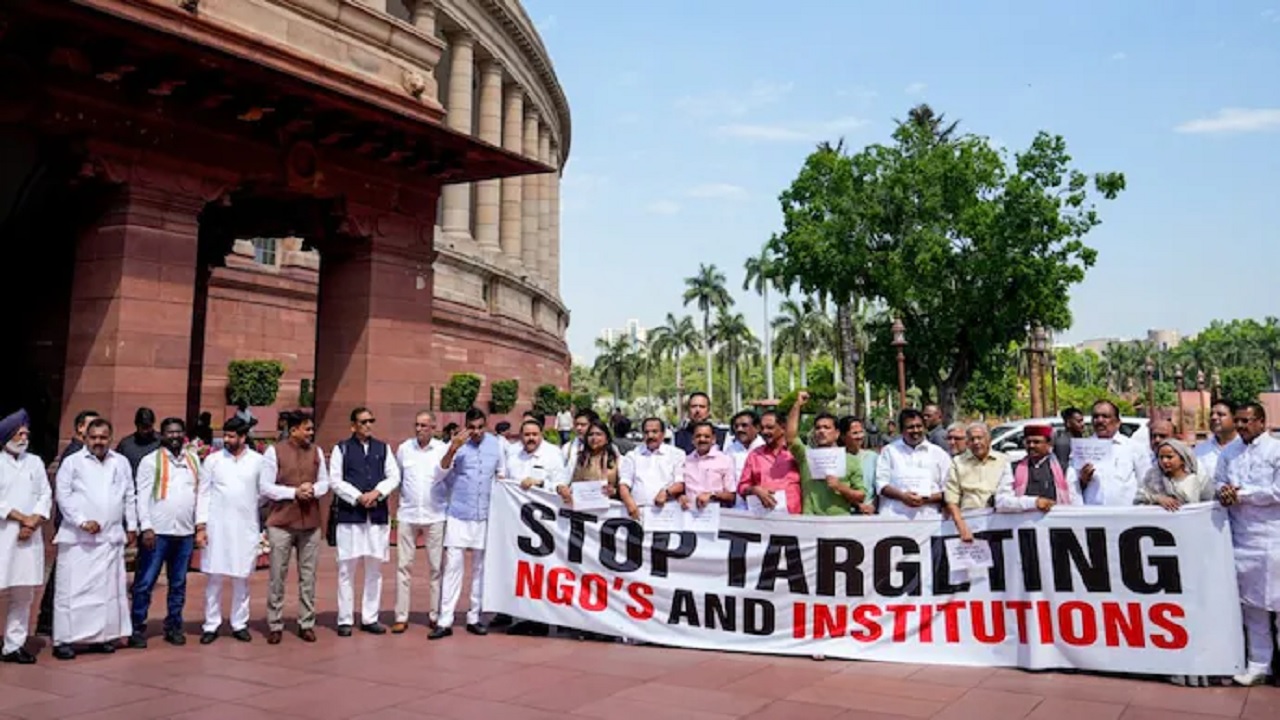
Opposition MPs staging a protest against the proposed FCRA Bill in New Delhi.

Synopsis: The proposed FCRA Amendment Bill, 2026, is a move to improve transparency and accountability in foreign funding. But the proposed changes have raised concerns among NGOs, minority organisations, and Christian groups, particularly about what could happen to assets if an organisation’s FCRA registration is cancelled, surrendered, expires, or is not renewed. Why the law matters to India’s voluntary sector, how the proposed asset-vesting mechanism could affect organisations that have relied on foreign funding in the past and why critics fear it could disrupt schools, hospitals, charities and grassroots services.
Indravati (name changed), a tribal single mother in Chhattisgarh’s Narayanpur district, is raising four children, aged four to 12. She works as a helper at a Christian congregation but is neither Christian nor involved in its religious practices. She remains firmly rooted in her Gonda tribal beliefs.
With school fees beyond her means, Indravati relies on a church-run organisation that provides her children free education. The support has helped her to keep them in school and provide them opportunities that might otherwise have remained out of reach.
Her story is one among many.
Across India, lakhs of families depend on voluntary organisations, community groups and religious charities for education, healthcare, livelihoods and other basic services.
Christian organisations have a long presence in remote and tribal areas where government services are often limited. However, their service is often misunderstood and their volunteers targeted.
Sister Rani Maria from Kerala was killed decades ago after being stabbed 54 times in a jungle area near Udainagar, Madhya Pradesh, allegedly over her work organising village women into self-help groups. Attacks on nuns and priests continue even today.
Their work spans schools, hospitals, nutrition, disaster relief, women’s welfare, employment and community development.
This is where the debate over the Foreign Contribution (Regulation) Amendment Bill, 2026, becomes important.
At the heart of the controversy is a question that goes beyond foreign donations: what happens to organisations and the assets they built with foreign contributions when their FCRA registration is cancelled, surrendered, expires or is not renewed?
Also Read: Kerala Assembly adopts anti-FCRA amendment resolution
The Foreign Contribution (Regulation) Act regulates how overseas contributions, including grants and donations, can be received and used by individuals, associations and companies in India.

A church-run school in Kabir Nagar, Chhattisgarh
Its stated purpose is to ensure that foreign money is not diverted towards activities considered harmful to national interest.
India first introduced an FCRA framework in 1976. FCRA, 2010, replaced it.
The earlier system did not place a time limit on registration. The 2010 law introduced a five-year registration period, which organisations have to renew, while also providing a route for prior permission for entities seeking foreign contributions for a specific purpose.
In simple terms, an organisation that wants to receive foreign donations for activities such as education, healthcare, humanitarian relief or research has to comply with the FCRA framework. It must be registered or obtain permission in advance, receive the money through the prescribed banking system, maintain records and report how the funds were used.
The FCRA does not prohibit foreign charity or international grants. The government argues that the issue is how such money is received, accounted for and spent.
The scale of the foreign-funded voluntary sector is significant.
According to data cited by the Ministry of Home Affairs, 13,520 organisations received ₹55,741 crore in foreign contributions between 2019 and 2022. The FCRA portal showed 14,449 active FCRA certificates as of 15 July 2026.
At the same time, 22,498 certificates had been cancelled, and 15,212 were listed as expired.
For an organisation running a school, hospital, shelter or community programme, losing foreign funds can affect its ability to operate.
The FCRA has been amended several times since 2010, including changes made in 2016, 2018 and 2020.
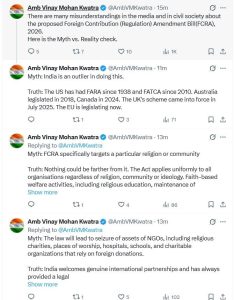
Kwatra’s X posts on FCRA
The government presents the proposed 2026 Bill and accompanying rules as another step towards transparency, clarity and administrative oversight.
India’s Ambassador to the US, Vinay Mohan Kwatra, has argued that the proposed changes should not be understood as an attempt to stop foreign funding to Indian organisations.
According to him, regulating foreign financial flows is a sovereign responsibility and is linked to transparency and national security.
Kwatra has also pointed to other democracies that regulate foreign financial activity.
He cited the US Foreign Agents Registration Act and Foreign Account Tax Compliance Act, as well as legislation introduced in Australia, Canada and the UK. The European Union is also developing rules in this area.
In X posts, he rejected the argument that the proposed framework specifically targets religious organisations. He said faith-based welfare activities, including religious education, maintenance of places of worship and charitable work, remain eligible for foreign funding as long as organisations comply with the law.
Kwatra also cited government figures showing that foreign contributions received by registered organisations increased from about $1.2 billion in 2010-11 to $2.67 billion in 2024-25.
He noted that India has more than three million NGOs, while only about 14,450 organisations currently have FCRA registration.
The government’s argument, therefore, is that FCRA regulation does not prevent civil society organisations from working. Rather, organisations receiving foreign contributions must follow a particular regulatory system.
But the question is not only whether organisations can receive money. It is also what happens to organisations when they lose their FCRA status.
Also Read: Release of Kerala nuns from Chhattisgarh jail likely soon
Under the existing law, property or foreign contribution held by an organisation can come under government control following cancellation or surrender of its registration. The government has argued that this principle is not new and dates back to 2010.
The proposed framework seeks to establish a Designated Authority to take over, manage and dispose of assets of organisations whose FCRA registration has been cancelled, surrendered or has ceased.
The government says this mechanism is intended to protect such assets.
Kwatra argued that if an organisation subsequently restores its registration, its assets and unused foreign funds could be returned in full.
The proposal also contains a provision concerning places of worship.
If an organisation’s registration is cancelled and property connected to a place of worship is affected, Kwatra said the property would be transferred to another FCRA-registered organisation of the same faith so that worship can continue.
Supreme Court lawyer Babila Ummar Khan told South First that the concern is not limited to organisations that have been found guilty of wrongdoing. It also extends to those whose FCRA registration lapses just because they no longer renew it.
She explained this with the example of a charitable healthcare organisation that receives foreign contributions and uses them to construct a hospital. Years later, if the organisation stops receiving foreign funding and begins running the hospital entirely on domestic donations and other resources, it may choose not to renew its FCRA registration.
”Under the proposed framework, such an organisation could still face the risk of losing assets that were created using foreign contributions in the past,” Khan said. ”If those assets are treated as having been created from foreign contributions, they could vest in the Designated Authority, which would have the power to manage, transfer or dispose of them.”
According to her, this raises a fundamental concern about whether organisations would have a clear and straightforward way to exit the FCRA regime while retaining assets that were legitimately created with foreign funding.
”In effect, an organisation that no longer depends on foreign contributions may still have to maintain its FCRA registration and remain within the regulatory framework to protect assets that were created using foreign contributions in the past,” she said.
The proposed framework becomes particularly significant when an FCRA certificate is not renewed.
The FCRA registration is normally valid for five years.
If an organisation does not renew it, the certificate is treated as having ceased. The proposed Bill would link such cessation to the vesting of assets with the Designated Authority.
This has raised concerns about organisations that are otherwise functioning normally.
The 2026 FCRA Amendment Rules also propose that, for renewal, an organisation would be considered to have undertaken reasonable activity in its chosen field if it has used at least ₹10 lakh of foreign contribution during the previous two financial years.
This could create a difficult situation for smaller organisations.
Imagine a rural organisation that received foreign money to establish a library costing ₹30 lakh. The library now operates at an annual cost of around ₹5 lakh. The organisation receives foreign funding only according to its actual needs. If it receives less than ₹ 10 lakh over two financial years, questions could arise over renewal.
The organisation may be perfectly capable of continuing the library using domestic donations. But if its FCRA registration is not renewed, the assets created from foreign contributions could potentially come under the proposed asset-vesting mechanism.
The proposal could create a situation where organisations that have moved away from foreign funding are nevertheless compelled to remain within the FCRA system to protect their existing assets.
Khan pointed to another concern: appeal and hearing rights.
The existing Act provides avenues to challenge cancellation of an FCRA certificate and certain confiscation orders, including an appeal to the relevant high court. However, the law does not provide an equivalent appeal mechanism when the government refuses to renew a certificate.
“The proposed Bill treats a denied renewal as cessation of the certificate. If cessation results in assets being transferred to the Designated Authority, an organisation could therefore lose assets without the same hearing and appeal safeguards available in cancellation proceedings. This is one of the most serious gaps in the proposal,” Khan told South First.
Amid growing concerns among Christian organisations over the Bill, Union Home Minister Amit Shah held meetings with two delegations, including representatives of various Christian denominations and communities. While Shah assured them that the proposed legislation was ”religion-neutral” church groups in Kerala said the assurance has so far remained largely rhetorical.
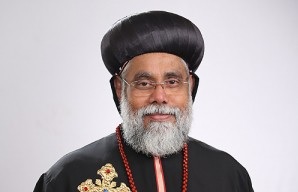
H.G. Dr Yuhanon Mar Meletius Metropolitan
H.G. Dr Yuhanon Mar Meletius Metropolitan of the Malankara Orthodox Syrian Church told South First that, ”This is a straightforward loot and theft of the Christian institutions and their properties through a legal amendment of a bill. If this law is passed, this will be the legalised loot of the global Christian community.”
He argued that the proposed law is part of a broader attempt to take control of Christian institutions after years of FCRA cancellations and non-renewals. He also said some church-run NGOs had already shut down and been unable to continue after failing to secure renewal despite repeated requests.
”Even before passing it, a few NGOs of our church have already closed and didn’t get renewal for continuation even after repeated requests; we didn’t even get a proper reply from the Centre,” he said.
Aji Puthiyaparambil, a Syro-Malabar Catholic priest from the Thamarassery diocese, also told South First that, ”This is not merely an attack against Christians; it’s against the minority and poor. We are not opposing transparency; we already have that, but taking up institutions may lead to another level of harassment against minorities.”
Christian organisations pointed to the impact of earlier FCRA actions.
Since 2014, more than 20,000 FCRA registrations have reportedly been cancelled or not renewed. They said the enforcement has disproportionately affected sections of the Christian voluntary sector.
Organisations including the Evangelical Fellowship of India, Church Auxiliary for Social Action, World Vision India and Compassion International have already faced FCRA-related restrictions.
Compassion International lost its FCRA registration in 2017 and subsequently left India, ending support for hundreds of churches and programmes that it said reached around 1,47,000 babies, children, young adults and mothers.
Other changes have also increased the compliance burden.
FCRA organisations are required to route foreign contributions through the designated State Bank of India branch in New Delhi. In contrast, the permitted share of foreign contributions that can be used for administrative expenses was reduced from 50% to 20%.
Organisations are also restricted from transferring foreign contributions to other entities that are not registered under FCRA.
For large organisations, these requirements may be manageable. For smaller grassroots groups, they can become a major operational burden.
AICC general secretary KC Venugopal called the proposed legislation “unconstitutional,” “anti-people,” and an “anti-Constitution Bill,” arguing that it could financially weaken voluntary organisations, NGOs, and minority institutions.
He has said the Opposition will strongly resist the Bill in Parliament.
Speaking to South First, Biju Kumar, a BJP activist from Ernakulam, alleged that Christian missionaries in Kerala, particularly those working in India’s tribal areas, are using the FCRA as a means to facilitate religious conversion.
He said the BJP’s Ghar Wapsi campaign seeks to bring tribal communities back to Hinduism.
But the experience of people like Indravati complicates that claim.
For many tribal communities, the question is not simply whether they are Christian or Hindu. Their identity is deeply rooted in their tribe and indigenous forms of worship- practices that often predate and exist outside the framework of organised religion.
H.G. Dr Yuhanon Mar Meletius, Metropolitan, points to another reality- Christians account for only around 2% of India’s population. ”If conversion was our target” he asked, ”what is the rate of conversion?”
For families like Indravati’s, the debate over the Bill is about whether a school continues to function, whether her children can remain in the classroom, whether a rural healthcare centre stays open, or whether a community programme can continue.
(Edited by Majnu Babu).



