

Published Apr 16, 2026 | 4:03 PM ⚊ Updated Apr 16, 2026 | 4:03 PM

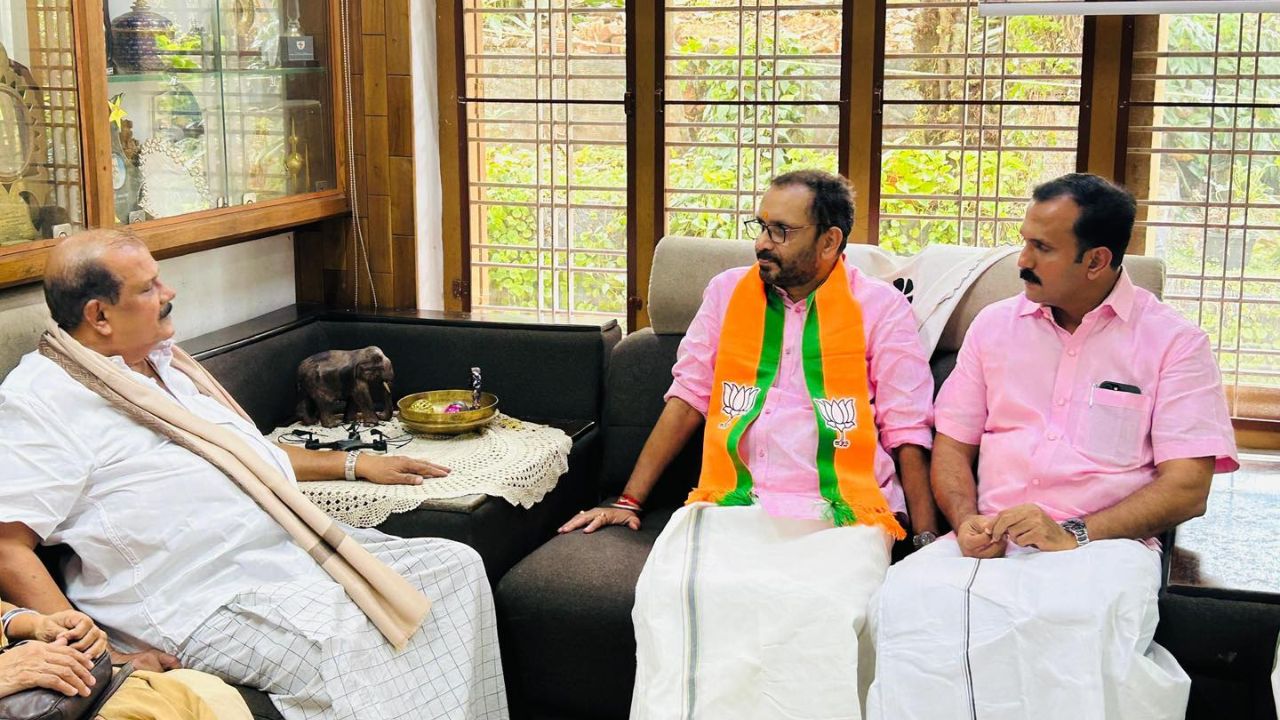
PC George and Shone George with former BJP Kerala president K Surendran.

Synopsis: At a time when the BJP is trying to woo the Christian community in Kerala, two leaders of the party, the father-son duo of PC George and Shone George, have made a dent in the party’s outreach efforts. Speaking of the FCRA, they accused a section of the Christian clergy of supporting organisations engaged in irregular or unlawful activities and straying into partisan politics. The remarks have upset the Church and the BJP is engaged in efforts to reduce its effect.
In Kerala’s central Travancore belt, politics and the Church rarely move on separate tracks. It was against this backdrop that a father-son duo stirred a controversy.
The timing could not have been worse for the BJP in Kerala. Just as the party appeared to be making incremental, carefully calibrated inroads into central Travancore’s influential Christian belt, the controversy hit.
At the centre of it stood a father and son — PC George and Shone George — whose sharp, unrestrained remarks have now left the BJP navigating an uncomfortable phase in its carefully calibrated outreach to Kerala’s Christian community.
What might have remained a policy disagreement over amendments to the Foreign Contribution (Regulation) Act (FCRA) instead grew into a wider confrontation, touching on political loyalty, religious authority and the limits of public speech. In the process, it exposed both the possibilities and the fragility of the BJP’s attempts to expand its footprint among Christian voters in the state.
Also Read: KC Venugopal eyeing Kerala CM chair?
The immediate trigger came on 25 March, when the Union government introduced the proposed amendment to the FCRA framework in the Lok Sabha. The Bill, piloted by Minister of State for Home Affairs Nityanand Rai, sought to tighten oversight on foreign contributions.
Among its more contentious provisions was the idea that assets raised by foreign funds could be under government control if an organisation lost its registration.
In Kerala, where churches run a vast network of schools, hospitals and charitable institutions — several of them historically supported by overseas donations — the proposal was read with caution. Church bodies did not wait long to react. The Kerala Catholic Bishops’ Council raised concerns, and senior leaders, including Cardinal Baselios Cleemis, publicly urged the Union government to reconsider provisions that could, in their view, place undue pressure on minority institutions.
The timing made matters more sensitive.
With the Assembly elections days away, political parties were acutely aware of the electoral weight carried by Christian voters in constituencies across Kottayam, Pathanamthitta and Ernakulam districts.
The Bill was eventually dropped from the immediate parliamentary agenda. Officially, it was described as a move to avoid disruptions during a politically charged period. Unofficially, many saw it as a pause prompted by the pushback.
It was in this atmosphere that Shone George stepped in, attempting to calm nerves. On 30 March, he argued that the proposed amendments were not aimed at churches but at organisations engaged in irregular or unlawful activities. Institutions that maintained proper accounts, he said, had nothing to worry about.
That line, however, did not settle the matter. Within days, his father struck a very different tone.
On 1 April, PC George accused sections of the clergy of straying into partisan politics. He suggested that some bishops were implicitly backing the Congress-led UDF and dismissed their concerns over the Bill as politically motivated.
His remarks did not stop there. By questioning the demographic weight of Christians and linking their position in India to what he described as the BJP’s generosity, he triggered criticism that cut across political lines.
What had been a policy debate was beginning to acquire a sharper edge.
Also Read: Where are the final figures? Kerala’s final poll data delay sparks row
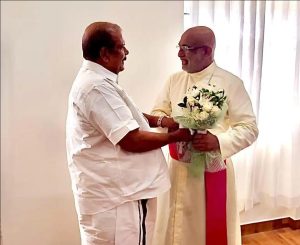
P C George with Major Archbishop Mar Raphael Thattil.
If the days leading up to polling were marked by tension, the day after voting saw an outright rupture.
On 10 April, PC George launched a blistering attack on the leadership of the Kanjirappally diocese.
He alleged that the bishop had instructed nuns to vote for the UDF candidate — an accusation that immediately drew attention for both its seriousness and its lack of substantiation. He questioned why Church institutions appeared uneasy about financial scrutiny and used language that many found needlessly provocative.
His criticism extended to Deepika, the Church-run Malayalam daily, which he accused of deliberately sidelining him in its coverage. The tone of his remarks — dismissive and, at points, openly derisive — quickly became the focal point of the controversy.
Shone George, who had until then tried to project a conciliatory approach, did little to soften the impact.
He echoed concerns about the Church’s political positioning and suggested that if the institution viewed the BJP as dispensable, the party (BJP) might reciprocate that stance.
He also pointed out that BJP leaders had intervened to address Church concerns about the FCRA amendments, only to receive what he described as indifference in return.
The shift from reassurance to confrontation was complete.
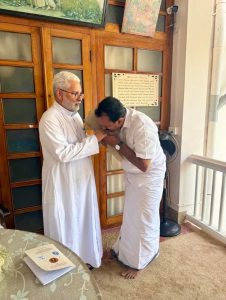
Shone George with Pala Bishop Mar Joseph Kallarangatt
The response from the Church was measured at first, but firm.
On 11 April, Deepika carried a strongly worded editorial that avoided naming individuals but left little doubt about its target.
It criticised “political opportunists” and warned against attempts to silence voices raising legitimate concerns. Drawing on a historical anecdote involving global leaders, it made clear that intimidation — real or perceived — would not alter its stance.
A day later, the tone hardened further.
Speaking at a public gathering, Mar Joseph Kallarangatt, the Bishop of Pala, delivered what was widely seen as a direct rebuttal.
Without naming the Georges, he cautioned those in public life against using disrespectful language when referring to religious leaders. The emphasis was not merely on disagreement but on decorum.
He also addressed the broader question that lay beneath the controversy: Whether clergy should remain politically neutral.
His answer was unambiguous. Neutrality, he suggested, could render the Church irrelevant in public discourse.
Religious leaders, he argued, had both the right and the responsibility to speak openly on issues that concerned their community. At the same time, he rejected the idea of covert political canvassing, insisting that any engagement would be transparent.
The message was clear — criticism could be engaged with, but not if it crossed into what the Church viewed as intimidation.
For the BJP in Kerala, the episode could not have come at a worse time. The party has spent years trying to build bridges with Christian communities, particularly in central Travancore.
That effort has included outreach on issues ranging from minority scholarships to land concerns, as well as attempts to position itself as an ally rather than an adversary.
The Georges, with their longstanding connections in the region and within sections of the Christian community, were seen as part of that strategy.
Now, their remarks threatened to undercut it. Within the party, there was visible discomfort.
While the state leadership stopped short of openly criticising the father-son duo, it neither fully endorses their statements.
The ambiguity reflected a larger dilemma: Distancing itself too sharply could alienate a section of its own support base, while backing the remarks risked deepening mistrust with Church leaders.
Leaders within the BJP across central Travancore are speaking in a noticeably subdued tone, weighing their words even in private conversations.
Many admit that the unease over the proposed FCRA changes had already made this election cycle more delicate than usual, particularly in constituencies where Church influence is decisive.
A senior district office-bearer from Kottayam, who has been involved in the party’s outreach among Christian groups for several years, said the timing could not have been worse.
“There was already confusion among people about the Bill. Even though it was explained, doubts remained. In that situation, such remarks only complicate things. We were just beginning to build some trust,” the leader told South First.
Another functionary, who has been part of the BJP’s minority outreach programmes, said, “The FCRA issue itself created anxiety. We were trying to reassure people that institutions following the rules have nothing to fear. Now, with this kind of language entering the debate, it sends a mixed message. It becomes harder to convince anyone.”
At the same time, few are willing to openly criticise PC George or Shone George on record. The hesitation reflects both political calculation and the Georges’ local influence.
“They have their own support base and history with the community,” one leader said carefully. “But the language could have been avoided. That is what many of us feel.”
Meanwhile, the BJP leadership has moved quietly to contain the fallout. At a core committee meeting, convened on 14 April, the party is understood to have asked both PC George and Shone George to refrain from further public remarks and to effectively draw the line under the controversy.
Sources indicated that the issue was brought up during the meeting by Anoop Antony, the BJP state general secretary and NDA candidate from Thiruvalla, who is learnt to have flagged the potential political costs of allowing the matter to escalate further.
Opposition parties wasted little time in seizing the moment. Leaders from the Congress and Kerala Congress (M) accused the BJP of revealing its “true face” on minority issues.
Senior Congress leader VD Satheesan condemned the language used against the clergy, while KC(M) chief Jose K Mani warned against politicising a sensitive issue like foreign funding.
The controversy had moved beyond a bilateral dispute. It is now a political talking point.
Few politicians in Kerala have moved across alliances as restlessly — or as dramatically — as PC George.
His career has been shaped as much by shifting political equations as by his own unfiltered, often confrontational style that kept both allies and rivals on edge. Before his brushes with the BJP-led NDA, he was deeply embedded in the Congress-led UDF.
He held the influential post of Government Chief Whip during the tenure of Chief Minister Oommen Chandy, a position that placed him at the centre of legislative management and coalition coordination. Even then, trouble was never far away.
PC George’s public criticism of the government, particularly during the solar scam controversy in 2013, rattled the UDF from within. He openly targeted Chandy, at one point demanding his resignation and alleging complicity — a rare instance of a senior functionary turning against his own leadership so sharply.
His political friction was not limited to the Congress. Within the Kerala Congress factions, George’s long-running feud with KM Mani proved decisive.
By 2015, the relationship had deteriorated beyond repair. Mani, then the finance minister and a dominant force in Kerala Congress (M), pushed to strip George of key positions, including that of Chief Whip. George’s removal in March that year only formalised what had already become an untenable arrangement.
The split had deeper roots. George had earlier navigated multiple mergers and breakaways within the Kerala Congress family.
After differences with Thodupuzha MLA PJ Joseph, he carved out space for himself, eventually merging his faction with Kerala Congress (M) in 2009 — a move that restored his relevance.
But the later merger involving Joseph altered internal dynamics, leaving George increasingly isolated. By 2015, he walked out.
In a dramatic move, he resigned from the Assembly, handing over his letter directly to the then-Speaker N Sakthan and insisting it take immediate effect. The resignation came amid his sustained campaign demanding Mani’s exit over corruption allegations.
That year also saw him briefly align with the LDF during local body elections, where his outfit managed notable gains. Yet, even as he explored new equations, legal complications followed.
The Kerala High Court later struck down the Speaker’s order disqualifying him under the anti-defection law, while also nullifying his resignation — effectively restoring his status as an MLA linked to Kerala Congress (M), at least on paper. In 2016, George chose to resign again, this time positioning it as a moral decision ahead of the Assembly elections.
Contesting from Poonjar as an independent after being denied entry into the LDF, he took on candidates from all three major fronts — UDF, LDF and NDA — and won with a commanding margin of 27,821 votes. His vote tally climbed from 59,809 in 2011 to 63,621, underlining his personal hold over the constituency.
The next phase of his journey saw a gradual shift towards the BJP.
In 2018, during the Sabarimala protests, PC George appeared in the Assembly alongside BJP leader O Rajagopal, both dressed in black, associated with Ayyappa devotees, signalling a shared political position against the state government’s handling of the issue.
By 2019, his party, Kerala Janapaksham (Secular), formally entered the BJP-led NDA.
George cited the Union government’s approach to the rubber sector and a commitment to protecting religious faith as reasons for the move.
The association, however, proved short-lived. Within the same year, his party walked out, accusing the NDA of failing to uphold secularism and protect minority interests. The distance did not last long.
In 2023, George announced a return to the NDA fold ahead of the Lok Sabha elections, marking yet another turn in a career defined by reversals and recalibrations.
His party endorsed the leadership of Narendra Modi, praising the Union government’s developmental agenda. Across decades, George’s trajectory has rarely followed a straight line.
Alliances have shifted, positions have changed, but one constant remains — a political style that thrives on confrontation, often unsettling the very platforms he occupies.
Also Read: One turnout, three narratives: Why Kerala’s voter surge complicates predictions
Coming back to the recent controversy, the Georges relied heavily on past episodes to defend their position.
Shone George pointed to the 2021 controversy surrounding remarks by the Pala Bishop on “love jihad” and “narcotic jihad”.
At the time, he noted, the bishop had faced criticism from both the Left and the Congress, while the BJP and leaders like his father had stood by him. That memory, he argued, should count for something.
He also raised questions about why political parties that were now supporting the Church had not acted on its concerns in earlier legislative matters. The implication was that the BJP’s engagement had been more substantive, even if it was not always acknowledged.
For the Church, however, the issue at hand was not a ledger of past support. It was about the tone and substance of the present criticism.
By 14 April, there were signs that the temperature needed to be lowered.
Shone George met Mar Raphael Thattil, the head of the Syro-Malabar Church, in what was widely seen as an effort to reopen dialogue. After the meeting, he spoke of plans to facilitate discussions between Church representatives and the central leadership, including Prime Minister Narendra Modi and Union Minister of Minority Affairs Kiren Rijiju.
He reiterated that the proposed amendments were not targeted at Christians and applied uniformly across organisations. He also pointed out that some of the provisions being criticised had origins in earlier legislative changes.
The emphasis had shifted back to reassurance.
At the same time, he publicly endorsed Bishop Kallarangatt’s call for openness, suggesting that transparent articulation of positions could, in fact, clarify misunderstandings. It was a notable change in tone, even if it did not immediately resolve the underlying tensions.
Yet, the damage — at least in the short term — is hard to ignore.
At a moment when the BJP sought to present itself as a viable alternative for Christian voters, two of its most visible Christian faces ended up triggering a backlash from the very constituency the party has been courting.
Within the BJP, there is a growing sense of disquiet at how painstakingly built political capital can unravel with startling speed — not under opposition fire, but from within its own ranks.
In this instance, it was a father and son who, perhaps unwittingly, ended up unsettling a strategy the party had crafted with considerable care.
(Edited by Muhammed Fazil.)



