

Published Feb 05, 2026 | 8:00 AM ⚊ Updated Feb 05, 2026 | 8:00 AM

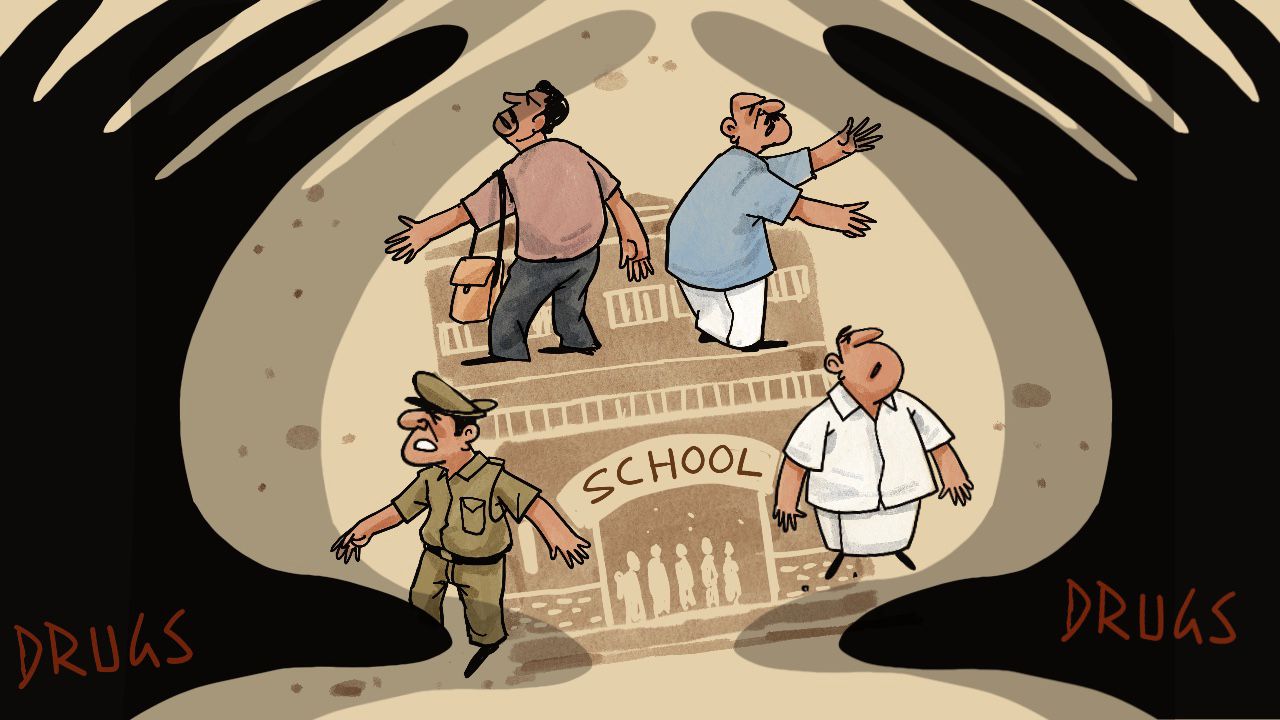
A single, integrated SPG in every school, involving all stakeholders and focused squarely on anti-drug action, is now seen as the way forward.
Synopsis: Kerala has overhauled its School Protection Group system after 14 years, putting in place a single, structured safety mechanism in every school as drug trafficking involving young people becomes more organised and widespread. The new model draws in police, teachers, parents and local residents such as shopkeepers and auto-rickshaw drivers to spot risks early and act before drugs and crime reach classrooms.
Outside Kerala’s schools, a quiet watch is taking shape. The shopkeeper who sees students linger after the final bell, the auto-rickshaw driver who notices unfamiliar faces near the gate and the neighbour who watches children walk home each day are now being pulled into the state’s frontline response to drugs and crime.
As narcotics cases involving young people climb steadily, the government is betting on eyes and ears at ground level to flag trouble before it reaches classrooms. Real-time tips from those who live and work around schools, officials say, could help police step in faster, sometimes within minutes.
This community-led vigilance now forms the backbone of a revamped School Protection Group (SPG) system.
Fourteen years after the idea was first floated as a voluntary initiative, Kerala is rolling out a single, structured protection group in every school. The move replaces scattered and informal bodies with one unified mechanism focused on discipline, safety and anti-drug surveillance.
The rollout is backed by a new standard operating procedure and driven by grim numbers. Tens of thousands of NDPS cases have been recorded over the past decade, many involving young people and schoolchildren. The scale of the problem explains why the state is now looking beyond campus walls to keep classrooms safe.
The Kerala government’s decision to move beyond a 14-year-old police circular and put in place a uniform, state-wide SPG system grew out of both courtroom orders and ground-level realities.
Official records show that momentum for a unified mechanism picked up after a series of directions from the Kerala High Court between July 2025 and January 2026. The court pushed the state to revisit how school safety mechanisms actually work, not just how they exist on paper.
The idea of SPGs is not new. It dates back to 2011, when the then State Police Chief issued a circular saying District Police Chiefs may, wherever feasible, form SPGs in schools.
The effort was clearly voluntary. Schools and individuals were not required to form or join these groups. Their remit was limited to collecting and passing on information on the sale and supply of drugs, narcotics and other illegal activities affecting students.
Fourteen years on, statistics placed on record show a steady rise in such cases over the past decade. This has raised doubts about whether purely informal arrangements are enough.
The state has flagged another problem as well, the presence of multiple bodies such as SPGs, Jagratha Samitis and anti-narcotic clubs, all working informally with overlapping aims. The conclusion was blunt. Fragmentation weakens enforcement.
A single, integrated and formally structured SPG in every school, involving all stakeholders and focused squarely on anti-drug action, is now seen as the way forward.
The state’s decision to tighten and streamline school-level protection mechanisms comes from sobering statistics that show the scale of the drug problem among Kerala’s young people.
Government data show that between 2016 and 20 January 2026, the Excise Department alone registered 48,371 NDPS cases involving youths and schoolchildren. In the same period, the department booked 67,125 NDPS cases in total.
Data from the Kerala Police show that from 2020 to 2025, up to November, 1,30,433 NDPS cases were registered across the state.
Alongside these numbers are growing complaints that drug trafficking networks have entered schools, colleges and hostels, and even shops operating within school and college premises.
A further concern is the shift to digital channels. Since 2016, authorities have detected 16 cases involving drug sales through online platforms, social media and the dark web.
In response, the Excise Department has set up a dedicated cyber cell to track the movement of narcotics, including synthetic and chemical drugs, through platforms such as WhatsApp, Facebook and Instagram, as well as covert online marketplaces.
The statistics, officials admit, leave little room for complacency.
The General Education Department, which rolled out the revamped SPG model, has framed it as the first line of defence against threats ranging from drug abuse to ragging and violence.
Under the new structure, the SPG will be chaired by the head of the institution. The Station House Officer will serve as convener, with the Child Welfare Police Officer or a Designated Police Officer nominated by the Station House Officer acting as joint convener.
The group will have broad representation. Members will include PTA representatives, teachers, School Parliament representatives, SPC, NCC, NSS and Scout and Guides members, reputed retired personnel from the school’s locality, political party representatives, ward members of the local self-government body, and representatives of nearby merchants and auto and van drivers. Officials from various departments and special invitees will also be part of the group.
To widen community participation, shop owners, auto and van drivers and local leaders will act as an extended safety net. As “eyes on the street”, they are expected to stay alert and inform school authorities or police as soon as they notice anything that threatens student safety.
Officials said tackling the drug menace is a key focus. This includes deterring drug mafias, stopping peddling through students and spotting early signs of substance abuse. But the SPG’s mandate goes further. It also covers protection from physical, mental, economic and emotional exploitation, as well as emergency preparedness.
A standard operating procedure issued by the department says the SPG will safeguard students and the school environment by enforcing safety protocols, carrying out risk assessments and training staff and students. The aim is to make schools safer places to learn and develop.
The groups will also play a role in preventing ragging by tightening vigilance, offering clear reporting channels and enforcing a comprehensive anti-ragging policy so that schools remain ragging-free and safe for children.
At the same time, a senior Excise Department official told South First, “Community vigilance is necessary, but we should be careful not to assume it is a substitute for professional enforcement.”
He continued:
“Drug trafficking today is organised, mobile and increasingly digital. While shopkeepers or auto drivers may notice suspicious behaviour, most narcotics cases we detect involve supply chains that operate far beyond the school gate. SPGs can help with early alerts and awareness, but unless this is backed by sustained intelligence gathering, cyber monitoring and coordinated action between police and excise, there is a risk of creating a sense of safety without actually dismantling the networks behind it.”


