

Published Apr 08, 2026 | 8:00 PM ⚊ Updated Apr 08, 2026 | 8:00 PM

LDF feels rebels won't matter. It says personal vote has a ceiling. Beyond that, it’s the front that carries — or doesn't — a candidate.
Synopsis: Kerala’s election battles may spotlight charismatic individuals, but the real contest still runs through party machinery, booth networks, and voter consolidation. Across constituencies, personal appeal can stir the surface, but it rarely shifts the outcome without the weight of an organised political base behind it.
In Kerala, elections rarely turn on a single face. Symbols matter. Networks matter more.
And yet, every election throws up a handful of figures who seem to test that rule—not by abandoning the system, but by leaning hard on something more personal, less scripted. And thus the question: Can individual charisma — detached from party structure — actually move votes in Kerala?
In Nemom, the contest has once again drawn attention for its layered dynamics.

Kerala Education Minister V Sivankutty. (Facebook)
The sitting MLA, V Sivankutty, carries more than just party backing into the fray. His political persona has expanded well beyond traditional cadre politics. His engagement with students, a visible and often informal public presence, and a social media footprint that resonates with younger voters have contributed to making him a distinct personal brand.
There is, undeniably, a warmth attached to his public image. Videos of interactions with schoolchildren circulate widely. His accessibility is often cited by supporters as a differentiator.
But Nemom is also where the limits of such individual appeal become clear.
In 2021, the seat witnessed a tightly fought contest where the Left edged past the BJP in a triangular fight. Even then, independents—despite being present—barely registered, collectively polling under one percent. The decisive factor wasn’t personality. It was a consolidation.
Sivankutty’s popularity matters. It helps energise a base, smoothen edges, and perhaps bring in undecided voters at the margins.
Even today, his appeal — particularly among younger voters — sits atop a much deeper foundation: CPI(M)’s booth-level network, cadre mobilisation, and the broader LDF machinery.
Strip that away, and the question becomes uncomfortable.
The core vote remains anchored in party identity. Nemom doesn’t reward personality in isolation; it rewards personality aligned with machinery.
If Nemom is about testing charisma within a party, Ambalapuzha is about testing it outside — or at least, partially outside.

G Sudhakaran
Here, the spotlight is firmly on G Sudhakaran—a seasoned leader who has stepped away from the CPI(M) fold and entered the fray as an independent, albeit with clear backing from the opposition UDF.
Sudhakaran is no ordinary candidate. His long political career, administrative experience, and deep local connections have given him a stature that transcends routine electoral arithmetic. In political conversations across the constituency, his name is invoked not just with respect, but familiarity.
Yet, this is not a pure test of individualism. The scaffolding beneath his candidacy matters. The UDF’s tacit and organisational support ensures booth-level presence, voter outreach, and election-day mobilisation—elements no independent can replicate alone.
What unfolds here is not a rebellion of personality against party politics. It is a recalibration within it.
The real question in Ambalapuzha isn’t whether Sudhakaran’s charisma can win votes—it almost certainly can. The question is whether it can reorganise them. Whether it can pull enough from the Left’s traditional base while consolidating opposition voters into a single channel.
That is a far steeper climb.
In 2021, Ambalapuzha was comfortably in LDF territory. The margin wasn’t razor-thin. There was no indication that an independent could disrupt the equation.
The year 2026 feels different — but only because this is not individualism in isolation. It is calibrated rebellion.
Move north to Nattika, and the contrast is stark.

CC Mukundan.
CC Mukundan represents a different kind of electoral reality. This is a constituency where voting behaviour has been consistent, almost methodical. Margins have been decisive. The LDF’s organisational depth is visible in every election cycle.
There is little appetite here for disruption driven by personality alone.
In 2021, independents barely registered. Not metaphorically — numerically. Their vote shares hovered at fractions of a percent. The contest was never about them.
Mukundan’s strength lies not in cultivating a personal cult but in aligning seamlessly with the NDA machinery. That alignment matters more than individual flair.
Nattika is not a constituency that lends itself easily to disruption. The organisational depth of the Left, combined with a loyal voter base, creates a stability that individual candidates—no matter how well-regarded—struggle to unsettle.
In Payyannur and Taliparamba, the conversation around individual charisma almost feels misplaced.
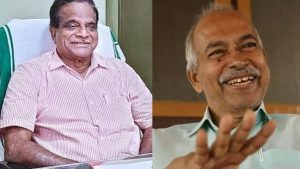
TK Govindan and V Kunhikrishnan
The candidates in focus are V Kunjikrishnan and TK Govindan, who came out of CPI(M) and are contesting from Payyannur and Taliparamba, respectively, with UDF backing.
Kannur’s political culture is not merely partisan. It is deeply ideological. Voting patterns here are shaped by decades of political socialisation, grassroots networks, and an almost inherited alignment to party lines.
Here, the CPI(M)’s presence is not limited to election cycles. It is embedded in everyday life — through networks, local committees, and a long history of ideological consolidation.
Figures associated with the Left in Payyannur and Taliparamba operate within this ecosystem. Their personal credibility matters, but largely as an extension of the party’s credibility.
In 2021, margins here were decisive. Independents polled numbers were so small that they barely entered the narrative.
To expect a personality-driven upset in such constituencies would require a structural collapse of existing loyalties. There is little evidence of such a collapse.
An LDF leader put it with a hint of impatience: “Every election throws up a few faces who believe they can outrun the party system. Some of them have switched sides, some carry new symbols with old loyalties. But Kerala doesn’t vote in fragments like that. Personal vote has a ceiling. Beyond that, it’s the front that carries you — or doesn’t.”
From the UDF camp came a slightly different emphasis, though the caution sounded familiar: “Individual credibility matters, no doubt. A candidate who has moved from another party or is backed by another front may bring along a slice of goodwill. But elections here aren’t decided in isolation. The question is whether that goodwill travels across booths, across panchayats.”
Between those two views lies the quiet uncertainty surrounding such candidates — visible, talked about, occasionally disruptive, but rarely decisive on their own.
(Edited by Majnu Babu).


