

Published Apr 06, 2026 | 8:07 AM ⚊ Updated Apr 06, 2026 | 8:07 AM

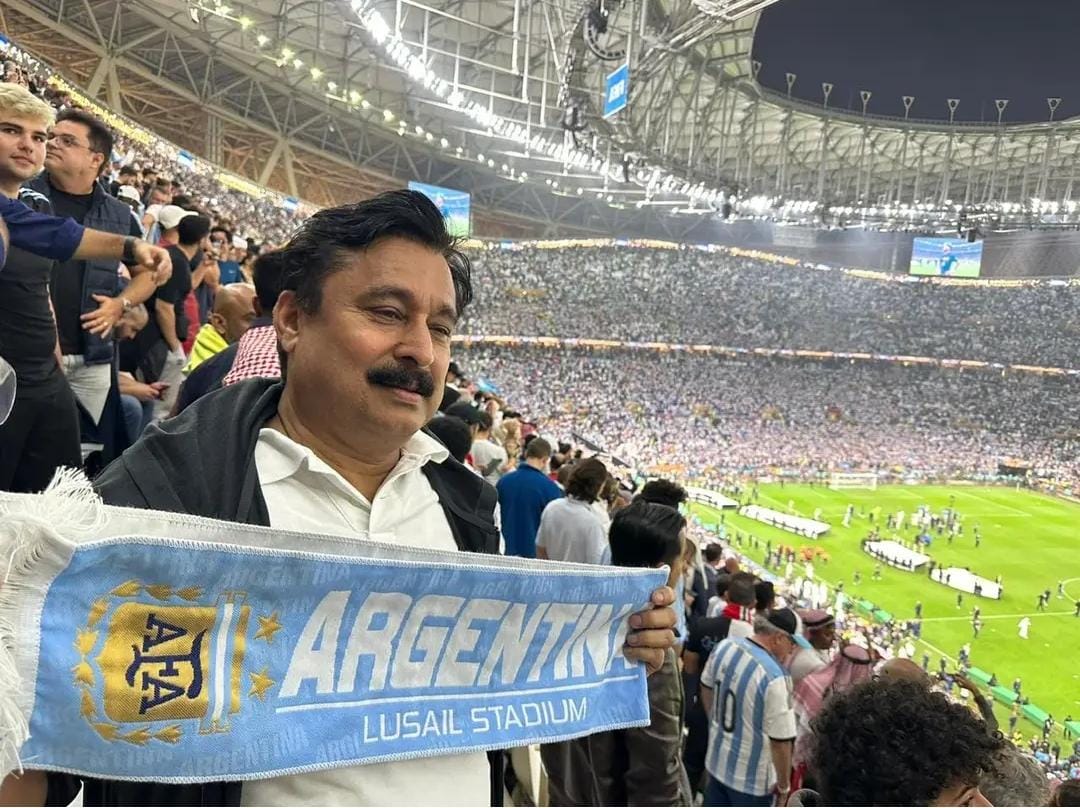
Sports Minister V Abdurahiman at the Lusail Stadium, Qatar during the Qatar FIFA World Cup in 2022.
Synopsis: What began as a grand promise to bring Lionel Messi and Argentina to Kerala has unravelled into a tense pre-poll flashpoint, with Sports Minister V Abdurahiman now alleging betrayal after crores were mobilised and expectations stretched to the brink. As elections near, the narrative has left behind uneasy questions over money, transparency, and whether the spectacle was ever truly within reach.
It was supposed to be a spectacle that would outlive governments — a night when Kerala’s football-mad crowds would finally see their adopted heroes in blue and white stripes, not on television screens or flex boards, but under the floodlights at their own turf in Kochi. Instead, the promise unravelled into a messy, high-stakes controversy, now spilling into the political arena just days before Kerala votes.
At the centre of the storm is Sports Minister V Abdurahiman, who has gone from chief architect of the ambitious plan to bring the Argentina national football team to Kerala, to its most vocal accuser.
His blunt accusation that the Argentina national football team, led by Lionel Messi, or specifically the Argentine Football Association (AFA) “cheated” Kerala has shifted the narrative from missed opportunity to alleged betrayal.
His next step, he says, could be legal action. The timing of that accusation has drawn as much attention as the claim itself.
Speaking during an election campaign in Malappuram on 2 April, Abdurahiman did not mince his words.
He described the episode as a “betrayal,” said Kerala had been “cheated,” and hinted that the only recourse left might be to approach the courts. He spoke of multiple rounds of discussions, of sponsors lining up funds, of expectations built carefully over years — only for the plan to collapse without delivery.
For someone who had repeatedly assured the public that Messi would come, that the visit was only delayed and never cancelled, the shift in tone was unmistakable. This was no longer a delayed event. It was, in his telling, a broken promise by the other side.
Yet, the statement did more than assign blame. It reframed the narrative at a politically sensitive moment.
Those close to him say the outburst was inevitable. For Abdurahiman, this was never just another event on a government calendar. It carried weight — an unspoken understanding with fans who had allowed themselves to believe that the world champions would finally play on their soil. That belief has now crumbled, and with it, the expectations built over months.
He is in the middle of an electoral battle in Tirur, deep inside Malappuram — a territory where Argentina is not just a team, but an obsession. Matches are followed with near-religious intensity, and Lionel Messi is more than a footballer there; he is an emotion woven into everyday conversations. In such a setting, the promise carried consequences far beyond sport.
Now, standing before voters who had bought into that promise, the minister appears to be shifting the frame. The line he is drawing is clear enough: The government did its part, the fans deserved the spectacle, and the breakdown happened somewhere else.
It also serves another purpose. By pushing the blame outward, the move insulates the CPI(M)-led front at a crucial moment. With ballots looming, it blunts what could have turned into a sharper political attack — that of raising hopes it ultimately failed to meet.
The origins of the plan go back to December 2022, immediately after Argentina lifted the FIFA World Cup. Within days, Abdurahiman wrote to the president of the AFA, inviting the national team to visit Kerala.
The letter highlighted the state’s extraordinary support for Argentina during the tournament and pitched Kerala as a natural destination for international friendlies.
The proposal did not remain on paper.
In April 2023, Chief Minister Pinarayi Vijayan met Argentina’s ambassador to India in New Delhi, exploring possibilities for broader football cooperation.
A few months later, Abdurahiman publicly stated that Argentina had shown interest in playing matches in India and Bangladesh, although he criticised the All India Football Federation (AIFF) for not taking the opportunity forward, citing financial constraints.
From that point on, Kerala positioned itself as willing and ready to host the team independently.
By early 2024, discussions appeared to have moved into a more concrete phase. After virtual meetings, the AFA reportedly accepted Kerala’s invitation. The scope extended beyond a single match — there were talks of training exchanges, academies, and even the establishment of a sports institute linked to Calicut University.
A visit in June 2024 was initially considered, but dropped, as the minister’s officer said, due to the monsoon.
In September that year, Abdurahiman and officials travelled to Madrid, Spain, at the invitation of the AFA. The trip, which cost over ₹13 lakh from the state’s Sports Development Fund, was described as a crucial step in firming up the arrangement.
Two months later, the minister made his most definitive announcement yet: Argentina, including Messi, would visit Kerala in 2025 for a FIFA-sanctioned friendly. The venue was expected to be Kochi’s Jawaharlal Nehru Stadium. Funding, he said, would come entirely from private sponsors, with no burden on public finances.
That assurance did not hold steady for long.
The initial sponsor, the Kerala Gold and Silver Merchants’ Association, ran into trouble securing Reserve Bank clearance. Internal disputes surfaced, with rival factions accusing each other of collecting money from members under misleading claims about the event.
The controversy grew, prompting petitions to the Chief Minister’s Office and raising uncomfortable questions about transparency and oversight.
Amid this, a new sponsor stepped in — Reporter Broadcasting Company, led by businessman Anto Augustine. The company claimed it had secured the necessary approvals and was ready to take the project forward.
What followed was a surge of optimism.
By mid-2025, significant payments had reportedly been made to the AFA. The total value of the deal was pegged at around ₹250 crore. The proposed match was projected as a high-profile fixture, potentially featuring Argentina against Australia.
The minister himself took to social media to declare that Messi would indeed come.
The first major setback came in August 2025.
The AFA informed Kerala that it could not accommodate the proposed October–November window due to a packed international calendar. Alternative commitments had already been lined up elsewhere.
A new date — March 2026 — was suggested.
The response from Kerala’s side was far from uniform. The sponsor expressed unwillingness to shift dates, citing financial and logistical implications, and even hinted at legal action. State officials, meanwhile, maintained that the agreement had been breached.
Then came another shocker.
A statement attributed to Leandro Petersen, the Chief Commercial and Marketing Officer of the AFA, began doing the rounds — one that squarely accused the Kerala government of breaching its agreement to host the Argentina national football team led by Lionel Messi.
However, Kerala Sports Minister V Abdurahiman wasn’t buying it.
Despite the uncertainty, public messaging remained cautiously optimistic. The visit, the minister said, was postponed — not cancelled.
Adding to the frustration was the fact that Messi did visit India during the same period, but not Kerala.
In December 2025, he appeared in West Bengal and later in Hyderabad as part of an exhibition tour. At the Rajiv Gandhi International Stadium, alongside Luis Suarez and Rodrigo De Paul, he engaged with fans in a light exhibition setting, drawing massive crowds.
For Kerala’s supporters, the optics were hard to ignore. The team that had been promised to them had found time for appearances elsewhere.
Even as doubts grew, preparations continued.
The Jawaharlal Nehru Stadium in Kochi was handed over for renovation, with reports suggesting that the sponsor had invested heavily in upgrading the facility. Officials from Argentina also visited to inspect the venue.
Yet, when Argentina’s international schedule was announced, Kerala was not on the list. Instead, the team was slated to train in Spain and play elsewhere.
Slowly, yet unmistakably, the truth began to take hold — Messi and his team are unlikely to set foot in Kerala.
With barely six days left for the polls, Abdurahiman on 2 April struck a note of sharp disappointment, alleging that the Argentina national football team had deceived the state by failing to turn up for a much-anticipated match despite receiving payment.
He said efforts to bring the team — along with global icon Lionel Messi — to Kerala were extensive and far from straightforward, involving multiple rounds of talks and the difficult task of mobilising sponsors to raise nearly ₹250 crore.
According to him, expectations collapsed after the payment was made, with the team not honouring its commitment.
When he probed further, he claimed to have learned that similar incidents had occurred in at least five other countries as well, where money was allegedly taken without matches materialising.
The minister indicated that legal options, including seeking compensation, were now under consideration.
The episode, he said, had left football enthusiasts across Kerala disheartened, adding that the sense of letdown was deeply personal as much as it was public.
The minister’s claim that only private sponsors bore financial losses has been challenged.
Former footballer and coach Pramod Kunnumpurath publicly criticised the handling of the project, citing RTI findings that indicate public funds were spent on preliminary efforts, including foreign travel.
He questioned the lack of transparency, asking why agreements and financial transactions have not been made public. If the deal was above board, he argued, there should be no hesitation in disclosing details.
His criticism goes beyond this episode. He pointed to a pattern — ambitious announcements, foreign trips, and initiatives that failed to materialise as promised. He contrasted the large sums discussed for bringing international stars with the struggles faced by Indian athletes, some of whom have had to resort to protests for basic support.
His message is blunt: The narrative of “cheating” should not become a shield against scrutiny.
Opposition parties have seized on the controversy, describing the entire exercise as an election-driven spectacle that lacked proper planning and coordination.
Questions have been raised about the role of the AIFF, the feasibility of securing international fixtures within a crowded calendar, and the transparency of financial arrangements.
There are also concerns about the renovation of the Kochi stadium — its funding, approvals, and the absence of a clear tendering process.
The government, however, maintains that it acted in good faith, that formal agreements were in place, and that the failure lies with the Argentine side.
Abdurahiman has indicated that legal options are being considered. Whether such a case will be pursued — and on what grounds — remains to be seen.
And most importantly, whether voters accept that framing of ‘betrayal’, or see it differently, will be known soon enough.
(Edited by Muhammed Fazil.)


