

Published May 23, 2026 | 5:44 PM ⚊ Updated May 23, 2026 | 5:44 PM

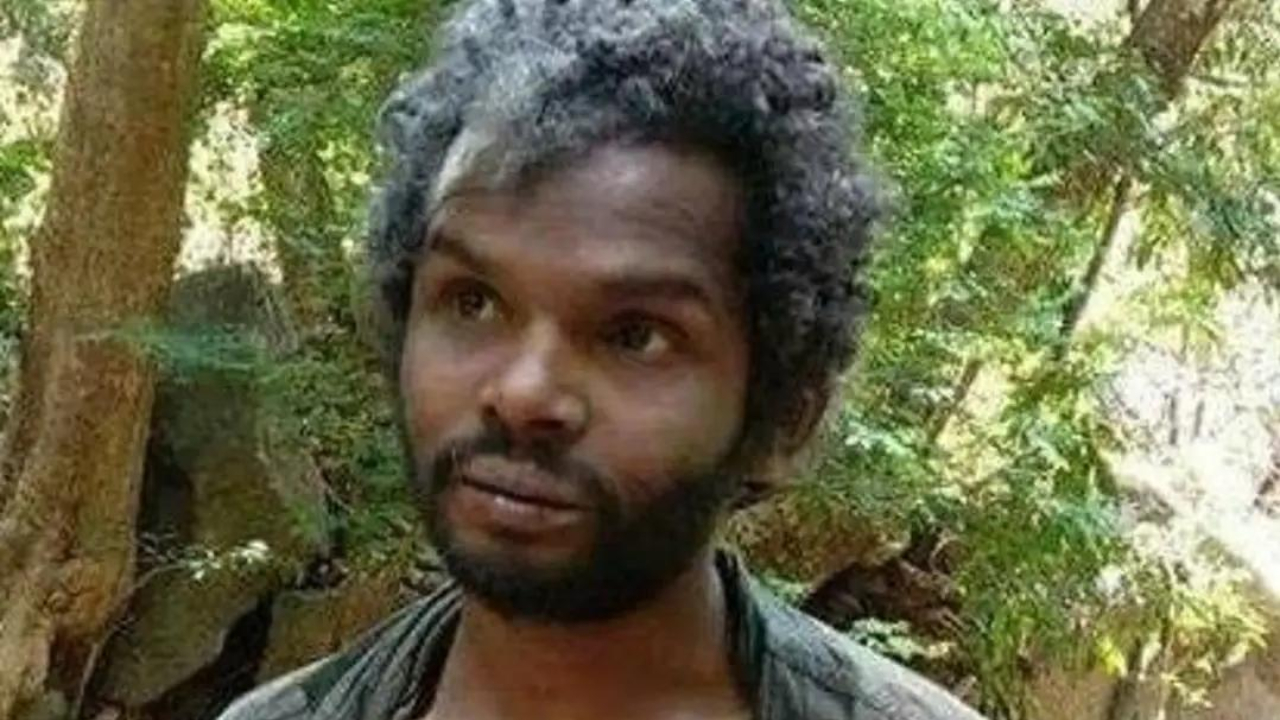
Madhu

Synopsis: Eight years after the lynching of tribal youth Madhu exposed the brutal underside of Kerala’s social conscience, the case has returned to focus with the Kerala High Court set to decide appeals against the 2023 conviction of 14 accused. The verdict will revisit not only the punishment awarded in one of the state’s most disturbing mob violence cases, but also the memory of a frightened Adivasi man whose public humiliation and death continue to trouble Kerala long after the outrage faded.
On an afternoon in February 2018, deep inside the hills of Attappady, a frail tribal youth stood surrounded by a crowd that had already decided his fate.
Madhu, barefoot and visibly terrified, clutched what little he had as men mocked him, beat him and photographed his humiliation. In the images that later spread across the country, his eyes carried something far more disturbing than fear — a stunned, wordless disbelief at the cruelty unfolding around him.
For many in Kerala, those pictures shattered the comforting myth of a humane and progressive society.
Eight years later, the case that shook the state’s conscience has returned to the centre of public attention.
The Kerala High Court is set to pronounce its verdict on 25 May in the appeals challenging the 2023 trial court judgment in the Madhu lynching case. A Division Bench comprising Justices Raja Vijayaraghavan V and K.V. Jayakumar has directed all the accused to appear before the court at 10.15 am on the day of the verdict.
Madhu, a mentally challenged Adivasi youth from Attappady, was lynched by a mob after being accused of stealing rice from a grocery shop. The brutality of the attack, and the manner in which it was recorded and circulated, triggered outrage across the country and renewed scrutiny over the treatment of tribal communities.
In 2023, the Special Court for SC/ST (Prevention of Atrocities) Act in Mannarkkad convicted 14 of the 16 accused and sentenced them to seven years of rigorous imprisonment along with a fine of ₹1 lakh each for offences including culpable homicide. The convicted men later approached the High Court challenging the verdict and sentence.
The state, too, moved the High Court, seeking conviction under more serious charges and enhancement of the punishment awarded by the trial court.
Also Read: Mob lynching in Kerala’s Kozhikode echoes the horror of Madhu’s death
For months, during 2017 and 2018, petty thefts in the tribal hamlets of Mukkali and Chindakki had unsettled residents. Rice, spices, cooked food, beedi packets, cigarettes, torches and batteries would go missing from shops and houses.
The losses were small, but fear and suspicion spread through the locality.
Villagers believed the man behind the thefts was Madhu, a 30-year-old tribal youth from the Muduka community in Chindakki Ooru. Madhu, who suffered from a minor mental illness, often wandered through areas including Agali and Mukkali.
Locals knew he survived by taking food items from nearby shops without permission.
On 22 February, 2018, a group of men from the Mukkali area decided to track him down.
Acting on information that Madhu was inside the Aandiyallachaal reserve forest, they entered the forest in search of him. He was eventually found, restrained and brought back to Mukkali.
Police were informed after Madhu was taken to the village.
Officers reached the spot around 3 pm and took him into custody. Nearly half an hour later, while the police jeep was heading towards Agali, Madhu reportedly vomited near Mele Thavalam while seated in the rear of the vehicle.
The police rushed him to the Community Health Centre in Agali at around 4.15 pm. Doctors declared him brought dead.
The case took a grave turn after the postmortem examination conducted at Government Medical College Hospital, Thrissur, on 24 February.
The medical findings ruled out a natural death. Doctors concluded it was a case of homicide. The postmortem report stated that Madhu died due to multiple blunt injuries sustained on his body.
Injury numbers 1 to 15 were identified as the cause of death.
Also Read: Madhu lynching case: Finally, Kerala court holds 14 people guilty, acquits two
The prosecution in the Madhu lynching case has laid out a chilling sequence of events that began deep inside the forest beneath Ajmudi hill and ended with a tribal youth being publicly humiliated, assaulted and allegedly beaten to death.
According to the prosecution, the chain of events started around 12.15 pm on 22 February, 2018, when the second accused, Marakkar, allegedly spotted Madhu near the Vandikkadavu teak plantation inside the forest area.
He is said to have informed the ninth accused, Ubaid, who then passed the information to the third accused, Shamsudheen. The message quickly spread among the remaining accused.
By around 12.30 pm, several accused persons had gathered near the shop of the ninth accused.
The prosecution says they assembled there with the common intention of tracking down Madhu, abducting him from the forest and inflicting fatal injuries on him. Some arrived in an autorickshaw, while another accused reached the spot on a motorcycle.
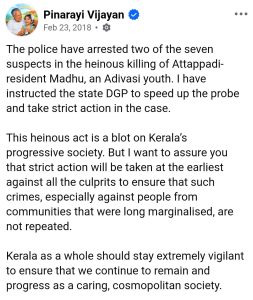
Then Chief Minister Pinarayi Vijayan’s statement condemning the incident
The group then travelled to the Vandikkadavu teak plantation in a jeep owned by the ninth accused. After parking the vehicles, they allegedly entered the reserve forest along with Marakkar and moved nearly 2 km through the forest terrain near the Bhavani river in search of Madhu.
The prosecution says the group found Madhu around 1.10 pm at a rocky forest area known as Andiyallachaal.
What followed, according to the charges, was a violent assault.
Madhu was allegedly overpowered, stripped of his clothes and tied up using his own dhoti. He was punched and kicked repeatedly on his face and back while being held captive.
Some among the accused allegedly recorded visuals of the assault on their mobile phones.
One of them later circulated the footage on social media, allegedly to publicly shame him. Investigators say another accused tied Madhu’s hand using the zip strap of a bag to stop him from escaping.
The prosecution further alleges that a sack containing rice and other items was placed on Madhu’s shoulder while the group branded him a thief, abused him and continued assaulting him. He was allegedly beaten with a wooden stick during this period.
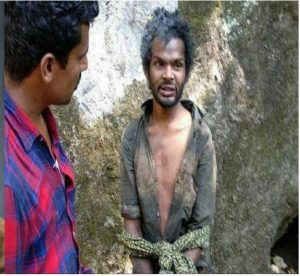
One of the accused questioning Madhu
Madhu was then forced to walk nearly 3 km from the forest to Mukkali junction in a half-naked condition. The prosecution describes it as a public parade carried out with the intention of humiliating him before others.
The first accused, Hussain, is alleged to have reached the spot later.
Prosecutors claim he assaulted Madhu near a shop by stamping on his chest while he was seated against a treasure box. The impact allegedly caused Madhu’s head to slam against the box, leading to serious injuries.
The prosecution has also invoked provisions of the SC/ST (Prevention of Atrocities) Act, alleging that the accused, who belong to forward caste communities, targeted Madhu fully aware that he belonged to a Scheduled Tribe community.
A total of 16 persons were arrested in connection with the case.
Also Read: Madhu lynching case: 9 out of 12 accused absconding after Kerala court quashes bail
It was nearly five years after the incident that the Special Court for SC/ST (POA) Act Cases in Mannarkkad convicted 14 of the 16 accused and awarded prison sentences ranging from three months to seven years.
The verdict was delivered on 4 April, 2023, by Judge K.M. Retheesh Kumar of the Additional Sessions Court, Mannarkkad. Two accused were acquitted after the court found insufficient evidence against them.
The court found the first accused guilty under Sections 143, 147, 323, 342 and 304 Part II read with Section 149 of the IPC. He was sentenced to seven years of rigorous imprisonment for culpable homicide not amounting to murder and fined ₹1 lakh. Additional jail terms and fines were imposed for unlawful assembly, rioting, wrongful confinement and causing hurt. All sentences will run concurrently.
Accused 2, 3, 5 to 10 and 12 to 15 were convicted under multiple provisions, including Sections 143, 147, 323, 324, 326, 367 and 304 Part II read with Section 149 of the IPC, along with Section 3(1)(d) of the SC/ST (Prevention of Atrocities) Act.
The court sentenced each of them to seven years’ rigorous imprisonment for the offence under Section 304 Part II and imposed a fine of ₹1 lakh each. They were also awarded seven years’ imprisonment under Section 326 for causing grievous hurt, five years under Section 367 for abduction and one to three years under other offences, including charges under the SC/ST Act. Separate fines were imposed for each offence.
The 16th accused was convicted only under Section 352 of the IPC for assault and sentenced to three months’ simple imprisonment with a fine of ₹500. The court cleared him of all other charges.
Accused 4 and 11 were acquitted under Section 235(1) of the CrPC. The court cancelled their bail bonds and ordered their release.
The judgment then stated that all substantive prison terms would run concurrently. The convicted persons will also get the benefit of set-off for the period already spent in custody during the trial under Section 428 of the CrPC.
The mob lynching case has returned to the centre of legal attention, with the Kerala High Court set to reconsider the punishment awarded to the convicts.
While the convicts challenged the Mannarkkad special court verdict seeking relief, the state moved the High Court demanding stricter punishment for those found guilty in the case.
A Division Bench, taking note of the status of all the accused, issued fresh directions on 19 May for their appearance before the court on 25 May at 10.15 a.m.
The court recorded that the first accused is presently out on bail. Accused 4 and 11 had earlier been acquitted of all charges by the trial court. Accused 16, who was convicted only under Section 352 of the IPC, has already completed the sentence imposed on him.
The remaining accused — 2, 3, 5, 6, 7, 8, 9, 10, 12, 13, 14 and 15 — are currently undergoing imprisonment following their conviction in the case.
The Division Bench directed the Superintendent of the concerned jail to produce the imprisoned accused before the court in person on 25 May. It also ordered accused 1, 4, 11 and 16 to appear personally before the Bench on the same day.
Eight years after the Madhu case stands at another turning point. But the very image — Madhu, bruised, frightened and surrounded by men who believed humiliation carried no consequence still outlives the crime and haunts Kerala’s conscience.
(Edited by Amit Vasudev)



