

Published Aug 31, 2022 | 5:35 PM ⚊ Updated Aug 31, 2022 | 5:35 PM

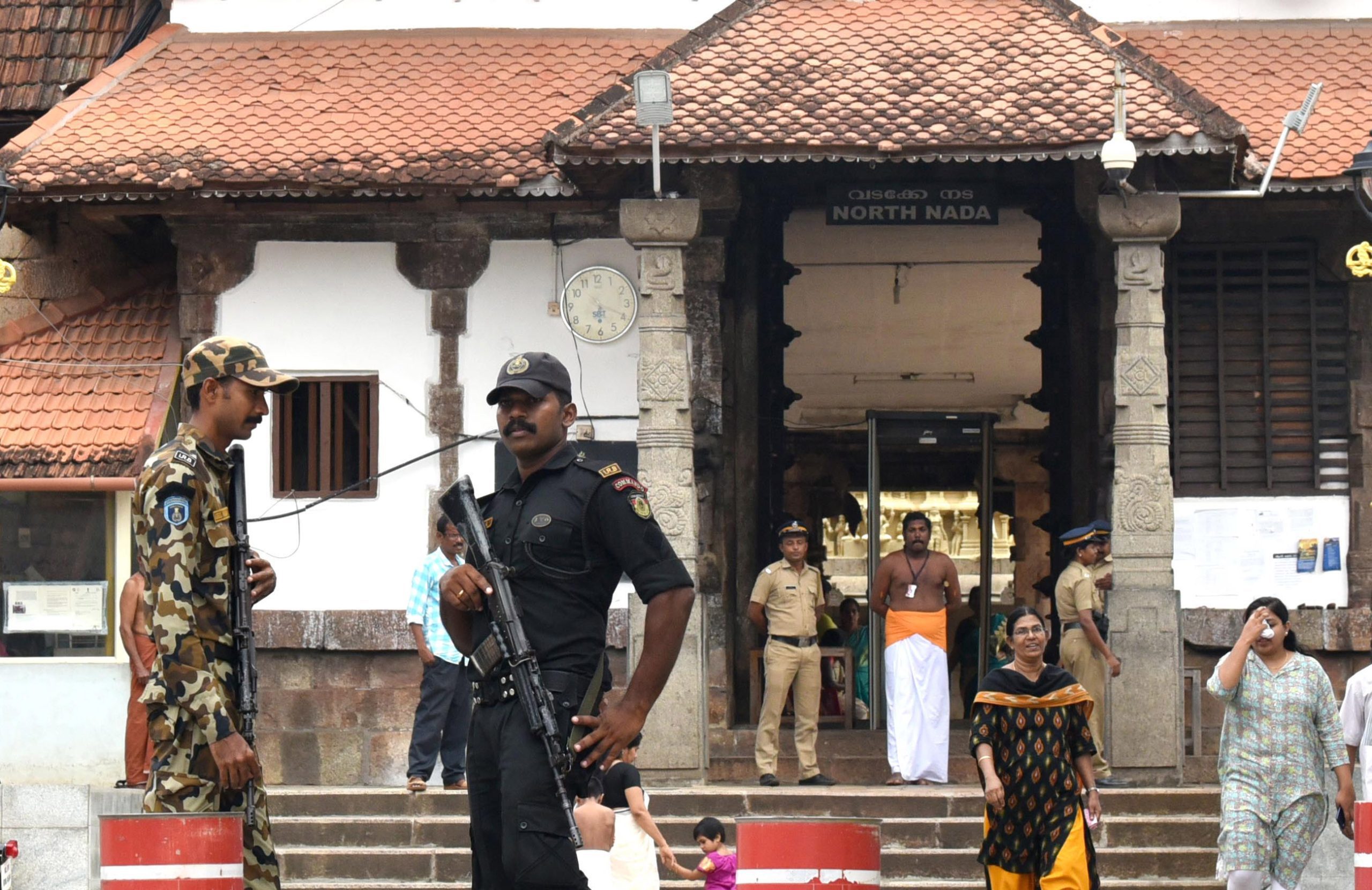
Police commandoes guarding the sanctum sanctorum of the Sree Padmanabhaswamy temple in Kerala's capital Thiruvananthapuram, India's richest temple. (Supplied)
Does Kerala’s communist government take money from Hindu temples, including the one touted to be the richest in India, the Sree Padmanabhaswamy temple in the state capital Thiruvananthapuram?
It does, says retired Supreme Court judge Indu Malhotra. We do not, retorts the government.
Quite unusually for the often bitterly partisan politics of the state, backing the communists of the ruling LDF on the issue is none other Kerala’s Opposition leader VD Satheesan of the Congress party.
“No government in Kerala, irrespective of party colour, collects income from any temple and deposits it in the treasury for meeting administrative expenses,” Satheesan told South First.
“This is a campaign by right-wing elements in the country.”
Satheesan jibe about a “campaign” was an oblique reference to comments that Justice Malhotra made during a visit to Padmanabhaswamy Temple on 28 August.
A video clip of her interacting with devotees shows her accusing communist regimes in India of eyeing temple funds.
“That is what happens with these communist governments,” Justice Malhotra is heard saying in the video that has gone viral since then.

A government appointed cleaning worker on duty at the Padmanabhaswamy temple. (Supplied)
“They want to just take over because of the revenue (of the temples). Their problem is the revenue. All over they have taken over. All over. Only Hindu temples. So Justice (UU) Lalit and I said, no, we will not allow it.”
Justice Malhotra’s reference to Justice Lalit — who was sworn in as India’s Chief Justice a day earlier — and herself seems to be an allusion to their July 2020 verdict upholding the rights of the Travancore royal family to manage and maintain the Sree Padmanabhaswamy temple.
They also ruled that a committee be set up to manage and administer the temple. Their proposal: The committee comprise the Thiruvananthapuram district judge, the temple’s chief priest, and a nominee each from the royal family, the state government, and the central government.
Media reports said Justice Malhotra was in to Kerala to attend a string of events, including one related to the platinum jubilee celebrations of the Thiruvananthapuram Medical College Hospital.
Let alone take from the temple coffers, the state government has been spending crores on its security, says Kerala’s Temple Affairs Minister K Radhakrishnan.
“We are cash-strapped, but we are still allocating funds for its security and other expenses,” he told South First. “We have not received a single paise from the temple.”

The Sree Padamanabha temple in Thiruvanathapuram. (Supplied)
Radhakrishnan claimed the government had spent ₹62 crore on temple’s security system alone in the last decade, apart from shelling out ₹38 lakh on digitising its archives.
The ancient temple is today equipped with a five-tier security system comprising satellite surveillance, seismographic-linked alarms, metal detectors, X-ray scanners, and more than 250 police commandos, whose salaries are met by the state exchequer.
Radhakrishnan also said his government has never eyed the temple’s funds or its administrative control.
“Our government was not a party to the high court order taking away the temple administration rights from the royal family of Travancore,” he said.
“Former IPS officer and devotee TP Sunderrajan won that order after a protracted legal battle, but the Supreme Court later overturned it. We have always respected orders of both the high court and the Supreme Court.”
Kerala’s former temple affairs minister Kadakampally Surendran said all temple funds are audited by either the local fund department or Kerala High court-appointed auditors. “All audit reports are public documents and available to anybody for scrutiny,” he said.
The Congress party’s Satheesan came to the defence of the ruling communists, saying Kerala had a “long history” of setting budgetary allocations for meeting expenses of different temples.
For instance, he said, successive governments have extended special financial aid worth ₹20 lakh to the Padmanabhaswamy temple every year since 1970.
“No church or mosque in the state gets such concessions,” he said.
The last Kerala budget paints a rosy picture of official support to temples in the state, including to the Padmanabhaswamy temple.

A night view of Sree Padmanabhaswamy Temple in Thiruvanathapuram. (Supplied)
According to it, ₹100 crore was given for enhancing facilities of temples under the Travancore Devaswom Board, ₹36 crore was sanctioned for temples under Cochin and Malabar Devaswom Boards and ₹142 crore for Sabarimala temple. There was no special budgetary allocation for Sree Padmanabhaswamy temple in the latest budget.
The state government also sanctioned ₹2 crore as interest-free loan to the temple in January to help it tide over a financial crisis.
The Padmanabhaswamy temple, deemed India’s richest temple after gold, worth an estimated $1 trillion, was found in hidden chambers, has managed to raise only half of its expenses through donations since the lockdown; it requires ₹1.5 crore every month for maintenance and paying its 132 permanent staff and 112 daily wage workers.
It was in 2011 that the temple created international headlines when treasures worth over $1 trillion were discovered from one of its secret vaults.
The temple has six underground chambers or vaults near the sanctum sanctorum and they are named Vault A to Vault F by experts. The E and F chambers are opened daily for regular poojas, while C and D are opened only for occasional events.
The other two were said to be both secret and sacred.
It was following a Supreme Court order that Vault A was opened and priceless wealth was discovered in it, making the temple the richest in the country.
The court order came in response to complaints that hidden assets of the temple were missing.
Efforts to open Vault B were dropped following objections by the devotees.



