

Published May 30, 2026 | 8:00 AM ⚊ Updated May 30, 2026 | 8:00 AM


The depth of the crisis is evident from the fact that a worker appointed as a dhobi (washerman) is currently assisting in mortuary duties.

Synopsis: Despite emerging as one of Kerala’s busiest public health institutions, Government Medical College, Manjeri, is struggling with severe staff shortages, vacant specialist posts and administrative bottlenecks. As Malappuram gains unprecedented political influence in the new UDF government, expectations are running high that long-pending issues at the medical college will finally be addressed.
With 16 MLAs and five ministers in the newly sworn-in UDF government, Malappuram finds itself at the centre of Kerala’s political landscape.
The district’s unprecedented presence in the corridors of power has sparked hopes across sectors.
Among the institutions curious to see whether this political strength can bring long-awaited change is Government Medical College (GMC), Manjeri, a hospital that carries much of the healthcare burden of Kerala’s most populous district, Malappuram.
Established in 2013 as the sixth government-run medical college in the state and the first in the public sector after 31 years, the institution fulfilled a decades-long demand of Malappuram.
Over the years, it grew into a major tertiary-care teaching hospital, serving patients from across north Kerala.
Despite handling nearly 3,000 outpatients and more than 450 inpatients daily, the medical college continues to grapple with chronic staff shortages, vacant specialist posts and mounting workload pressures.
The depth of the crisis is evident from the fact that a worker appointed as a dhobi (washerman) is currently assisting in mortuary and embalming duties in the Anatomy Department because of the lack of dedicated staff.
The unusual arrangement has illustrated the grave manpower shortages that have forced employees across the institution to take on responsibilities far beyond their designated roles and expertise.
As the new government begins its term, the future of GMC-Manjeri may become an early test of whether Malappuram’s newfound political influence can translate into tangible improvements for one of Kerala’s most overstretched healthcare institutions.
Also Read: Dr Harris reiterates equipment shortage at Thiruvananthapuram MCH
Administrative challenges continue to affect the functioning of the GMC as the institution operates under a dual control system involving both the Medical Education Department and the Health Department.
Government Medical College, Manjeri
The medical college, which comes under the administrative control of the Medical Education Department, has employees from both departments on its rolls.
Officials pointed out that this arrangement often led to delays and complications in administrative matters.
At present, the Medical Education Department has sanctioned 271 posts in gazetted and non-gazetted categories, including 231 permanent positions and 40 outsourced posts. Nine of these posts are remaining vacant.
The Health Department has allotted 406 posts across 48 categories to the institution. Of these, 374 posts have been filled, leaving 32 others open.
Key vacant positions included the Deputy Superintendent post, consultant posts in General Medicine, General Surgery, Gynaecology, Paediatrics and ENT, besides the post of Nursing Superintendent.
In total, the GMC has been functioning with 677 employees drawn from both departments.
Hospital operations depend largely on the limited staffing pattern originally designed for district hospitals under the Health Department.
The shortage of personnel has prompted demands for immediate appointments to the nine vacant posts under the Medical Education Department and the 32 vacancies under the Health Department.
Efforts are also underway to bring Health Department employees working in the institution under the Medical Education Department to streamline administration and improve efficiency.
Apart from the sanctioned permanent workforce, the institution has been relying heavily on temporary staff for its day-to-day operations.
A total of 436 temporary employees are currently serving at the medical college, including 234 staff members engaged through the Hospital Development Society (HDS) and 202 employees working under the Karunya Arogya Suraksha Yojana (KASP), a state-funded health insurance scheme.
Another major concern is the shortage of speciality ward facilities despite the expansion of services at the medical college. While the hospital has a sanctioned bed strength of 501, it is currently operating with 556 beds.
However, despite 27 departments functioning in the institution, 12 super-speciality departments have not been allotted separate beds.
These include Radiotherapy, Endocrinology, Medical Gastroenterology, Surgical Gastroenterology, Nephrology, Urology, Neurology, Neurosurgery, Plastic Surgery, Paediatric Surgery, Reproductive Medicine and Pulmonary Medicine.
The absence of dedicated beds for these departments has increased pressure on existing wards and poses challenges in providing specialised patient care.
Also Read: Beneath rubble lies Kerala’s healthcare illusion
A work-study conducted by the Personnel and Administrative Reforms Department, presented in 2026, painted a stark picture of the staffing situation at the GMC. It revealed that several outsourced employees are currently discharging duties far beyond the responsibilities for which they were originally appointed.
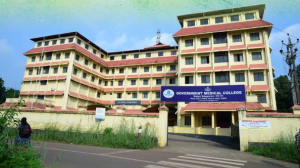
Government Medical College, Manjeri
The study found that severe staff shortages have compelled hospital authorities to deploy outsourced workers in crucial sections to ensure the uninterrupted functioning of departments.
Employees recruited for one category are often working in entirely different posts, including highly specialised and sensitive assignments.
Among the cases highlighted is that of a person who was appointed in the Dhobi category but is presently serving as an attendant in the Anatomy Department.
The report noted that he, along with a daily-wage worker functioning as a mortuary attendant, has been handling embalming procedures and other mortuary-related responsibilities.
The study pointed out that training recruits in embalming and related procedures requires considerable time. In the absence of adequate staff, these workers have become indispensable to the functioning of the department.
The deployment pattern of employees in the dhobi category further illustrates the extent of the manpower shortage.
Of the five employees appointed as dhobis, only two are actually working in that role.
One has been assigned to the Anatomy Department, another is functioning as office attendant-cum-driver, while a third is working as a cleaner.
An outsourced power laundry attendant has also been posted as an attendant in the library.
Officials, who conducted the study, reported that they received direct representations from heads of departments, doctors and staff members across the GMC regarding the acute shortage of personnel.
Based on field visits and discussions, the team concluded that inadequate staffing has emerged as a major obstacle to the smooth functioning of the institution.
The report also highlighted the situation in the Anaesthesia Department, where six units operate across 10 operating theatres.
Around 20 major surgeries, 25 minor surgeries and 10 emergency procedures are carried out every day. Despite this workload, only four Anaesthesia Technicians are available.
To bridge the gap, contract employees are being engaged through the Hospital Development Society (HDS).
However, frequent resignations and absenteeism arising from the lack of job security have affected the continuity of services.
The GMC Principal has therefore recommended the creation of six additional Anaesthesia Technician posts, one for each surgical unit.
After assessing the functioning of 40 employees working in outsourced categories, the study team concluded that these workers have become integral to the day-to-day operations of the GMC.
It was observed that similar categories already exist as permanent posts in other government medical colleges across Kerala.
The team recommended that all 40 outsourced posts spread across 14 categories be converted into permanent posts and filled through the Kerala Public Service Commission.
It has also proposed the creation of six new posts — one Junior Superintendent, four clerks and one driver.
The study team further urged the government to constitute a joint team of senior officials from the Administration Department and the Medical Education Department to visit GMC-Manjeri and assess first-hand the growing workload and the necessity for additional posts.
According to the report, regularising the 40 outsourced posts would require an annual expenditure of ₹1.94 crore.
After deducting the ₹99.92 lakh currently being spent on daily-wage and outsourced engagements, the additional financial burden on the government would be ₹94.57 lakh annually.
The proposed six new posts would involve an additional annual expenditure of ₹29.52 lakh.
Taken together, the recommendations would entail an additional annual commitment of ₹1.24 crore.
The study team maintains that the expenditure is justified, considering the growing patient load and the critical role these employees already play in sustaining services at the GMC.
(Edited by Majnu Babu).



