


Published Mar 03, 2026 | 7:00 AM ⚊ Updated Mar 03, 2026 | 7:00 AM

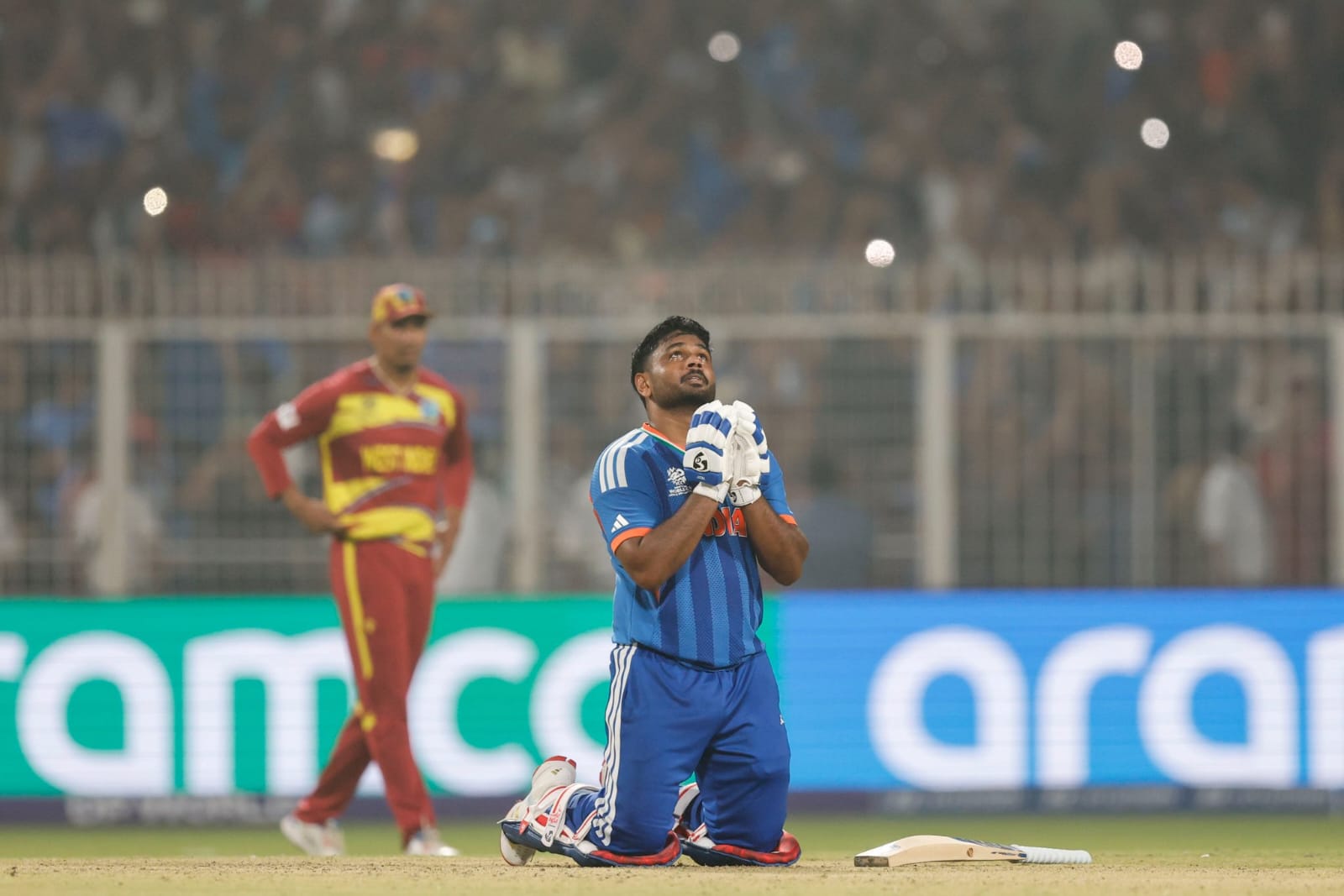
Sanju Samson after playing the winning knock
Synopsis: Sanju Samson scored an unbeaten 97 as India chased down 196 against West Indies to reach the T20 World Cup 2026 semi-final. The innings followed years of inconsistency in selection and competition for his place in the side. Raised in a Delhi Police colony, he moved to Kerala after his father took voluntary retirement to focus on his sons’ cricket, a decision that shaped his path to the international stage.
On a humid March night in the City of Joy, Kolkata, the noise of a packed Eden Gardens dissolved into one arresting frame.
Sanju Samson on his knees. Arms outstretched. Eyes skyward. A quiet prayer in the middle of the pitch.
It was not a celebration aimed at the galleries. It was a conversation with the heavens.
Because for Sanju, that moment was not about conquest. It was about relief.
India had just powered into the T20 World Cup 2026 semi-final, chasing down 196 against the West Indies. At the heart of it stood Samson, unbeaten on 97, unflustered, unyielding, scripting a knock that finally refused to be brushed aside. He eclipsed Virat Kohli for the highest score by an Indian in a T20 World Cup chase, but the numbers only told half the story.
For a cricketer whose international journey since 2015 has lurked between promise and pause, this was something deeper.
Fifty-nine T20Is across 11 years. Flashes of brilliance. Long gaps. Comebacks heavy with expectation. The talent never in doubt. The place in the XI always up for debate.
On 1 March, that script shifted.
There was a different air about him. Not the restless brilliance that has so often defined his best and worst days, but a measured assurance, almost Zen-like in its clarity. The strokes were crisp, the decisions cleaner. No rush, no visible burden of the past. Just presence.
This was a departure from the Sanju of previous comebacks, the one eager to prove, sometimes too eager. In Kolkata, he did not chase redemption. He let the game come, weighed it, and then owned it.
The boy from coastal Thiruvananthapuram, raised on discipline and oversized dreams, appeared to grasp a simple truth that had once slipped through his fingers: big nights are not won in a rush. They are built, ball by ball, until the moment arrives and you take it without hesitation.
And, finally, Sanju Samson looks inevitable.
Long before the IPL lights and India caps, before the applause and the scrutiny, there was a little boy walking out of a police colony in North Delhi with a bat that looked almost too big for him.
Sanju Vishwanath Samson, born on 11 November 1994, grew up in Kingsway Camp, officially Guru Teg Bahadur Nagar, in a Delhi Police residential colony. The police grounds were right across the road. For most children, that would have been convenient.

T20 captain Suryakumar Yadav takes off cap and bows to Sanju Samson after the knock
For Sanju, it was destiny.
His parents say he began playing at five. Six at the most. By then, he was not just playing. He behaved like a cricketer.
Even as a schoolboy, he believed he was one.
He carried himself that way.
There was a quiet seriousness about him.
“Playing cricket was the only thing I looked forward to,” he would later say.
And those who watched him then agree. He did not pretend to be a cricketer. He lived like one.
Sanju was born into a Malayali Christian family in Delhi. His father, Samson Viswanath, was not just a Delhi Police officer. He was a sportsman to the core. A striker who represented Delhi in the Santosh Trophy in 1984, he played for the Delhi Police football team.
Discipline, fitness, hunger. These were things he knew intimately.
There was a time when Viswanath had duty at the old Feroz Shah Kotla Stadium during a match.
He took his children, Sanju along with his elder brother Saly Samson, with him. The boys found the nets. The sound of leather on willow echoed through their childhood after that.
At home, tennis-ball matches were organised almost like mini tournaments. Their father gathered neighbourhood children, drew lots, and made sure everyone batted until dismissed. But if Sanju or his elder brother Saly got out cheaply, there was no sympathy. “Go home,” their father would say. Standards were set early.
Viswanath also took the boys to Delhi Police practice sessions.
He would ask grown men, 25-year-old bowlers, to bowl as fast as they could at his sons. They were still children. “However fast you want,” he would say.
The boys coped. More than coped. They played comfortably, even when bowlers shortened the pitch to test them.
Competition in Delhi cricket, however, is relentless.

A poster from CSK following the win
It is played in every lane, every park.
The brothers went for age-group trials a couple of times. They did not make it.
For a city that is one of Indian cricket’s nerve centres, breaking through demands more than talent. It demands timing, opportunity, backing.
Viswanath sensed a wall coming.
Then came the turning point. He took voluntary retirement from Delhi Police to focus entirely on his sons’ cricketing futures and decided to move to Kerala.
In 2006, the Samsons made a bold decision to leave Delhi and move to Kerala.
At the time, only two cricketers from the state, Tinu Yohannan and Sreesanth, had played for India.
It was hardly a traditional cricket powerhouse.
Sanju himself later revealed the atmosphere within his family then.
“It was a difficult phase for the family,” Sanju once recalled. “But my parents never made us realise they were struggling.”
They settled near Vizhinjam, a coastal village in Thiruvananthapuram, and from there began a daily routine that would shape his temperament as much as his technique.
The distance from Vizhinjam to the Thiruvananthapuram Medical College ground is about 22 kilometres.
Through blazing afternoons and sudden downpours, Sanju and his brother covered that distance without complaint.
Cricket kit slung over his shoulder, school uniform folded into his bag, he made the trip part of his routine. It meant changing two buses on most days.
On others, it meant walking the last three kilometres when there was no other option.
And when luck was on his side, he would hop onto the back of his father’s motorcycle, holding tight as they rode toward the ground.
At 11, he came under the wing of coach Biju George.
Right from the beginning, he was pushed.
Made to bat against the best bowlers in the academy, even those who had already played for Kerala.
What stood out was not just talent. It was discipline.
Years later, words attributed to Biju would describe the routine, as told to Chennai Super Kings, Sanju’s new IPL franchise.
He would be at the ground by 5.30 am. Train. Sweat. Take a bath from a common tap. Rush to school. Back at the nets by 4 pm. Train till 7 pm. Then begin the long journey home. Daily.
Dreams, if they had a timetable, would look something like that.

BCCI poster on Sanju Samson after his knock
Though South First got in touch with Biju George, he politely declined to delve into Sanju’s career or dissect his technique at this juncture. With the finals around the corner, he felt it would not be appropriate to shift the spotlight. “Let’s talk once the finals are done,” he said.
Sanju first played club cricket at Masters Cricket Club in Thiruvananthapuram before progressing through another academy system under Biju.
From 2008 onwards, he was firmly on Kerala selectors’ radar. Under-13. Under-16. He began dominating age-group tournaments.
One landmark performance stood above the rest. Nine hundred and seventy-three runs in the Kerala Cricket Association Inter-State Under-13 tournament, which earned him the Player of the Tournament award. By the time he reached Under-19 level, he was already turning out for Kerala’s senior side.
There were setbacks. He did not make the Indian squad for the 2012 Under-19 World Cup. But he kept scoring.
Sanju made his first-class debut for Kerala in 2011.
His List A debut followed in 2012.
In 2013, he was picked by Rajasthan Royals in the IPL, a break that altered his trajectory.
Earlier, he had been released by Kolkata Knight Riders without getting a game.
In January 2013, Sreesanth took him for trials with Rajasthan. What followed still reads like something out of a script.
He found himself batting in front of Rahul Dravid and Paddy Upton. No nerves. He just expressed himself. Drove. Cut. Pulled.
After the second day, Dravid walked up to him and said he had a “very special talent” and wanted him in the Rajasthan Royals team, asking him directly if he would play for them. The question stunned him.
From there, the climb accelerated.
He was soon touring England with India A in 2014.
In 2015, he made his India debut against Zimbabwe, a dream come true for the 19-year-old who once walked out of a Delhi police colony with borrowed tennis balls.
At one point, as a second-year degree student at Mar Ivanios College in Thiruvananthapuram, he became only the fourth cricketer from Kerala to be named in the national squad, after Tinu Yohannan, Abey Kuruvilla and S Sreesanth.
Sanju still speaks fondly of Delhi.
His first cricket memory?
The streets of GTB Nagar. Walking out with a bat and finding boys his age to play. The police grounds across the road. The competitive culture. The sting of failed trials.
Delhi gave him the hunger. Kerala gave him the runway.
It is tempting to imagine where he might have been had he remained in Delhi’s crowded system.
But perhaps it was not about geography.
It was about faith. A father who saw beyond selection lists, who believed talent without grind is wasted, and who gave up his career so his sons could chase theirs.
Raised by a sportsman who understood sacrifice, Sanju learned early that flair must be built on discipline. That fame means little without grounding. That setbacks are detours, not endings.
He fell in love with the game as a child. And he never really stopped playing it the way he did then, freely, expressively, as though every innings still begins in a narrow street in North Delhi.
That is how Sanju Samson was shaped, not in stadiums packed with thousands, but in quiet mornings, long bus rides, and a father’s uncompromising belief.
There was something unmistakably different about the innings Sanju Samson crafted against West Indies.
It was not just the unbeaten 97 off 50 balls. It was not merely the timing of his strokes or the audacity of his shot selection.
It was the authority with which he owned the moment. By the end of it, commentators were calling him Sanju “Special” Samson, a deceptively powerful batsman often underestimated by rivals.
For Samson himself, it was “one of the greatest days of my life.”
The knock did not come in isolation. It was layered with years of waiting, setbacks, self-doubt and quiet resilience.
“I’ve only played maybe 50 to 60 games, but I’ve watched around 100,” Samson reflected later in the post-match. “I’ve seen how the best finish games and how they adapt to situations. The last match in Chennai against Zimbabwe, we were batting first, so it was about setting a huge total. I wanted to go big from ball one. But this game was different. Once we started losing wickets, I knew I had to build a partnership and stick to my process,” he added.
That shift in temperament defined the innings.
Before the T20 World Cup 2026, there was a time when Samson was India’s preferred wicketkeeper-opening option. Then came the lean patch. Form dipped. Momentum slipped. Ishan Kishan surged ahead with explosive performances against New Zealand just before the World Cup, and the pecking order shifted overnight. Samson found himself back where he had been too often, on the sidelines, waiting.
But fate has its own timing.
Abhishek Sharma’s sudden stomach ailment opened the door. Opposition teams had begun targeting India’s left-handers with off-spin. Rinku Singh’s father fell ill. One by one, circumstances aligned. Samson got his chance, not planned, not promised, but earned through persistence.
And when it came, he did not rush it away.
Prasanth Joseph, a cricket aficionado and a keen observer of Samson’s journey, felt the difference immediately.
“This wasn’t the Sanju we’ve seen before,” he said.
“From the first ball, his body language was different. There was clarity, almost a statement that he belonged there. Earlier, after hitting a big shot, he would sometimes look to continue attacking and get out. This time, he picked his moments. After a boundary or six, he rotated strike. He played the situation. He batted through,” Prasanth told South First.
That restraint was crucial. For years, opponents had studied him. Slight adjustments in length often brought his dismissal, usually right after he had struck a commanding blow. Against West Indies, he refused to fall into that pattern.
Instead of chasing the game, he read it.
Instead of forcing dominance, he grew into it.
By the time he approached the nineties, the innings had become more than a score. It was control. It was maturity. It was survival meeting opportunity.
“It means the whole world to me,” Samson admitted in the post-match. “Ever since I started playing cricket, I dreamed of representing the country. I’ve had ups and downs. I’ve doubted myself. I’ve wondered if I’d make it. But I kept believing. I’m grateful for this day.”
The unbeaten 97 was not just about accelerating India into the semi-finals.
It was about an 11-year wait condensed into one evening. It was about a player who had often promised brilliance finally delivering it when it mattered most.
For Sanju Samson, this was not just another knock.
It was redemption written in real time.


