

Published Mar 13, 2026 | 3:00 PM ⚊ Updated Mar 13, 2026 | 3:00 PM

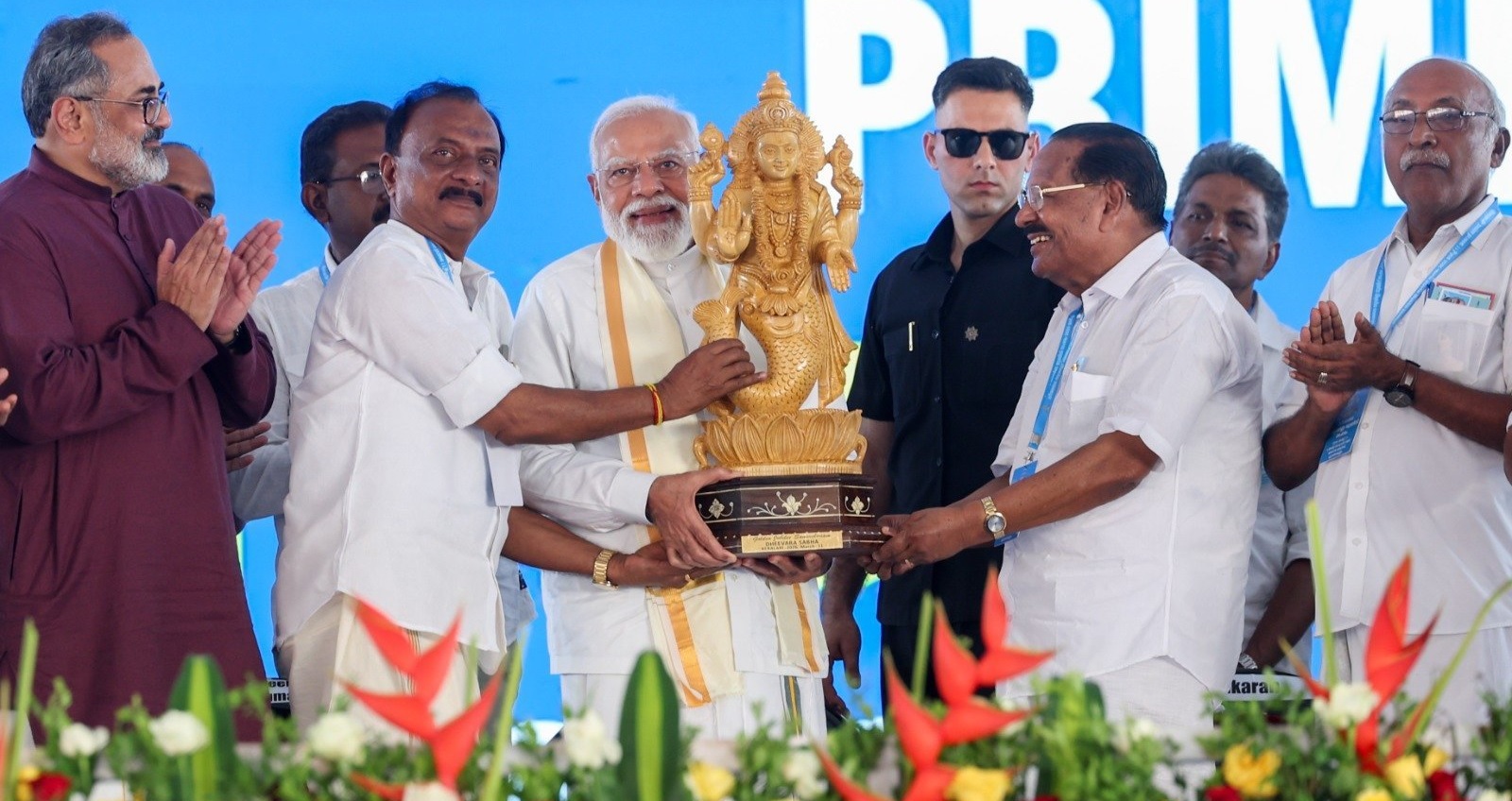
V Dinakaran and other leaders from the Dheevara community presenting a sculpture to Prime Minister Narendra Modi.
Synopsis: Ahead of the 2026 Assembly elections, the BJP is making efforts to influence coastal communities in Kerala. In the last Lok Sabha elections, particularly in Alappuzha, where the Dheevara community forms the second-largest population, the party secured a significant vote share. The BJP is now looking to strengthen its connection with the community further.
Sudha Ponnappan, a fisherwoman from Ambalapuzha in Alappuzha, still carries the excitement of seeing Prime Minister Narendra Modi up close. Dressed in a traditional white Kerala saree with a blue blouse, Sudha stood among thousands of women from the coastal belt who travelled to Kochi to attend the golden jubilee celebrations of the Akhila Kerala Dheevara Sabha, where Modi was the chief guest.
For them, the event was not just a celebration but also a rare moment when their community felt seen.
The BJP has in recent years intensified its outreach to coastal communities, long considered a difficult political terrain for the party. Fisherfolk populations spread across Kerala’s shorelines have traditionally leaned towards the LDF and UDF, but the party now appears determined to make inroads.
Coastal and semi-urban constituencies are emerging as key battlegrounds ahead of the Assembly elections. Kerala has 32 Assembly constituencies located along the coast, densely populated by fishing communities, including the Hindu Dheevara community and the Christian Latin Catholic community.
From Thiruvananthapuram in the South to Kasaragod in the North, the coastline stretches across nine districts — Thiruvananthapuram, Kollam, Alappuzha, Ernakulam, Thrissur, Malappuram, Kozhikode, Kannur and Kasaragod. Along this 580-kilometre shoreline lie 222 fishing villages.
For decades, these shores have been filled with the sight of fishing boats heading into the Arabian Sea at dawn. Now, another kind of activity is becoming visible along the coast — political mobilisation.
As parties prepare for the next electoral battle, the BJP is casting its net across Kerala’s fishing villages.
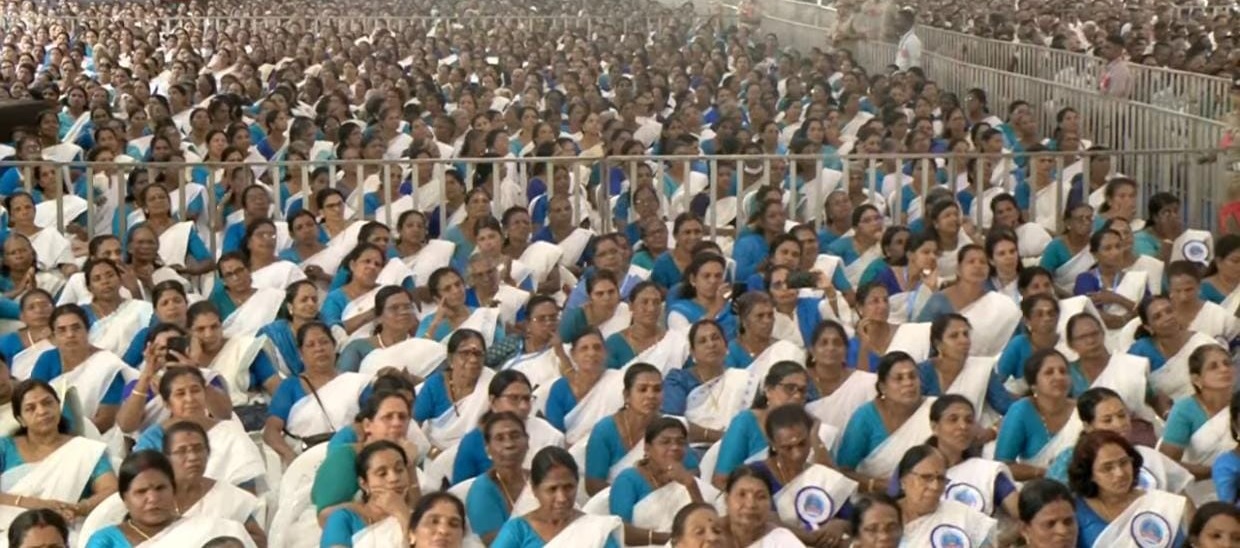
The golden jubilee celebrations of the Akhila Kerala Dheevara Sabha in Kochi witnessed a large turnout of women.
Even though Prime Minister Narendra Modi did not announce any special package specifically for the Dheevara community during the event, he referred to several Central government initiatives aimed at strengthening the fisheries sector and improving the livelihoods of fishermen.
Leaders of the community said that his presence at the event itself carried political significance.
Speaking to South First, Akhila Kerala Dheevara Sabha general secretary and former MLA V Dinakaran said the organisation had initially invited Chief Minister Pinarayi Vijayan to attend the golden jubilee celebrations.
“We invited the chief minister, but he showed no interest in attending. So, we decided to invite the Prime Minister, and he came for us,” Dinakaran said.
He also clarified that the organisation does not direct its members to support any particular political party.
According to Dinakaran, the Dheevara community, traditionally associated with fishing and marine livelihoods, has a population of around 25 lakh people in Kerala. Currently classified under the Other Backward Castes (OBC) category, the Dheevara community includes fishermen from around 10 Hindu sub-castes.
Over the decades, they have been demanding inclusion in the Scheduled Castes (SC) category, arguing that their socio-economic conditions warrant greater protection.
Both the Kaka Kalelkar Commission and the Mandal Commission had recommended special consideration for the community and measures to address their backwardness. In 1984, the Kerala Institute for Research Training and Development Studies on SC/ST communities was tasked with studying the socio-economic status of the Dheevara community in the state.
The institute’s findings concluded that the community was eligible for inclusion in the SC category. Based on the report, the Kerala government forwarded a proposal to the Union government on 14 October 1986. However, the demand remains pending.
“We should be included in the SC category. It is a decades-old demand which has been ignored by both the UDF and LDF governments. We hope PM Modi will consider it,” Dinakaran said.
V. Dinakaran and other leaders from the Dheevara community presenting a sculpture to Prime Minister Narendra Modi.
Despite the Dheevara community’s strong presence in several coastal pockets of Kerala, the two major fronts- the LDF and the UDF have traditionally allocated the community only one Assembly seat to contest, usually from the Alappuzha Assembly constituency.
Currently, the seat is represented by CPI(M)’s PP Chitharanjan, a leader from the Dheevara community.
Several constituencies across Kerala have a significant Dheevara population, making their voting pattern politically important.
These include Vypin and Thrippunithura in Ernakulam district, Alappuzha, Aroor, Ambalapuzha and Haripad in Alappuzha district, Kollam and Karunagappally in Kollam district and Nemom in Thiruvananthapuram district.
The voting behaviour of the Dheevara community in these coastal belts can influence electoral outcomes in tightly contested seats.
BJP Kerala General Secretary Dr KS Radhakrishnan told South First that Dheevara votes are as crucial as Latin Catholic votes in the coastal belt.
“Traditionally, backward Hindu communities, including Dheevara, have been inclined towards Left politics, while Latin Catholics usually support the Congress. But if you analyse voting patterns in the coastal belt in recent elections, you can see an increase in the BJP’s vote share in these pockets,” he said.
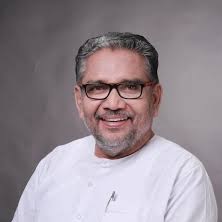
BJP Kerala General Secretary Dr KS Radhakrishnan.
In the 2019 Lok Sabha elections, Radhakrishnan secured 1,87,729 votes in the Alappuzha constituency, an increase of about 89,000 votes compared to the previous election. Political parties closely analysed this rise in support, especially in coastal areas of Alappuzha and Ernakulam, where the constituency had traditionally leaned towards the CPI(M) or the Congress.
Although the BJP did not win in these pockets, its vote share increased in several coastal villages, including Ambalapuzha, Haripad, Purakkad and Thottappally.
However, the party’s vote share dipped in the recent local body polls. According to data released by the State Election Commission, the BJP-led NDA secured 14.76 percent of the vote, down from 19.26 percent in the 2024 Lok Sabha elections.
Union Home Minister Amit Shah, while addressing local body representatives, pointed to the BJP’s long-term growth in the state.
“In 2014, we received 11 percent of the vote, in 2019 it was 16 percent, and in 2024 it rose to 20 percent. The journey from 20 percent to 30 percent and 40 percent will not be long, and we will prove this in 2026,” he had said.
During the last Lok Sabha election, the LDF alleged that Dheevara votes had shifted towards the BJP, while the Congress claimed the community continued to support the UDF along with the Latin Catholic electorate in the coastal belt.
Vishnu Gopal, a CPI(M) area committee member from Kottayam, told South First that the BJP had initially attempted to reach out to the Christian community but was rejected, which was evident in the local body elections.
He said the party is now trying to attract the Hindu backward communities. However, he argued that these communities are rooted in Left ideology. In regions such as Alappuzha and Kollam, where Communist movements have shaped people’s lives and ensured dignified living, he said, they would continue to stand with the Left, no matter what.
Alappuzha District Congress Committee (DCC) chief Babu Prasad told South First that several pockets across Alappuzha district’s nine Assembly constituencies have a strong presence of the Dheevara community, along with Latin Catholics, Nairs and Ezhavas.
According to him, the BJP managed to make noticeable gains in some of these areas during the last Lok Sabha election. “In Ambalappuzha, they finished in second position, and in Haripad, they secured crucial vote numbers,” he said.
Haripad is currently represented by the former leader of Opposition in Kerala Assembly, Ramesh Chennithala.
Prasad said that a section of voters who had earlier supported the Left shifted towards the BJP during the parliamentary polls. However, he added that the Congress-led UDF regained several of its strongholds in the subsequent local body elections.
“The Ambalappuzha Block Panchayat is now governed by the Congress. Panchayats such as Punnapra South and Thottappally are also now under Congress rule,” he said.
“At the same time, it is clear that the BJP is making strong attempts at political polarisation in these coastal regions,” Prasad added.
The shifting political mood was also reflected in the recent local body elections across Kerala’s coastal belt.
In Ernakulam district, the UDF swept most of the coastal region. Grama panchayats such as Chellanam, Elamkunnapuzha and Kadamakkudy — areas that witnessed strong resentment over issues such as sea wall protection and fish mortality — voted for the UDF.
All block panchayats in the coastal belt went to the UDF except Vypeen.
Fisherfolk said the Left retained Vypeen largely because of the work carried out by MLA KN Unnikrishnan, whose development initiatives helped the party maintain support in the area.
In Alappuzha district — traditionally considered a Left stronghold, the UDF still managed to win in several places and swept five municipalities. In Thrissur district, while places like Chavakkad and Guruvayur remained with the Left, constituencies such as Chalakudy and Nattika voted for the UDF.
Meanwhile, the BJP has been steadily expanding its outreach among the Latin Catholic community, particularly in the Ernakulam and the Thiruvananthapuram districts. The effort intensified after the controversy surrounding the Munambam Waqf land issue.
The shift was visible when, for the first time, a BJP panchayat representative was elected from Munambam in the 2025 local body polls.
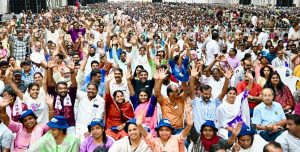
From the golden jubilee celebrations of the Akhila Kerala Dheevara Sabha in Kochi
Yuva Morcha Kollam chief Pranav Thamarakkulam said coastal communities have long felt ignored by mainstream politics.
“No political front has done anything meaningful for coastal people except promises during elections. It was only after Narendra Modi came to power that fishermen got a department of their own. Now they receive accurate climate alerts and subsidies, and BJP’s local leaders have also been in the forefront of protests against seashore mining in several coastal pockets,” he told South First.
The BJP believes that coastal and suburban constituencies often decide electoral outcomes in Kerala and that these regions usually record heavy polling. The party sources pointed to the 2024 Lok Sabha election in Thiruvananthapuram as an example. Shashi Tharoor won the seat with a margin of 99,989 votes in 2019, but the margin dropped sharply to 16,077 votes in 2024.
“Tharoor retained support only in the coastal stretch from Pozhiyoor to Pallippuram, areas with a large concentration of Latin Catholic and Dheevara voters,” a senior BJP leader noted.
For generations, coastal voters say they have placed that faith in political parties. But many feel that once elections pass, their daily struggles — with sea erosion, fragile homes and uncertain livelihoods are often forgotten, leaving them to face the sea and its risks largely on their own.
(Edited by Muhammed Fazil.)


