


Published Apr 03, 2026 | 5:26 PM ⚊ Updated Apr 03, 2026 | 5:26 PM

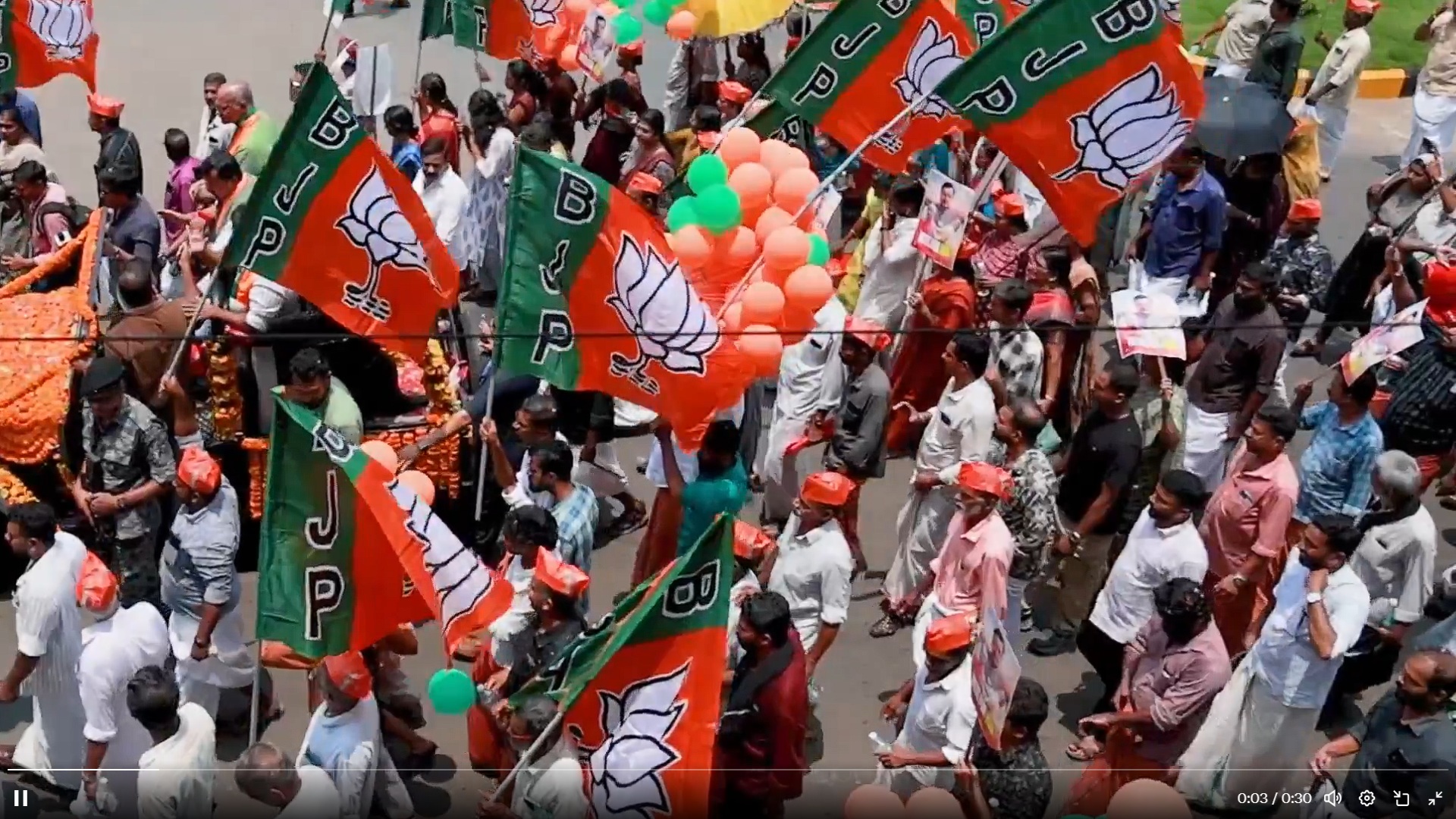
Despite widespread expectations, former state unit president K Annamalai’s name does not feature in the list.
Synopsis: The BJP’s Kerala campaign, initially built around expansion and narrative control, has been repeatedly knocked off course by a cascade of controversies—from affidavit disputes and communal remarks to FCRA anxieties and local confrontations—leaving the party reacting more than leading. As each episode lingers and overlaps, party leaders themselves admitted that the controversies blur its message, just as it tries to convince voters it can break into a deeply bipolar political landscape.
There was supposed to be a rhythm to it.
A tightly-scripted campaign. A familiar arc. The star power of Narendra Modi anchoring the pitch, Union ministers, central, state and local leaders amplifying it, and a steady drumbeat around development, and incremental growth in a state that has long resisted the Bharatiya Janata Party (BJP).
Instead, what has unfolded in Kerala for the BJP over the past two weeks feels less like a campaign and more like a sequence of interruptions —each controversy bleeding into the next, each message blunted before it could land.
Every time it attempts to reset the conversation, something else intrudes. Then another. And another.
Inside the party, the unease is no longer whispered—it’s acknowledged, albeit cautiously.
“We are spending more time responding than communicating,” a senior BJP functionary admitted, requesting anonymity. “That was never the plan.”
The BJP entered the 2026 Kerala Assembly elections with a sharper sense of purpose than in previous cycles. There was visible intent: expand beyond the party’s traditional pockets, make inroads into central Kerala’s Christian belts, consolidate gains in temple-heavy and Hindu vote consolidation constituencies, and present itself as a viable third force in a state defined by bipolar politics.
Fielding state president Rajeev Chandrasekhar in Nemom was not just a tactical move—it was symbolic. The party wanted to signal seriousness.
But the campaign’s opening stretch quickly veered off course.
The first tremor came with the affidavit controversy surrounding Rajeev Chandrasekhar, the party’s high-profile candidate in Nemom. Allegations over non-disclosure of assets—particularly a Bengaluru property—quickly escalated into a political flashpoint.
Chandrasekhar dismissed the charges outright.
“These are completely fabricated claims,” he said at a campaign stop. “Every detail required by law has been disclosed. This is nothing but a desperate attempt to distract voters.”
Yet the episode lingered. It offered opponents an early opening—and they used it to frame the BJP as evasive on transparency.
Before that narrative could settle, another controversy surfaced in Guruvayur.
BJP leader and Guruvayur constituency candidate B Gopalakrishnan’s remarks about the constituency lacking a “Hindu MLA” for decades triggered legal complaints and accusations of communal messaging.
Gopalakrishnan stood his ground.
“I stated verifiable facts,” he said. “If speaking about representation becomes controversial, then we must ask who is uncomfortable with the truth.”
Cases were filed. The Election Commission stepped in. Opposition parties seized the moment.
Within BJP circles, there was discomfort.
One state office-bearer described it as “avoidable.”
“Why step into territory that invites legal complications in the middle of a campaign?” he asked. “We had other issues to talk about.”
Yet the campaign did not pause long enough to recover.
Running parallel to these controversies has been the Congress-led charge of a covert understanding between the BJP and the CPI(M) in select constituencies. The BJP has rejected the claim repeatedly, but the allegation has proved sticky.
“There is no question of any deal,” said senior BJP leader Sobha Surendran to the media then. “This is a narrative manufactured by the Congress because they are afraid of losing ground. We are fighting on both fronts.”
For a party trying to position itself as an alternative to both fronts, the optics were complicated.
Even so, the damage was less about proof and more about perception.
Perhaps the most consequential setback has come from beyond the state campaign itself. It’s a development from Delhi that complicated matters further.
The controversy around proposed amendments to the Foreign Contribution Regulation Act (FCRA) has unsettled Kerala’s Christian community—an electorate the BJP has been actively courting.
Union Minister George Kurian, one of the party’s key faces in central Kerala and who is contesting from Kanjirappally, moved quickly to reassure voters.
“There is no intention to target any community or institution,” he said. “Misinterpretations are being spread for political reasons. The government is committed to fairness.”
BJP state president Chandrasekhar also stepped in.
“There is no intention to harass any community or institution,” he said. “The objective is transparency and accountability, not targeting.”
But reassurance has had limited traction, especially after remarks by NDA candidate PC George drew sharp reactions from sections of the clergy.
George, never one to temper his language, went beyond defending the legislation. He openly questioned the basis of the fears being raised by sections of the Church, suggesting that the concerns were exaggerated and politically orchestrated.
Reacting to criticism of the FCRA amendments, George did not just dismiss the concerns—he ridiculed them.
“Some of these bishops are speaking as if they have lost their balance,” he said, in comments that quickly drew outrage. “They are simply blabbering—criticising the BJP for anything and everything without even understanding the law.”
He went further, suggesting that the backlash was politically orchestrated rather than organic.
“There is a deliberate attempt to mislead the Christian community,” George argued. “Every move by the BJP is being twisted and projected negatively. This is not about FCRA—it is about politics.”
Within the party, there was little appetite to escalate the issue further—but neither was there a clear way to contain it.
“Everyone has their style,” a BJP district leader said cautiously. “But during elections, every word carries weight.”
Though the Centre’s decision to defer discussion on the bill offered temporary relief, the political impact had already set in.
A BJP leader from Kottayam acknowledged the challenge.
“The timing was unfortunate. Even if the policy intent is misunderstood, elections are about perception. And perception has shifted.”
If the earlier rows played out in statements and documents, Palakkad brought confrontation to the streets.
The incident involving Congress candidate Ramesh Pisharody—blocked while campaigning in Vadakkanthara—has since escalated into a police case.
BJP councillor Sindhu Rajan and others now face charges ranging from wrongful restraint to electoral interference.
Chief Minister Pinarayi Vijayan seized on the episode.
“Preventing a candidate from campaigning is not politics—it is a violation of democratic rights,” he said at a public meeting.
The BJP has pushed back, framing the confrontation as a spontaneous protest.
“This did not happen in a vacuum,” Palakkad BJP candidate Shobha Surendran argued. “People reacted to statements that were seen as offensive. The BJP does not endorse any unlawful act, but public anger cannot be ignored.”
Individually, each controversy might have been containable. Together, they have formed a pattern—one that has steadily pulled the BJP away from its intended messaging.
There have been smaller irritants too: administrative lapses like the “BJP seal” issue involving an Election Commission communication, quickly corrected but widely circulated; localised tensions that flare and fade but add to the overall churn.
The cumulative effect is harder to dismiss.
“We are not on the back foot,” a senior state leader insisted, requesting anonymity. “But yes, the conversation has been diverted. Instead of discussing what we want to do in Kerala, we are responding to what others are alleging.”
This is not entirely new territory for the BJP. Nationally, the party has often navigated controversies while maintaining electoral momentum.
Kerala, the leaders themselves admitted, however, operates differently.
The electorate is more fragmented, more politically aware, and less susceptible to singular narratives. Small shifts in perception can have outsized consequences.
With polling day approaching, the BJP is attempting a reset.
Campaign speeches are returning to familiar themes—development projects, central welfare schemes, infrastructure, and governance.
Modi’s rallies, scheduled on 4 April at Kottayam and Thiruvananthapuram, are expected to refocus attention.
Whether that shift comes in time remains uncertain.
A leader, who is in charge of campaigning in Nemom, stated, “People of Kerala are intelligent voters. They look beyond propaganda and judge based on facts.”
That may be true.
But elections are not decided only on facts. They are shaped by mood, momentum, and memory.
For now, the party is caught in a loop: responding, resetting, responding again.
And as polling day approaches, one question hangs heavier than the rest—
Is the party fighting its opponents—or the cumulative weight of its own missteps?
(Edited by Majnu Babu).


