

Published Jun 05, 2026 | 9:14 AM ⚊ Updated Jun 05, 2026 | 9:14 AM

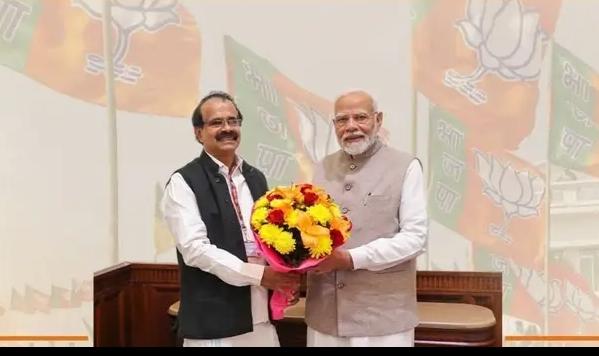
George Kurian with Prime Minister Narendra Modi.

Synopsis: George Kurien’s possible exit from the Union Cabinet has exposed the BJP’s stalled attempt to make deep political inroads into Kerala’s Christian heartland, with his poor Kanjirappally performance in the Assembly polls weakening the party’s carefully crafted outreach strategy. Once projected as the BJP’s key Christian face in Kerala, Kurien now symbolises the limits of symbolic representation when electoral acceptance and grassroots connect fail to follow.
The rise of George Kurien in the BJP was projected as more than a routine ministerial appointment.
When Prime Minister Narendra Modi inducted the veteran Kerala BJP leader into the Union Council of Ministers in 2024, the message from the party was unmistakable: the BJP was attempting a serious and calibrated expansion into Kerala’s influential Christian belt.
Two years later, that experiment appears to have hit a wall.
The BJP’s decision to deny Kurien another Rajya Sabha term from Madhya Pradesh has triggered intense speculation over his continuation as Union Minister of State in the expected Cabinet reshuffle.
With the party naming Tarun Chugh and Rajneesh Agarwal for the two Rajya Sabha seats from the central Indian state, Kurien’s omission is being interpreted within BJP circles as a signal that his ministerial innings may soon come to an end.
For Kerala BJP leaders, the development is politically significant not merely because a Union Minister may lose office, but because Kurien represented a carefully crafted outreach strategy aimed at reshaping the BJP’s fortunes among Kerala Christians.
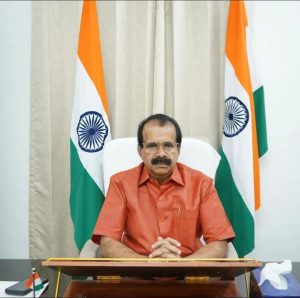
George Kurian
Kurien was never a mass leader in the conventional Kerala political sense.
Unlike celebrity entrants or high-profile defectors, he belonged to the BJP’s old organisational core and had worked within the Sangh Parivar ecosystem for decades. His elevation was therefore seen as a reward for loyalty as well as a political calculation.
As a senior Christian face from the Syro-Malabar Catholic community and a former Vice-Chairman of the National Commission for Minorities, Kurien was expected to become the BJP’s bridge to central Kerala’s Christian population, particularly in Kottayam and Pathanamthitta districts, where the party sensed emerging social churn.
The BJP leadership believed the timing was favourable. Through sustained Christmas and Easter outreach programmes, direct engagement with Church leaders and a sharper focus on minority welfare narratives, the party hoped to soften long-standing resistance among Christian voters toward the BJP in Kerala.
Kurien’s induction into the Union Cabinet was meant to give that outreach credibility.
Also Read: How Munambam’s ‘Thank You Modi’ event turned sour
The strategy reached its peak when the BJP fielded Kurien in Kanjirappally during the 2026 Assembly elections. The constituency, located in the heart of Kerala’s Christian belt, was seen as a politically symbolic terrain.
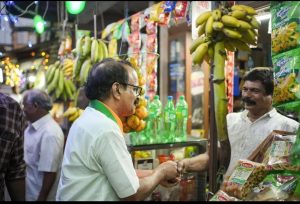
George Kurian during the Assembly election campaign at Kanjirappally.
The expectation within the BJP was that a sitting Union Minister contesting from Kanjirappally could transform the electoral dynamics of the seat and potentially trigger a larger political shift across central Travancore.
Party strategists believed Kurien’s ministerial position, combined with the BJP’s growing visibility among sections of Christians, would help the party emerge as a decisive third force in a constituency traditionally dominated by the UDF and the LDF. It didn’t.
The BJP also expected Kurien’s candidature to consolidate Christian votes that had shown signs of drifting away from traditional fronts in select pockets. Leaders pointed to encouraging trends in nearby constituencies such as Pala and Thiruvalla, where BJP-backed candidates made noticeable gains and unsettled established political equations.
But the Kanjirappally result turned into a major disappointment.
Despite the high-voltage campaign and extensive central leadership backing, Kurien finished third with just 19.84% of the vote share.
More damaging for the BJP was the comparison with former Union Minister Alphons Kannanthanam’s performance in 2021.
Kannanthanam had also finished third, but secured a higher vote share and a larger tally than Kurien, who had the advantage of being a serving Union Minister.
Kannanthanam got 21.17% of the total votes polled.
Within the BJP, many privately acknowledge that the result severely weakened Kurien’s political standing in Delhi.
The defeat exposed the limits of the BJP’s Christian outreach experiment in its present form.
While the party succeeded in generating conversation and visibility within sections of the Christian community, it struggled to convert that engagement into electoral consolidation.
The election campaign was also complicated by controversy surrounding the Foreign Contribution Regulation Act amendments, which created unease among Church institutions and clergy.
Christian organisations and Church-linked publications openly expressed concerns that minority educational and charitable institutions were being unfairly targeted.
That anxiety appeared to trigger a late-stage consolidation of Christian voters behind the Congress-led UDF in several constituencies.
In Kanjirappally, anti-incumbency sentiment against the sitting LDF MLA did not translate into gains for the BJP. Instead, the bulk of those votes shifted toward the UDF candidate, pushing Kurien to the third position.
Political observers also point to another factor: Kurien struggled to shake off the perception that he was more of a Delhi-based organisational leader than a grassroots constituency politician.
Local campaign networks effectively amplified the “outsider” narrative, contrasting him with candidates who possessed deeper constituency-level connections.
Also Read: FCRA row hits BJP’s plan to woo Kerala Christians
Kurien’s likely exit from the Union Cabinet now leaves the Kerala BJP confronting difficult political questions.
The party had invested heavily in projecting him as a symbol of its changing relationship with Kerala Christians. His appointment as minister was showcased repeatedly as evidence that Christians could find representation and influence within the BJP-led central government.
If he exits the Cabinet barely two years after his induction, the party will need to recalibrate both its messaging and leadership strategy in the state.
At present, actor-turned-politician and Thrissur MP Suresh Gopi remains the BJP’s prominent ministerial face from Kerala. But within the state unit, discussions have already begun over whether the party needs a stronger locally rooted leadership structure rather than symbolic appointments aimed at social outreach.
For Kurien, the turn of events marks a sharp reversal. From being projected as the BJP’s key Christian face in Kerala and a Union Minister entrusted with politically sensitive portfolios, he now finds himself uncertain about both his parliamentary and ministerial future.
(Edited by Majnu Babu).



