


Published Mar 11, 2026 | 1:00 PM ⚊ Updated Mar 11, 2026 | 1:00 PM


BJP Kerala election campaign.
Synopsis: With the Assembly elections fast approaching, the BJP in Kerala is positioning itself as the champion of protecting the state’s linguistic identity. With the Union government approving the change of the state’s name to Keralam, the saffron party is using it as a poll plank, claiming it will transform the state into a “new state with a much more developed identity”. By also supporting the Malayalam Language Bill, the party expects to garner the support of a large chunk of the electorate.
Kerala’s political battles have long played out in the streets and at the ballot box, but a quieter contest now appears to be unfolding in the state’s cultural and linguistic spaces — arenas traditionally dominated by the Left.
The BJP’s recent interventions, from backing the move to rename the state “Keralam” in line with its linguistic identity to championing the Malayalam Language Bill that strengthens the use of Malayalam across governance and institutions, have drawn attention beyond routine politics.
The party has also facilitated visits by prominent cultural and literary figures to Prime Minister Narendra Modi and Governor Rajendra Viswananth Arlekar, projecting these developments as milestones worth acknowledging.
Within the party, many see this push as more than symbolic — a calibrated effort to stake a claim in Kerala’s cultural discourse as the Assembly election climate is taking shape.
The term of the current Kerala Assembly ends on 23 May 2026, and hence, the elections are expected in April.

A poster being circulated by BJP following the Union Cabinet decision.
With the process for renaming Kerala as “Keralam” now formally set in motion, the BJP appears keen to own the narrative and turn the development into political momentum ahead of the Assembly elections.
From letters to the chief minister and to the Union government to social media messaging that ties the move to its campaign slogans, the party has been actively projecting the change as part of its larger pitch for a “new” Kerala.
The signs are increasingly visible.
The BJP leadership has been highlighting the development through slogans such as “Now Keralam, Next Vikasitha Keralam”, while linking it to its election themes like “Vikasitha Keralam” (developed Kerala) and “Marathathu Ini Marum” (what remained unchanged will now change).
The messaging suggests that the party sees the renaming exercise not just as a linguistic and cultural correction, but also as a political opportunity in the election season.
The debate, which had briefly faded from public discussion after the Kerala Legislative Assembly passed resolutions in August 2023 and June 2024, resurfaced after BJP state president Rajeev Chandrasekhar wrote to Prime Minister Narendra Modi earlier this year seeking intervention on the issue.
In the letter sent in January 2026, Chandrasekhar pointed out that the Assembly had already passed a resolution requesting the Union government to amend the Constitution’s First Schedule and change the state’s name from “Kerala” to “Keralam”, the form used in Malayalam.
He simultaneously wrote to Chief Minister Pinarayi Vijayan, extending the BJP’s “wholehearted support” for the move.

Chief Minister Pinarayi Vijayan’s letter to BJP state president Rajeev Chandrasekhar following his support for Keralam.
The BJP leader argued that “Keralam”, a name unique to the Malayalam language, reflects the state’s heritage and identity.
According to him, restoring the original name would help preserve cultural roots while strengthening social harmony and countering forces that attempt to divide Malayalis along religious lines.
The political momentum gathered pace on 24 February, when the Union Cabinet, chaired by Prime Minister Narendra Modi, approved the proposal to alter the state’s name from “Kerala” to “Keralam”.
Following the Cabinet decision, the President of India is expected to refer the Kerala (Alteration of Name) Bill, 2026 to the Kerala Legislative Assembly under the proviso to Article 3 of the Constitution, seeking the Assembly’s views. After the state’s response is received, the Union government will take further steps and obtain the President’s recommendation for introducing the Bill in Parliament.
The Cabinet nod immediately triggered political messaging within the BJP ecosystem.
On the same day, party social media groups began circulating the slogan “Now Keralam, Next Vikasitha Keralam“, quickly linking it to the party’s campaign theme of “Vikasitha Keralam” (Developed Kerala) — one of its key election narratives.
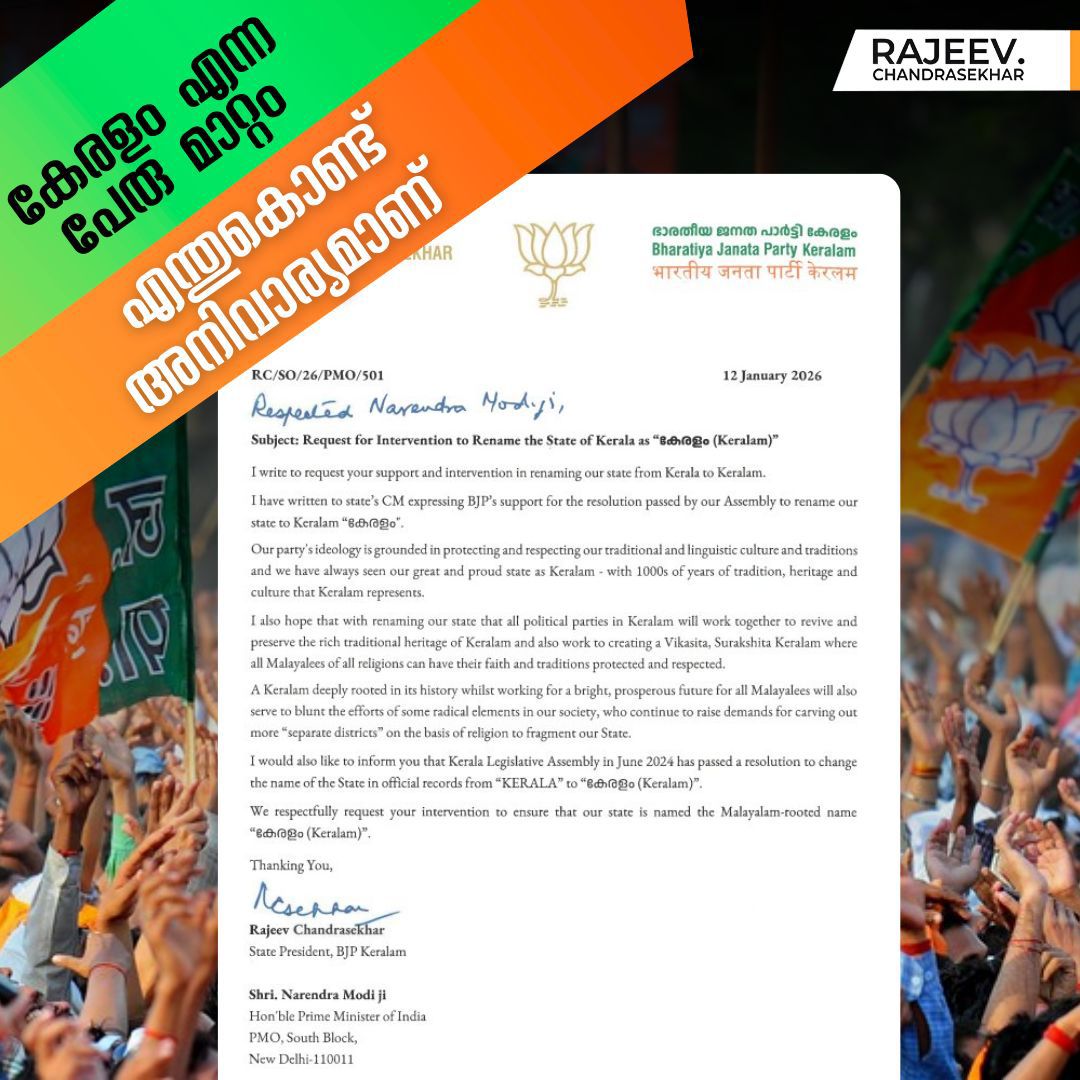
BJP state president’s letter to PM.
Chandrasekhar himself amplified the messaging on social media, thanking the Union government for considering his request and calling the decision one that serves the interests of Malayalis.
“While building a Vikasitha Keralam, we should never forget our uniqueness and identity. Restoring the original name of the state is only the first step towards that change,” he wrote, adding that the move reflects a determination to preserve heritage while protecting society from forces seeking to divide people along religious lines.
In another post a day later, the BJP leader linked the development with another of the party’s campaign slogans — “Marathathu Ini Marum” (what has remained unchanged will now change).
“What remained unchanged will change now. This is change,” he said, noting that the first Union Cabinet meeting held at the Prime Minister’s new office, Sevatheerth, had decided to rename the state.
Chandrasekhar said he had written to the Prime Minister on 12 January 2026, urging him to take what he described as a “historic step” to honour Kerala’s heritage and protect its language and cultural roots.
Adding a sharper political edge, he also accused the CPI(M), Congress and their allies of standing against the values of Malayalis, while asserting that the BJP-led NDA remains committed to heritage, security and development.
A clear indication that the BJP appears determined to make the most of the moment.
In the case of the Malayalam Language Bill, 2025, it’s the timing that draws political attention. It came into force a day after the BJP’s state leadership publicly urged the Governor to approve it.
The legislation, originally passed by the Kerala Legislative Assembly on 9 October, 2025, had been awaiting the Governor’s assent for months.
The comprehensive law was introduced after addressing concerns raised earlier by the Union Government as well as linguistic minorities regarding a similar bill that had been proposed in 2015.
On 3 March, Chandrasekhar wrote to Governor Rajendra Vishwanath Arlekar requesting that the bill be signed into law.
In his letter, he pointed out that a delegation of cultural leaders who had recently met Narendra Modi to thank him for officially recognising the name of the state as “Keralam” had also raised the need to approve the Malayalam Language Bill.
Chandrasekhar noted that the legislation would enhance the stature of both Kerala and Malayalam and would be a matter of pride for Malayalis across the world.

A BJP poster that credits Rajeev Chandrasekhar for the Malayalam Language Act.
At the same time, the BJP leader emphasised that giving primacy to Malayalam should not come at the cost of other languages. English and Hindi, he said, remain important for the progress of the youth, and the law should be implemented while ensuring that linguistic minorities do not face difficulties.
He also suggested that the concerns of minorities be addressed through detailed rules and a phased implementation of the law. The letter further called for a strong translation system, multilingual support wherever necessary and special provisions for border districts.
A day after the letter was sent, the Governor granted assent to the bill. With the Governor’s approval, the Malayalam Language Bill, 2025, came into immediate effect across the state.
The new law mandates the use of Malayalam in government administration and extends its scope to semi-government institutions, public sector undertakings and cooperative bodies.
It also seeks to strengthen the role of Malayalam in governance and education through a series of structural reforms.
Politically, the BJP’s state leadership is presenting the development as part of its continued intervention in cultural and linguistic matters in the state, claiming that its push helped bring renewed momentum to efforts aimed at strengthening the position of Malayalam.
Alongside its political outreach in Kerala, the BJP has also been making a concerted effort to engage prominent figures from the state’s cultural and literary circles.
As part of this initiative, a group of noted personalities met Prime Minister Narendra Modi in New Delhi on 27 February.
The delegation called on the Prime Minister, along with Chandrasekhar.

Delegation meeting the PM.
Among those present were Malayalam literary figures Dr George Onakkoor, Sreekumaran Thampi and V Madhusoodanan Nair, Kendra Bala Sahitya Akademi award winner Sreejith Moothedath, senior journalist P Sreekumar, and academician Dr AM Unnikrishnan.
Chandrasekhar later described the meeting as a privilege, saying the Prime Minister had received “giants of the Malayalam literary world” at his residence.
He said the delegation conveyed their appreciation to the Prime Minister for what he described as a long-pending demand being addressed — the formal adoption of the name ‘Keralam’ for the state, which, according to him, had remained unresolved for decades.
Chandrasekhar termed the move a significant step towards reaffirming the state’s cultural identity and traditions, adding that it reflected a style of leadership that prioritises implementation over prolonged debate.
The outreach continued on 6 March, when a group of prominent literary personalities met the Governor at Lok Bhavan.
Led by Onakkoor and poet Madhusoodanan Nair, the delegation presented the Governor with a sheaf of paddy and kanikkonna (Indian Laburnum or cassia fistula), Kerala’s official flower.
The group thanked the Governor for signing the Malayalam Language Bill, describing it as an important measure to strengthen the status and use of the language in the state.
The renewed political conversation around the name “Keralam” and the strengthening of Malayalam in governance has sparked a fresh round of claims, counter-claims and reflections on the place of language in Kerala’s public life.
A BJP leader said the developments go beyond a routine administrative decision and represent a broader attempt to reaffirm Kerala’s cultural identity.

A poster from the BJP that credits Rajeev Chandrasekhar for Keralam decision.
“For decades, the BJP has been unfairly portrayed as a party that promotes Hindi at the cost of regional languages. The developments surrounding the recognition of the name ‘Keralam’ and the coming into force of the Malayalam Language Act clearly show how misplaced that narrative is. India’s strength lies in its linguistic diversity, and Malayalam — with its rich literary heritage — deserves institutional support and pride of place in governance and public life,” he told South First.
According to the BJP, the language question is also tied to a broader developmental vision.
“When we speak about ‘Now Keralam, Next Vikasitha Keralam’, we are presenting a vision where identity and progress move together. As Kerala prepares for a new political phase, the BJP wants to make it clear that we are not just an electoral force but a party that respects the language, culture and civilisational roots of this land while working towards a developed and forward-looking Keralam,” he added.
Leaders in the CPI(M), however, view the BJP’s new enthusiasm with scepticism.
“It is quite amusing to see the BJP suddenly discovering a deep love for Kerala’s language and culture,” a senior CPI(M) leader told South First.
“The initiatives they are now trying to celebrate — whether it is the move to adopt the name ‘Keralam’ or the strengthening of Malayalam through legislation — are outcomes of processes shaped by the state government and the wider cultural community over many years. What the BJP is doing now is attempting to take credit for someone else’s labour,” he stated.
The leader argued that Kerala’s linguistic and cultural spaces have historically been nurtured by progressive movements.
“The Left movement in Kerala has always supported literary movements, progressive writers, cultural organisations and public institutions that defended Malayalam and encouraged a vibrant intellectual tradition. The BJP knows very well that it has very little organic presence in these spheres,” the leader said.
According to the CPI(M), the party’s recent cultural outreach is part of a broader political strategy.
“What we are seeing now is a calculated political exercise — an attempt to slowly enter and influence spaces that have long been shaped by progressive and Left-leaning ideas. By organising symbolic meetings with cultural figures and amplifying routine developments as major interventions, they are trying to create the impression of a cultural foothold. But Malayalis are politically aware and can see that these gestures are more about electoral optics than genuine commitment,” another CPI(M) leader told South First.
Political analyst Sreejith Panicker believes there is nothing unusual about political parties championing initiatives linked to language and cultural identity, but he doubts that such efforts would translate directly into electoral gains.
“Any political party operating in Kerala can legitimately take up initiatives that strengthen the state’s cultural identity or promote the Malayalam language,” he said. “But expecting these moves to automatically bring votes would be a misunderstanding of Kerala’s political temperament.”
Panicker pointed out that Malayalis have historically displayed a more open linguistic outlook compared to some other states.
“Compared to states like Tamil Nadu or Karnataka, Malayalis are not intensely territorial about their mother tongue. There has always been an openness here to learn and engage with other languages and cultures. So if anyone believes that championing such initiatives will automatically produce electoral dividends, they may end up disappointed,” Panicker told South First.
Senior journalist and noted literary critic PK Rajasekharan believes the discussion should move beyond the immediate political debate and look at the broader cultural meaning of the change.
“No other state in India faces the unusual situation of its name being pronounced in three different ways,” he noted. “Among Malayalis, it is Keralam, in English it becomes Kerala, and in Hindi it turns into Keral. What we have now allows us to say Keralam everywhere, and that carries symbolic value.”
At the same time, Rajasekharan cautioned against assuming that language alone could become a decisive political issue in the state.
“Malayalis have a long tradition of accepting and engaging with other languages. That openness is precisely why translation has flourished here. Cultural adaptation comes naturally to us. Some critics say Malayalis are not passionate about Malayalam, but that is not really true. People still read Malayalam classics and continue to celebrate Malayalam cinema and songs, even those produced decades ago,” he told South First.
He also noted that Kerala was among the early adopters of the three-language policy.
“The state embraced the three-language formula as far back as the 1970s. That itself reflects Kerala’s historically inclusive approach to language,” Rajasekharan added.
For now, the debate around Keralam appears to be as much about political positioning as cultural symbolism.
(Edited by Muhammed Fazil.)


