

Published Feb 09, 2026 | 8:00 AM ⚊ Updated Feb 09, 2026 | 8:00 AM

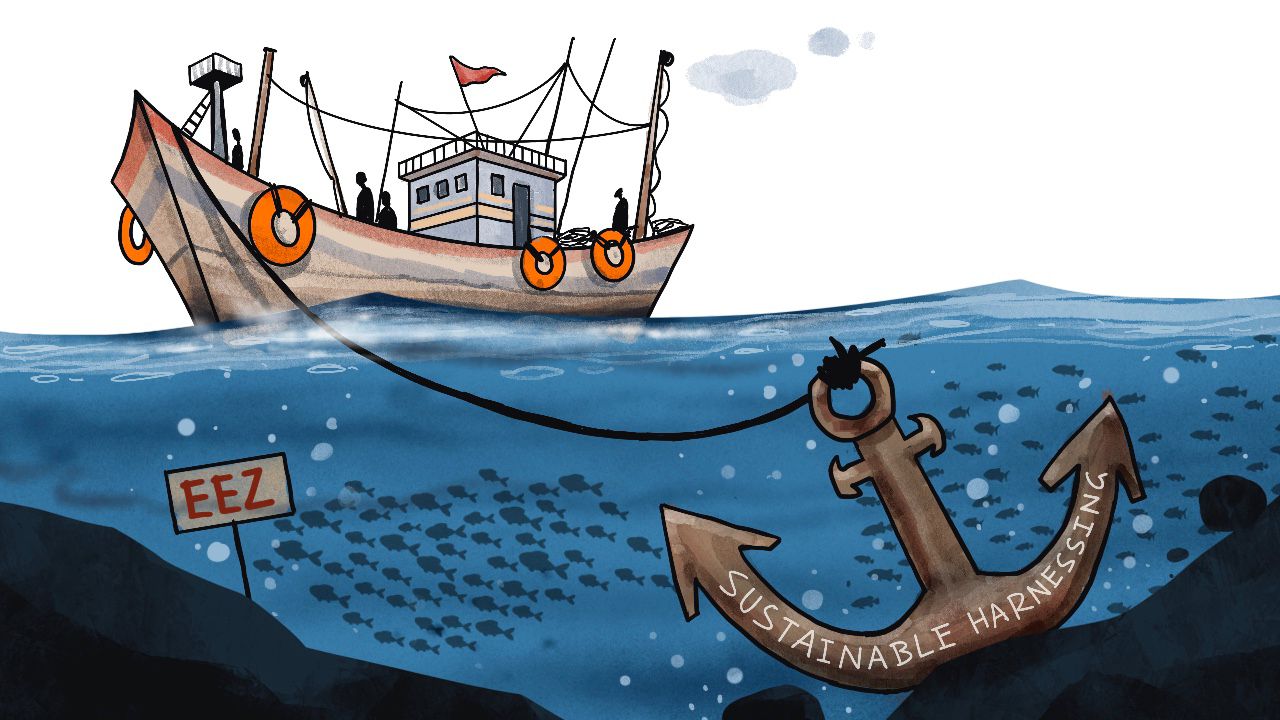
EEZ Kerala.
Synopsis: The fishing community in Kerala is concerned after the Union government notified the Sustainable Harnessing of Fisheries in the Exclusive Economic Zone (EEZ) Rules, 2025. Fishers in Kerala warn that the rules could accelerate corporate control over deep-sea fishing, weaken coastal livelihoods and divert economic activity away from the state’s harbours.
Kerala’s traditional fishing community is staring at a fresh crisis after the Union government notified the Sustainable Harnessing of Fisheries in the Exclusive Economic Zone (EEZ) Rules, 2025, triggering sharp opposition from the state and fisher organisations.
While the Union government describes the move as a cornerstone of India’s ‘Blue Economy’ vision, fishers in Kerala warn that the rules could accelerate corporate control over deep-sea fishing, weaken coastal livelihoods and divert economic activity away from the state’s harbours.
At the heart of the controversy is the provision allowing mid-sea transshipment of catch to large “mother vessels”, including factory ships — a mechanism Kerala fears could pave the way for illegal, unreported and unregulated (IUU) fishing, foreign vessel entry and the gradual marginalisation of small and traditional fishers.
The state has an EEZ of 2.18 lakh sq. km.
The Ministry of Fisheries, Animal Husbandry & Dairying notified the new rules in November 2025, describing them as a “major step towards a prosperous and inclusive Blue Economy”.
According to the Union government, the regulations are designed to unlock deep-sea fishing potential beyond India’s territorial waters and boost seafood exports through value addition, traceability and certification.
The rules give priority to Fishermen Cooperative Societies and Fish Farmer Producer Organisations (FFPOs) for deep-sea fishing operations and for managing technologically advanced vessels.
A key feature is the introduction of the “mother-and-child vessel” model, which allows fishing vessels to transfer their catch to larger mother vessels at sea under what the Union government calls an “effective monitoring mechanism”, aligned with Reserve Bank of India (RBI) guidelines.
The government has also promised extensive support for fishers through training programmes, international exposure visits, and capacity-building across processing, marketing, branding and exports. Easier access to credit is to be facilitated through flagship schemes such as the Pradhan Mantri Matsya Sampada Yojana (PMMSY) and the Fisheries and Aquaculture Infrastructure Development Fund (FIDF).
In its defence, the Union government said the EEZ Rules take a firm stand against environmentally destructive practices such as LED light fishing, pair trawling and bull trawling.
Minimum legal sizes for fish species are to be prescribed, and Fisheries Management Plans will be drawn up in consultation with stakeholders, including state governments, to rebuild depleted stocks.
The rules also promote mariculture activities such as sea-cage farming and seaweed cultivation as alternative livelihoods aimed at reducing pressure on nearshore resources.
According to the Ministry, these measures are expected to help small-scale fishers access deep-sea resources and earn higher incomes by targeting high-value species such as tuna for global markets.
Despite these assurances, Kerala has remained strongly opposed to several provisions.
Speaking in the Assembly on 2 February, Fisheries Minister Saji Cheriyan said the state had formally conveyed its “serious concerns” to the Union government regarding the deep-sea fishing policy embedded in the EEZ Rules.
“The regulations have made provision for allowing transshipment through mother vessels, including factory ships, in the mid-sea. This could lead to IUU fishing and the entry of foreign vessels,” the Minister told the House while responding to questions from MLAs E Chandrasekhran, PS Supal, Muhammed Muhsin and P Balachandran.
Kerala, he said, had objected to ownership definitions that could favour large corporate entities in deep-sea fishing and had demanded that such companies be excluded from the scope of ‘owner’.
The state also flagged mid-sea transshipment as a security risk and warned that it would destroy employment opportunities and economic activity centred around local harbours.
According to the minister, the Union government went ahead with the regulations despite Kerala’s objections, retaining provisions for corporate participation and mid-sea transshipment, subject to RBI guidelines.
Kerala had also sought a revenue-sharing mechanism between the Union government and states and proposed appointing district collectors as appellate authorities — measures it said were essential to uphold federal principles and protect ordinary workers.
“We will continue to exert pressure on the Union government to review provisions in the regulations that are harmful to fishermen,” Cheriyan said.
Responding to questions on whether fish resources from the Kerala coast could now be marketed and processed through large vessels, the minister confirmed that the new rules do allow certain deep-sea vessels to transfer fish to mother vessels at sea.
Cheriyan reiterated that ownership and control of fish resources in territorial waters rest with the state governments.
In Kerala, this authority is exercised through the Kerala Marine Fishing Regulation Act (KMFRA), which imposes strict safeguards including seasonal trawling bans, protection of traditional fishing gear, vessel registration and licensing, and the division of fishing zones.
He said the state was taking legal and administrative steps to protect fisheries resources as a natural asset of Kerala and to safeguard the livelihood of traditional fishers.
The complementary operation of the Central rules and the KMFRA, he added, would be used to prevent industrial exploitation and ensure food and nutritional security.
At the same time, South First has accessed the detailed objections raised by the state government to the Union government on the rules, warning that the framework could fundamentally alter fisheries governance to the detriment of traditional fishing communities.
The comments were formally shared in September 2025 with Dr Sanjay Pandey, Deputy Commissioner (Fisheries), Department of Fisheries, Ministry of Fisheries, Animal Husbandry and Dairying, and were issued by Abdul Nasar B, Special Secretary to the Government, State Fisheries Department.
The state’s primary objection relates to the legal form of the Rules.
Regulation of fisheries in the EEZ, involving sovereign rights, ecological sustainability, trade and maritime security, is of such national importance that it warrants a comprehensive law enacted by Parliament, the state argued.
It noted that such legislation is reportedly under preparation and would allow meaningful debate on the governance of national resources and the livelihoods of millions of fishers.
Institutionally, the state flagged the “convoluted” enforcement structure under the rules. While states are constitutionally responsible for fisheries regulation in territorial waters and already have Marine Fishing Regulation Acts, the new framework assigns them limited roles.
A state officer acts as verifier and adjudicator, while the issuing authority and appellate authority lie with the Union government.
This, the state warned, would force marginal fishers from remote coastal districts to appeal decisions before a Joint Secretary in Delhi, effectively denying them access to justice.
The rules’ heavy emphasis on Access Passes was another concern. By reducing governance to a licensing regime, they overlook conservation, equitable benefit sharing, livelihood security and food sovereignty.
The Access Pass, the state noted, adds another layer to existing state licences, increasing costs and duplication. The framework, the submission argued, favours export-oriented, industrial fishing interests.
A broad definition of “owner” places corporations on par with individual fishers, while provisions such as mid-sea transhipment benefit large mechanised operators and raise serious security and IUU fishing risks.
Small fishers, though nominally exempt, remain burdened by compliance and surveillance, while penalties for large vessels are disproportionately low.
The state also objected to revenue centralisation, pointing out that all fees and penalties flow into Bharat Kosh, even as enforcement costs fall largely on states.
Despite Kerala repeatedly flagging strong objections to the Union government’s deep-sea fishing policy and the new rules governing fishing in the Exclusive Economic Zone, several critical questions raised in the Assembly remain unanswered.
On 2 February, responding to a series of pointed queries by Mons Joseph MLA, the state Fisheries Minister said that information was still being collected.
The questions touched on core issues worrying the fishing community. These included why successive expert committee reports on deep-sea fishing, submitted between 1977 and 2014, were not accepted by the government, whether their recommendations would be implemented, and if so, what concrete steps had been taken so far.
The MLA also sought clarity on allegations that large industrial fishing vessels operating within the Indian EEZ were severely affecting the livelihoods of traditional fishermen, and whether any studies or assessments had been conducted to evaluate this impact.
Concerns over the ecological fallout of permitting factory trawlers and large vessels under the deep-sea fishing policy — particularly the possible decline in fish stocks in Kerala waters — were also raised, along with questions on whether any environmental impact studies had been carried out.
The minister offered the same response when asked about protective measures in the policy to ensure job security for an estimated 1.5 million people who directly and indirectly depend on fishing along the coast, as well as about consultations with traditional fishermen’s organisations and cooperatives before granting permissions.
The allegation that the policy was framed without taking into account the knowledge and experience of traditional fishermen, potentially leading to social inequality and job losses, was also brought to the floor, with a demand to know whether the government was considering a review of the policy.
Here too, the reply was that details were yet to be gathered.
Meanwhile, speaking to South First, Jackson Polayil, state president of the Kerala Swathantra Matsya Thozhilali Federation, said that while the Union government frequently projects the “blue economy” as a major policy priority, traditional fishers are often pushed to the margins, with the benefits largely flowing to corporate players.
Referring to the newly notified Rules, Polayil said that although there are certain provisions that appear, at least on the surface, to address the concerns of traditional fishing communities, a final position can be taken only after a detailed examination.
“We are not rigid about clinging to old ways. We understand that times are changing, and we are prepared to adapt,” he said. “But that cannot come at the cost of our very survival. If any provision threatens our existence as traditional fishers, we will oppose it strongly,” he stated.
He added that the Federation would study the Rules threadbare before arriving at a clear and collective stand.
With a 600-km coastline, about 13,000 sq. km of territorial waters and an EEZ of 2.18 lakh sq. km, Kerala has long been one of India’s most active maritime states.
Fisheries remain central to the state’s economy and livelihoods, supporting over one million people and contributing significantly to food and nutrition security.
In 2024-25, Kerala recorded a total fish production of 9.28 lakh Metric Ton (MT), of which 6.47 lakh MT came from the marine sector. The state also continues to be a major player in seafood exports, ranking third in quantity and second in value nationally.
During 2024-25, Kerala exported 1.80 lakh MT of seafood worth ₹6,941.29 crore, reflecting a steady rise in marine exports since 2015-16 and underlining the sector’s growing economic importance.
(Edited by Muhammed Fazil)


