

Published Apr 07, 2026 | 3:32 PM ⚊ Updated Apr 07, 2026 | 3:32 PM

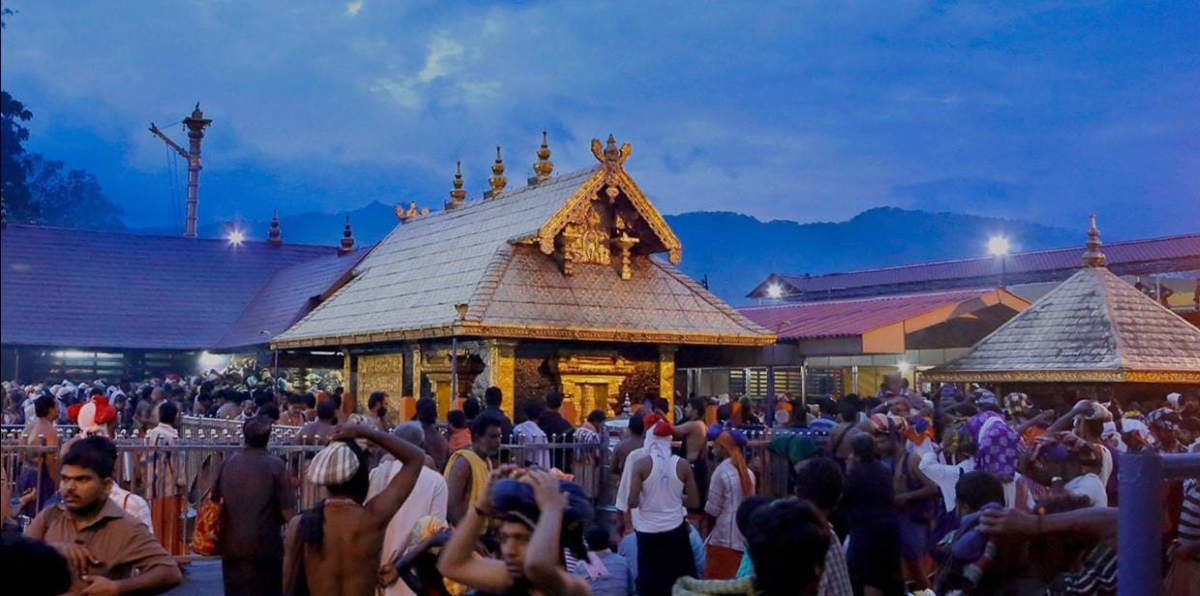
Sree Dharmasastha Temple at Sabarimala.
Synopsis: Even as Kerala is set to vote, and the Supreme Court simultaneously hears arguments on one of the state’s most emotionally charged issues: allowing — or not allowing — women of child-bearing age to worship at the Sabarimala temple.
Public campaigning for the Kerala Assembly elections will end at 6 pm on Tuesday, 7 April. The loudspeakers will fall silent, roadshows will stop, and candidates will get busy seeking votes personally.
But even as Kerala enters the silent phase before the 9 April polling, the political heartbeat around allowing — or not allowing — women into the Sree Dharmasastha Temple at Sabarimala is getting louder.
From Tuesday, the Supreme Court will begin hearing the Sabarimala review petitions once again. By the time Kerala goes to the polling booths, the court will still be hearing arguments over whether women of menstruating age, defined as those aged between 10 and 50, should be allowed to the hill shrine of the celibate God, Ayyappa.
The issue is touchy as well as legal. Major political parties avoided an open campaign on the issue during the run-up to the polls.
Unlike 2021, Sabarimala is not dominating speeches, posters or public rallies. Yet, behind the scenes, there is a sense that the issue has returned at a politically sensitive moment.
In many places, especially within sections of the Nair Service Society (NSS), a community organisation, and among traditional Hindu families, there are quiet discussions and whispered campaigns about the stand the state government should adopt.
For the ruling LDF led by Chief Minister Pinarayi Vijayan, the timing of the hearing is delicate.
The LDF is trying for a third straight term in power, something no front has achieved in Kerala. But the Sabarimala women’s entry issue remains a double-edged sword.
A strong stand in favour of women’s entry could alienate conservative Hindu voters. Moving too far in the other direction could upset the Left’s cultivated image of a progressive force that has stood for gender equality and social reform.
Perhaps no constituency captures the changing political reality around Sabarimala better than Konni in the Pathanamthitta district.
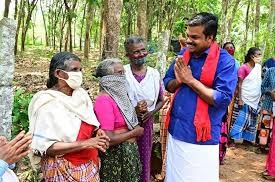
KU Janeesh Kumar
The hill shrine is in the Konni Assembly constituency. The seat is currently represented by CPI(M)’s KU Janeesh Kumar. The UDF has fielded Satheesh Kochuparambil, while the NDA has fielded TP Sundaresan.
In the 2021 election, BJP’s then state president K Surendran contested from Konni, hoping to cash in on the religious sentiments frayed by the entry of women, reportedly with LDF support, into the temple. The move, however, failed.
Konni’s social mix is more complicated than what meets the naked eye. The constituency has migrants from Central Travancore, large Hindu populations including Ezhava and Nair communities and a decisive Christian vote base including Dalit Christians.
For decades, Konni was a UDF stronghold. But after the 2019 Lok Sabha election, which Adoor Prakash of the Congress won, the subsequent bypoll saw CPI(M)’s Janeesh Kumar capturing the seat.
Speaking to South First, Ajith TP, a voter from Konni, said there were attempts at religious polarisation during the height of the women’s entry controversy. But he said that this time, the issue is not central to everyday political conversations.
He said people are more concerned about welfare schemes, development, road connectivity and recurring human-animal conflict.
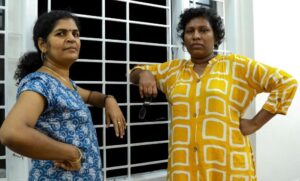
On 2 January 2019, Kanaka Durga and Bindu Ammini became the first women to enter the Sabarimala temple after the Supreme Court’s 2018 verdict.
”More than the women’s entry issue, the alleged Sabarimala gold theft is likely to be a major factor this time. The UDF has been aggressively campaigning around it, perhaps even more than the BJP. There is also a perception among some people that CPI(M) leaders were involved in looting temple assets, and that could influence voters.” he said.
Ajith’s words may explain why parties are being careful.
Both the Sabarimala women’s entry issue and the gold theft case carry strong emotional weight among devotees of Lord Ayyappa. It can influence sentiment quietly, especially among older voters and religious communities. But it no longer appears strong enough to define an election on its own.
Meanwhile, despite concerns over migration and locked NRI homes affecting local politics, Pathanamthitta district recorded an impressive 96.87% turnout in home voting for the Assembly elections. Among voters above 85 years, 9,022 out of 9,341 cast their votes, while 1,834 of 1,866 registered persons with disabilities exercised their franchise, taking PwD turnout to 98.29%.
In Pathanamthitta, where the Sabarimala women’s entry controversy was a major election issue last time, the LDF had swept all five Assembly seats. This time, the district has 9,77,921 voters in the rolls, including 5,09,792 women, 4,68,124 men and five transgender voters.
The first Pinarayi Vijayan government had strongly backed the Supreme Court’s 2018 verdict allowing women of all ages to enter Sabarimala. The then government described the judgment as a reflection of Kerala’s renaissance values.
It also attempted to implement the order despite strong protests from the Congress, BJP and various Hindu organisations, including NSS and the Sree Narayana Dharma Paripalana Yogam.
The 2018 judgment was delivered by a 4:1 majority. Then Chief Justice Dipak Misra, along with Justices RF Nariman, AM Khanwilkar and DY Chandrachud, held that devotion cannot be subjected to gender discrimination. Justice Indu Malhotra dissented.
The court ruled that devotees of Lord Ayyappa did not constitute a separate religious denomination and struck down Rule 3(b) of the Kerala Hindu Places of Public Worship (Authorisation of Entry) Rules, 1965, which barred women’s entry.
However, the political backlash that followed was severe.
The BJP used the issue to mobilise sections of Hindu voters. The Congress also opposed the government’s handling of the issue. Large, often violent, protests broke out across the state. Over the years, the LDF government appeared to soften its stand.
The shift has now become more visible in court.
In written submissions filed before the Supreme Court in March 2026, the Kerala government said any change to long-standing religious customs should happen only after wide consultations with religious scholars and social reformers. The government also said courts should consider the diverse Hindu practices.
Then came an even bigger shift.
On Monday, 6 April, the Advocate on Record for the Kerala government, Nishe Rajen Shonker, wrote to Krishna Kumar Singh, the nodal counsel for the review petitioners, saying that the state was now supporting the review petitions challenging the 2018 verdict.
The state requested that its name be included alongside those opposing the entry of women aged 10 to 50. It also asked for one hour to present arguments before the court. This is a major legal and political U-turn.
Earlier, senior advocate Jaideep Gupta had been allotted time to argue in support of the 2018 verdict on behalf of the Kerala government. Now, the government wants to stand with those challenging that judgment.
The Travancore Devaswom Board (TDB), which manages the temple, has also decided to oppose the entry of women aged 10 to 50.
Even though no party is openly foregrounding Sabarimala in campaign speeches, community organisations have once again entered the conversation.
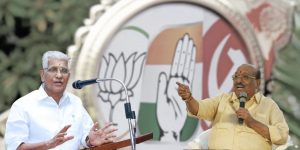
G Sukumaran Nair and Vellappally Natesan.
NSS general secretary G Sukumaran Nair said the Kerala government had protected traditional customs over the last six years while the case was pending before the Supreme Court. He said both the government and the Devaswom Board should clearly oppose women’s entry into the shrine.
He also said the NSS would pursue legal remedies if future decisions go against its position.
SNDP Yogam general secretary Vellapally Natesan took a slightly softer tone but also said the government had not seriously tried to implement the 2018 verdict because it knew public sentiment was against it.
Natesan told South First that customs and traditions should be protected unless they are harmful to society. He maintained that women’s entry into Sabarimala was not acceptable and said women were not allowed into the temple even in earlier times.
The pressure from Hindu community organisations like NSS and SNDP is significant because both influence several Assembly constituencies, especially in southern and central Kerala.
The case before the Supreme Court now goes far beyond Sabarimala.
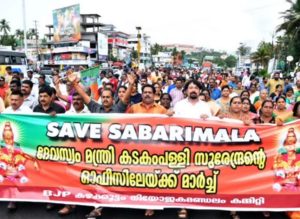
In 2018, BJP-RSS and other Hindu outfits opposed the Left government’s move to implement the women’s entry verdict.
A newly constituted nine-judge Constitution Bench led by Chief Justice Surya Kant will hear the matter from 7 April to 22 April. The Bench also includes Justices BV Nagarathna, MM Sundresh, Ahsanuddin Amanullah, Aravind Kumar, Augustine George Masih, Prasanna B Varale, R Mahadevan and Joymalya Bagchi.
The court had earlier taken up review petitions against the 2018 verdict, and in 2019, a five-judge Bench headed by then Chief Justice Ranjan Gogoi, referred larger constitutional questions to a nine-judge Bench.
Later, in February 2020, another nine-judge Bench clarified that important questions of law can be referred to a larger Bench even at the review stage.
The current Bench will now examine seven broad constitutional questions. These include the balance between the right to freedom of religion under Articles 25 and 26 and other rights such as equality and dignity under Article 14.
The court will also consider what ”constitutional morality” means, how far courts can examine whether a practice is essential to a religion, whether religious denominations and sections within them enjoy protection under Article 26, and how far public interest litigations can challenge religious practices.
The case also overlaps with other sensitive issues, including women’s entry into mosques, the practice of female genital mutilation among the Dawoodi Bohra community and the rights of Parsi women married outside the faith.
In total, 67 petitions are before the court.
Senior advocate K Parameswaran has been appointed amicus curiae. Krishan Kumar Singh is the nodal counsel for the review petitioners. Advocate Shivam Singh will assist the amicus curiae.
The review petitioners and those supporting them will be heard from 7 to 9 April. Those opposing the review petitions and supporting women’s entry will be heard from 14 to 16 April. Reply submissions will be taken up on 21 April, and the amicus curiae is expected to complete final arguments by 22 April.
This means that on 9 April, when Kerala votes, the Supreme Court will likely be hearing arguments from the Travancore Devaswom Board against the entry of women.
Solicitor General Tushar Mehta is expected to lead arguments supporting the review petitions. He is likely to argue that courts cannot decide essential religious practices and that Article 25 does not allow people to impose reforms on the internal traditions of a religious denomination.
Senior advocate V Giri will represent temple tantri Kandararu Rajeevaru. Senior advocate Abhishek Manu Singhvi will appear for the Travancore Devaswom Board.
On the other side, senior advocates Indira Jaising, Menaka Guruswamy, Shahdan Farasat, Vijay Hansaria, K Radhakrishnan and Sanjay Hegde are expected to defend the 2018 verdict.
Even as Kerala is set to vote, and the Supreme Court simultaneously hears arguments on one of the state’s most emotionally charged issues: allowing — or not allowing — women of child-bearing age to worship at the Sabarimala temple.
(Edited by Majnu Babu).


