


Published May 03, 2025 | 12:00 PM ⚊ Updated May 03, 2025 | 12:00 PM


Athirappilly Waterfalls courtesy - Kerala Tourism
Synopsis: The controversial Athirappilly hydroelectric project is back in focus as the Kerala State Electricity Board (KSEB) now seeks to revive it with a tourism spin. Rebranding it as a “green tourism” initiative, KSEB has commissioned a Tourism Master Plan to support the proposal. While the board argues it’s essential for energy security, environmentalists remain unconvinced about its ecological impact
Just when it was believed that the controversial Athirappilly hydroelectric project (HEP) had been quietly laid to rest, the Kerala State Electricity Board (KSEB) has breathed new life into it — with a clever twist.
In a fresh move that has set tongues wagging and activists on edge, the state-run power utility has proposed reviving the long-opposed project by adding a tourism-friendly façade.
To back its pitch, KSEB has even roped in an agency to prepare a Tourism Master Plan for Athirappilly, attempting to rebrand the hydro project as a ‘green tourism’ initiative.
But as expected, the development has rekindled familiar debates over its potential ecological and social consequences, with environmentalists warning that a new label won’t erase the old risks.
According to the KSEB, the long-pending 163 MW Athirappilly HEP is vital for the state’s energy security and economic sustainability.
With over 70 percent of Kerala’s electricity needs met by costly power purchases from other states — especially during peak evening hours when solar power is unavailable — the demand for reliable, domestic power generation has never been greater.
However, it has to be noted that the project that’s been floating in the air since the 1970s, only to be shelved every time controversy struck. Over the decades, multiple attempts were made to breathe life into it — but each faded into oblivion before it could take off.
The concerns were mainly raised about the project’s impact on the iconic Athirappilly waterfalls.
Meanwhile, KSEB asserts these fears are unfounded.
It points out that the project has been carefully designed to safeguard the water flow and natural beauty of the falls by including a dedicated 3 MW generator that will operate round-the-clock, ensuring uninterrupted water flow even during the summer months when the waterfall currently tends to dry up.
In fact, KSEB argues that the project would enhance tourism potential by maintaining the waterfall’s perennial charm, while also strengthening Kerala’s energy independence by reducing reliance on expensive thermal power imports from North India.
Despite securing all necessary environmental and forest clearances, the project has remained stalled due to opposition from certain quarters — a situation KSEB believes must be revisited in light of the state’s growing energy needs and the project’s minimal ecological footprint.
It was on 24 April 2025, that the KSEB issued orders for the preparation of a comprehensive Tourism Master Plan for Athirappilly, marking a fresh chapter in the controversial project.
The order highlighted that the tourism potential of Athirappilly was first highlighted during a presentation on 17 January 2025 by the Center for Environment Architecture and Human Settlements (C-EARTH), Kozhikode, before the KSEBL Chairman and senior officials.
The presentation focused on eco-tourism opportunities around Malankara Dam, Idukki Dam, and Banasurasagar, and sparked discussions on transforming the controversial Athirappilly Hydroelectric Project (HEP) into a tourism-friendly venture.
It was proposed to integrate tourism amenities such as a tribal hamlet, school, primary health centre, and public spaces alongside the project.
Recognising C-EARTH’s expertise and longstanding association with tourism projects in Kerala, the Deputy Chief Engineer (Hydel) recommended permitting them to visit Poringalkuth Dam, Athirappilly project site, and surrounding areas to submit their lowest rates for preparing the master plan.
The proposal was placed before the full time Directors of KSEB, who, on 19 March 2025, resolved to remodel Athirappilly HEP as a tourism-friendly project and decided to process C-EARTH’s proposal with detailed terms, conditions, and budget for final approval.
The KSEB has reiterated the merits of the proposed Athirappilly hydroelectric project, claiming it will ensure uninterrupted water flow to the iconic Athirappilly waterfall while boosting tourism and power generation.
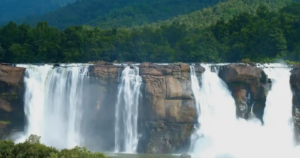
Athirappilly Waterfalls
Courtesy – Kerala Tourism
As per a statement from the KSEB Chairman and Managing Director’s office, the project includes a dedicated 3 MW generator operating round the clock to guarantee continuous water flow to the falls — addressing the perennial issue of the waterfall drying up during summers.
Additionally, the project proposes a reservoir to collect water released by upstream projects at night, releasing it through the waterfall during the day to enhance its beauty and ensure year-round tourist activity.
The KSEB also argues that the dam will help mitigate annual flood threats in the lower Chalakudy River by regulating water discharge.
Beyond power generation, the initiative promises to transform Athirappilly into a vibrant tourism hub, introducing boating, zip lines, ropeways, and possibly seaplane services if permitted.
The project also envisions acquiring nearby degraded plantation land to develop tourist amenities like parking, shopping spaces, and recreational areas.
The Board claims the integrated plan will multiply the region’s tourism potential, combining ecological allure with infrastructural and economic development.
Beyond the glossy image projected by the KSEB, environmental groups have long raised serious concerns over the proposed 163 MW Athirappilly HEP.
In a joint statement in 2007, organisations like WWF-India, River Research Centre, ATREE, Kalpavriksh, and SANDRP warned that the project grossly underestimates the region’s ecological and biodiversity value.
They pointed out that the Chalakudy river basin, especially the Vazhachal Division, is a vital ecological stretch in the Southern Western Ghats with an exceptionally high conservation value. Declared an Important Bird Area (IBA) by BirdLife International, it harbours all four species of hornbills found in the Western Ghats and critical migratory routes for elephants.
The National Bureau of Fish Genetic Resources recommended the upstream Chalakudy River as a fish sanctuary due to its 104 fish species — 42 of which are endangered, vulnerable, or near-threatened — surpassing even the Periyar River.
The joint statement also highlighted that conservationists like AJT Johnsingh have highlighted its importance as a biodiversity corridor linking Parambikulam and Chimony Wildlife Sanctuaries.
Despite the seemingly limited forest submergence, the long-term ecological cost — including the loss of low-elevation riparian forests, endemic species habitats, and crucial wildlife corridors — would be significant and irreversible for this biodiversity hotspot.
At the same time, a 2015 study by PM Government College, Chalakudy, published in the IOSR Journal of Humanities and Social Science, highlights the plight of the Kadar tribe — one of four major tribal communities living around the proposed Athirappilly HEP.
Among the Malayas, Mala Malasars, Mannans, and Kadars, it is the Kadars who have borne the brunt of repeated displacement due to large projects like Parambikulam/Aliyar, Peringalkuthu, Sholayar, Pothundi, Mangalam, and Thunakadavu.
Forced to abandon their ancestral habitats, the community continues to face severe socio-economic setbacks, with a literacy rate of just 27 percent — far below the state average.
The study underscores their economic marginalisation and calls for urgent, culturally sensitive rehabilitation and sustained government intervention before any new projects disrupt their fragile existence further.
Dissenting voices has started to trickle down as soon as the KSEB’s renewed attempts becomes public.
Responding to the same, the All India Youth Federation (AIYF), the youth wing of the CPI, state executive has come out strongly against it.
In a statement, AIYF state president N. Arun and secretary TT Jismon alleged that the project, which poses serious environmental threats and endangers the habitat and livelihood of local communities, is being pushed forward, despite being previously abandoned, under the pretext of promoting tourism.
They warned that the move to project Athirappilly as a world-class tourism destination is a cover to revive a venture that would destroy vital forest areas.
The AIYF leaders pointed out that while KSEB claims the project would generate 163 MW of electricity, current water levels in the Chalakudy river are insufficient to produce even half of that. Moreover, studies indicate the project would barely meet one percent of the state’s energy needs.
They also flagged the issue of tribal communities’ social forest rights in the proposed project area, noting that mandatory procedures for project implementation in forest land have not been followed.
Terming the move as a violation of the Left Democratic Front’s declared policy, the AIYF warned that the project’s implementation would be resisted at any cost.
Kerala’s power sector continues to be driven primarily by hydroelectricity, which contributes over 57 percent of the state’s total installed capacity of 3,818.82 MW as of March 31, 2024.
Solar power follows with a 26.9 percent share, while thermal and wind contribute 14 percent and 1.9 percent respectively.
The KSEB itself commands a capacity of 2,307.6 MW, largely from its 41 hydel stations.
In 2023-24, the state witnessed an 11.7 percent surge in electricity consumption — touching 28,360.25 MU — largely due to an intense summer.
With power demand expected to grow at a CAGR of 5.1 percent till 2029-30, Kerala is banking on nine ongoing hydro projects and 39 small hydro ventures to strengthen its renewable-heavy grid, while minimising dependence on costly thermal generation.
(Edited by Ananya Rao)


