


The rise of VD Satheesan and his group, which includes leaders like Shafi Parambil, has caused friction with Congress veterans and loyalists of Oommen Chandy and AK Antony.

Published Dec 12, 2024 | 6:39 PM ⚊ Updated Dec 12, 2024 | 6:39 PM

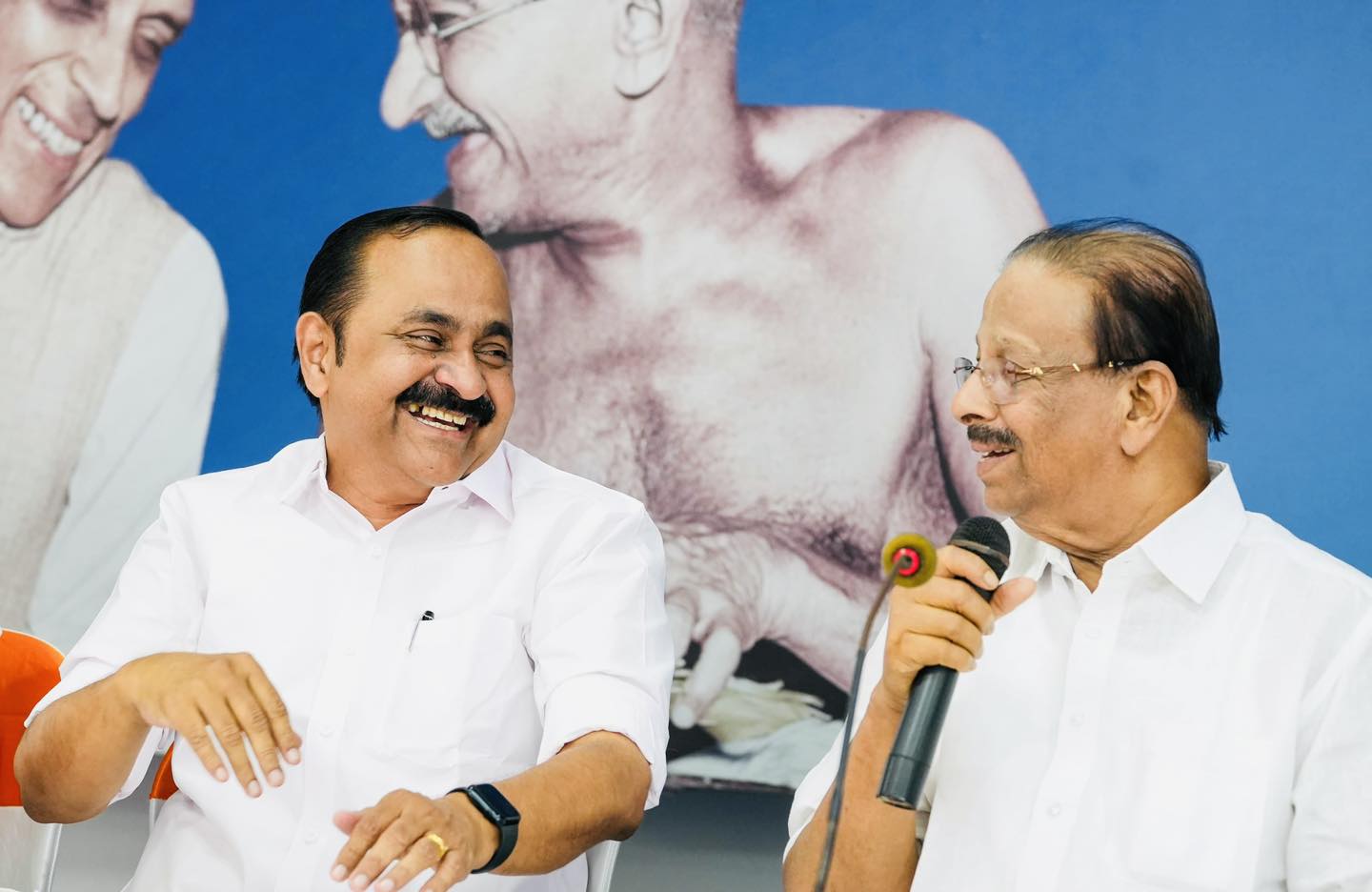
VD Satheesan (L) and K Sudhakaran.
For decades, the Congress in Kerala has been embroiled in internal power struggles, with groups carving out their spheres of influence, often backpedalling its growth and fracturing support.
Gone are the days of group politics, which once dominated the party’s landscape and a more insidious challenge has emerged.
Now, some of its senior leaders are quietly manoeuvring to establish personal powerhouses within the party, setting the stage for a fresh round of internal discord.
As these power plays unfold, the party is actively thinking about reorganisation.
The Congress party in Kerala, despite its recent electoral successes, finds itself entangled in the familiar web of internal discord and group politics causing the very fabric of Congress unity to be tested.
The latest trigger for unrest is the ongoing discussion about reorganisation within the party, which has revealed simmering discontent among its leaders and cadres.
The brewing tensions, marked by public outbursts and veiled accusations, underline the perennial challenge for the Congress: Its inability to escape factionalism and the disgruntlement it fosters.
Fresh from resounding victories in the Wayanad and Palakkad by-elections, and now the local body bypolls, the Congress seemed poised to consolidate its position.
However, the euphoria is being short-lived, as internal strife surfaced with MLA Chandy Oommen firing the first salvo.
Chandy, the son of former chief minister Oommen Chandy, publicly claimed he was sidelined during the Palakkad campaign, subtly targeting Leader of Opposition (LoP) VD Satheesan, who spearheaded the by-election efforts.
By sparing KPCC President K Sudhakaran from criticism, Chandy’s comments hinted at a brewing rift with the emerging “new generation” leadership within the party.
The young MLA’s remarks have sparked debates within Congress circles, with senior leader K Muraleedharan stepping in to defend Sudhakaran.
Muraleedharan’s assertion that Sudhakaran alone should not be held responsible for leadership issues has added weight to the internal divide, with calls for a broader overhaul of the party’s state leadership.
Amid talks of reorganisation, senior leaders like Ramesh Chennithala, Thiruvanchoor Radhakrishnan, Muraleedharan and Shashi Tharoor have thrown their weight behind KPCC president K Sudhakaran.
But there are some who wants Sudhakaran to be replaced. This according to those supporting Sudhakaran is being triggered by Satheesan.
“Factionalism has always existed within the Congress,” said a senior leader. “But during the conflicts between K Karunakaran and Oommen Chandy, or Oommen Chandy and Ramesh Chennithala, there was at least a semblance of structure and stability. Now, it feels like a circle of leaders is attempting to dominate the party without fostering trust or inclusivity.”
A section of the party believes that Sudhakaran, who has faced health issues, should be replaced with a younger leader capable of uniting the Congress ahead of the upcoming panchayat elections.
However, Sudhakaran has categorically dismissed these suggestions, declaring he will not step down.
“Reorganisation can be done in 10 minutes, if necessary,” Sudhakaran remarked, reflecting his resolve to stay in power.
The rise of Satheesan and his group, which includes leaders like Shafi Parambil, has caused friction with Congress veterans and loyalists of Oommen Chandy and AK Antony.
While Satheesan’s leadership was intended to rejuvenate the party following its dismal performance in the 2016 and 2021 Assembly elections, his approach is said to have alienated several senior leaders who feel marginalised.
Chandy Oommen’s comments have not only exposed these internal fault lines but also emboldened senior leaders like Muraleedharan and Chennithala to speak out indirectly against Satheesan.
“Reorganisation should be inclusive,” said a Youth Congress activist.
“Leaders and workers from all factions must feel they are part of the process. The current approach of sidelining senior leaders is detrimental to the party’s unity,” he said.
While internal squabbles dominate discussions, several leaders have pointed out that the Congress faces significant external challenges.
“If the party can’t stich the differences and addresses its weakness then it will have to pay a heavy price in the coming elections. Yes, some successes are there. But we have to look at the larger canvas. The rise of the BJP in Kerala, coupled with the CPI(M)’s tactics, poses a serious threat,” said a DCC member.
The Congress’s shift from being group-centric to leader-centric has further exacerbated its problems. The allegations of some leaders funding coordinated social media campaigns against their rivals within the party is also there.
“During the days of group politics, there was clarity and mutual respect despite differences,” said the DCC member. “Now, it seems to be a free-for-all with no trust or cohesion among leaders.”
With the local body elections and then the Assembly elections on the horizon, the Congress cannot afford prolonged infighting.
The reorganisation plans, which include changes in KPCC office-bearers and DCC presidents, could either rejuvenate the party or deepen its internal divides.
The key, it is said, will be striking a balance between accommodating senior leaders and empowering the younger generation.
As a senior Congress leader summed up: “If we don’t get our house in order soon, we risk losing the ground we’ve gained. But when it comes to the Congress, it seems there’s no redemption from the groups and the unrest they create.”
(Edited by Majnu Babu).


