


Published Feb 18, 2026 | 5:56 PM ⚊ Updated Feb 18, 2026 | 5:56 PM


Coconut grooves forming the background for turquoise water and silver sand are emblematic of Lakshadweep.
Synopsis: Islanders are worried that the No Vehicles on Wednesdays order will affect the livelihood of many. They felt the administration had acted, ignoring the reality of the islands.
The Lakshadweep administration has issued another seemingly controversial order, banning vehicles on the roads on all Wednesdays.
The latest order came four months after the administration had made police clearance mandatory for plucking coconuts in Andrott and Kalpeni islands.
“The Union Territory of Lakshadweep Administration hereby declares Wednesday of every week as ‘No Vehicle Day’ for all islands of Lakshadweep,” the order, signed by District Collector and Secretary (General Administration and Protocol) Dr R Giri Shankar, said.
It clarified that the measure was initiated “to promote the health of the islanders by promoting walking/cycling and reducing pollution from emissions from motor vehicles”.
Those violating the norm would be slapped with a fine of ₹500, the order dated 17 February said.
However, vehicles used by persons with disabilities, for security purposes or for emergency medical services have been exempted.
The order has surprised the islanders.
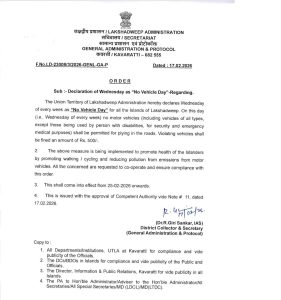
Copy of the Order
Lakshadweep MP M. Hamdullah Sayeed told South First that the no-vehicle day restriction could cause significant inconvenience for travellers, particularly those arriving by flights and ships on Wednesdays.
He urged authorities to reconsider the order and explore alternatives that balance environmental objectives with the welfare of island residents. He also emphasised that Lakshadweep is already eco-friendly, with a limited number of vehicles, making a full-day ban unnecessary.
Advocate Ajmal Ahmed R, Vice President of Lakshadweep Pradesh Youth Congress, told South First that Lakshadweep is one of the least polluted regions in the country, with very little traffic and almost no emissions compared to mainland cities.
“Imposing a blanket ban on all vehicles in the name of reducing pollution doesn’t make sense and ignores the realities of island life,” he said.
Ajmal also raised practical concerns.
”Ships and speed vessels regularly bring residents, patients, students, employees, and essential goods. If a ship arrives on Wednesday, how are the people supposed to get home from the jetty—especially those with luggage, elderly people, children, or patients?” Ajmal asked.
The order would also affect traditional cargo boats called ‘Manju‘(Uru), cargo barges, and goods carried on passenger ships.
Loading and unloading at the jetties have been dependent on local transport to ferry them to shops, warehouses, and homes. Restrictions on vehicles would leave essential commodities stranded at the jetty, he said, besides spoiling perishable goods.
He also raised concerns over the workers and daily wage earners losing their income on Wednesdays.
”Lakshadweep’s economy is small and fragile, and many families rely directly on port-related work and goods transport. A blanket vehicle ban without practical exemptions for passengers and cargo will harm livelihoods and disrupt essential supplies,” he said.
“Environmental awareness should be promoted through voluntary participation and public consultation, and not by rigid restrictions ignoring the unique geography and economy of our islands” he added.
Attakoya MI, a senior mukhtiyar from Lakshadweep, told South First that the timing of the order during the holy month of Ramadan has created panic among the people.
“Mobility is essential for religious obligations, school transportation, hospital visits, work, and daily activities. Earlier, schools had holidays during Ramadan, but now holidays are restricted,” he said.
Speaking to South First, Ajas Akbar, Youth Congress, Lakshadweep chief, said that the administration should have taken the people into confidence.
“It should begin this (the restriction) as a campaign with public cooperation. Instead, it is being forcefully enforced. Vehicles violating the restriction will be fined ₹500. The administration doesn’t know the meaning of democracy,” he said.
”Moreover, 2,000–3,000 government jobs in Lakshadweep remain unfilled, leaving many educated people to work as taxi drivers. If people depending on daily wages lose a day’s income, who will compensate them? Does the administration have a backup plan?” he wondered.
Ajas added that the Youth Congress would organise massive protests if the order is not withdrawn.
The administration refused to respond to South First.
(Edited by Majnu Babu).


