

Published May 28, 2026 | 2:10 PM ⚊ Updated May 28, 2026 | 2:10 PM

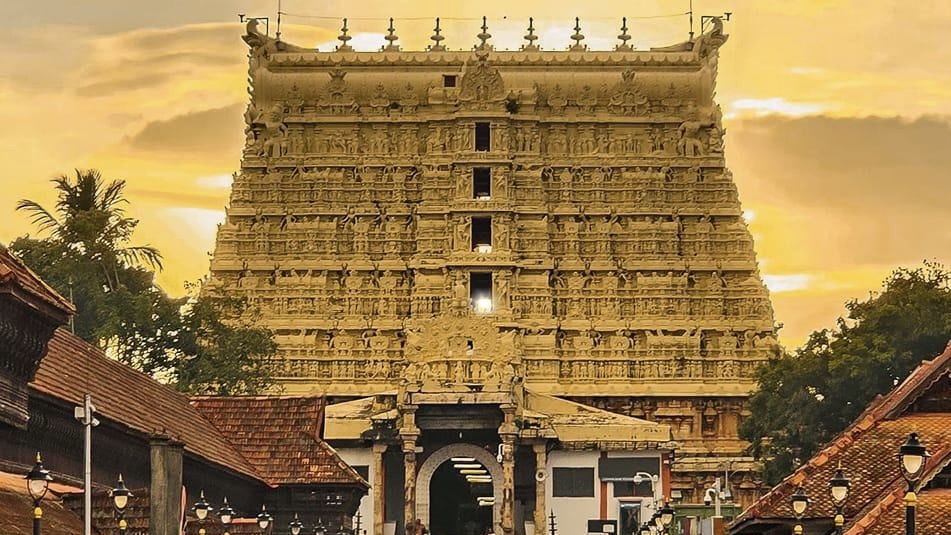
The Padmanabha Swamy Temple drew worldwide attention in 2011 when its underground vaults revealed treasures worth billions.

Synopsis: The famed Sree Padmanabha Swamy Temple in Thiruvananthapuram, Kerala, has once again been thrust into controversy after a confidential police report said 78 grams of gold went missing from the shrine. The report also raised questions about missing artefacts and alleged security lapses at the temple, claims the administration has denied. The developments have renewed concerns over how the temple’s vast wealth is being managed and protected, drawing scrutiny from both the Kerala and Union governments.
Yet another controversy over allegedly missing gold has surfaced at a temple in Kerala.
This time, the focus is on the centuries-old Sree Padmanabha Swamy Temple in Thiruvananthapuram, a shrine that drew global attention some 15 years ago for its legendary wealth.
The development comes even as multiple investigations into missing gold from the Sabarimala Sree Dharma Sastha Temple continue.
A confidential report submitted six months ago by the State Police Chief to the state Home Secretary has recently come to light. It states that gold bars and coins weighing around 78 grams went “missing” from the temple in recent months.
The temple administration has, however, dismissed reports of missing valuables, irregularities in the handling of devotees’ offerings, and security lapses, describing them as unfounded and misleading.
Meanwhile, the state’s Home and Devaswom Ministers have confirmed that the police report is under the government’s consideration, placing the matter firmly on the state’s agenda.
It is learnt that the Union Government has also intervened in the matter, though the details remain unclear.
Also Read: Sabarimala gold theft: Flag mast probe knocks on Mollywood’s door
The matter first came to light after the state’s intelligence unit flagged discrepancies in the temple’s inventory and alerted State Police Chief Ravada A Chandrasekhar through a confidential report.
The findings were subsequently communicated to the state Home Department for further action.
Apart from the reported disappearance of 78 grams of gold, investigators have pointed to the absence of several priceless artefacts of significant religious and historical value.
Among them are a multi-tiered gold lamp and the famed “Vaira Nama”, a diamond-studded ornament traditionally housed inside the sanctum sanctorum.
According to the report, the gold lamp had been taken out for maintenance work.
During the inquiry, officials found that the original lamp had not been returned and that a silver substitute had been placed in its stead. Investigators reportedly failed to locate any records, authorisations, or documentation explaining the replacement.
Questions have also surfaced over the whereabouts of the Vaira Nama. The ornament was reportedly removed several months ago for repair work but has not been restored to its customary place within the shrine. The report notes that it has remained unaccounted for over the past six months.
The inquiry has also highlighted what it describes as repeated violations of established security procedures.
Particular attention has been drawn to the Chembakathummoodu entrance, a passage commonly used by members of the erstwhile Travancore royal family, which continues to oversee the temple’s administration.
Investigators found that certain temple staff, security personnel, and individuals associated with the royal family were routinely exempted from mandatory security checks.
The report further notes that some persons believed to have close links with members of the royal family enjoyed unrestricted access to the temple premises. Several prominent local businessmen were also identified as frequent visitors who were allegedly allowed entry without undergoing standard screening procedures.
In view of the findings, officials recommended a series of urgent measures aimed at safeguarding the temple’s remaining valuables.
Among the proposals was the shifting of all gold, silver, and other precious items currently stored outside the main vaults, including those kept in offices and auxiliary facilities, into a centralised strong room with enhanced security.
The report also called for stricter monitoring of offerings made by devotees. It recommended that all valuables received by the temple be properly recorded and stored in designated lockers under continuous surveillance.
Authorities additionally sought the complete elimination of security exemptions, insisting that every individual entering the temple premises be subjected to the same screening process.
The developments have once again drawn attention to the temple’s unusual administrative arrangement.
While the temple’s day-to-day affairs are supervised by an administrative committee headed by the Thiruvananthapuram District Judge and supported by an advisory body, the Supreme Court has recognised the rights of the erstwhile Travancore royal family to manage the temple and oversee its vast assets.
The latest revelations carry added weight because of the temple’s immense wealth and global prominence. The shrine attracted worldwide attention in 2011 when underground vaults were opened under Supreme Court orders for inventory purposes.
Five of the six known vaults were examined, revealing an extraordinary collection of gold, jewels, and rare artefacts worth billions.
Vault B remains sealed, with religious traditions and long-standing beliefs continuing to prevent its opening.
Also Read: Kerala’s Left, once a champion of women’s entry to Sabarimala, now turns protector of ‘faith’
The leak of the findings triggered swift responses from both the temple administration and the state government, as each moved to address growing public concern.
Soon after details of the report surfaced in the media, the temple’s executive officer issued a clarification dismissing the allegations as completely unfounded.
The statement rejected claims relating to missing valuables, security breaches, and the alleged mishandling of offerings made by devotees.
According to the temple administration, the accusations are false and appear aimed at damaging the reputation of one of the state’s most revered shrines while creating unnecessary confusion among devotees.
The officer stressed that the temple’s treasures are protected under stringent security arrangements.
The premises remain under round-the-clock CCTV surveillance monitored by the temple security wing of the police. The statement added that any movement of valuable articles takes place only after security personnel are informed and in their presence.
Temple staff are also subjected to checks while entering and leaving the premises.
The administration maintained that no incident involving theft, loss of valuables, or misappropriation has been reported. It also urged devotees and the public not to be influenced by what it described as baseless rumours.
The clarification, however, stopped short of commenting on the artefacts cited in the report, leaving unanswered questions about their whereabouts and whether any verification had been carried out.
The controversy also drew a response from the state government.
Home Minister Ramesh Chennithala said the police report currently under discussion had been submitted nearly six months ago. He stated that the matter had already been discussed with Devaswom Minister K Muraleedharan and indicated that follow-up action would be taken after examining its findings.
Muraleedharan pointed out that the temple is currently overseen by a court-appointed administrative committee. A report has been sought from the committee, he said, and any decision on further action would be taken only after it is reviewed.
The minister also hinted at intervention by the Union Government as the issue continues to attract attention.
The administrative committee is expected to convene on Friday to discuss the controversy.
Also Read: Desecration in the hills: The unsolved arson of Sabarimala Temple
The immense wealth of the temple has captivated the world ever since the opening of its secret vaults. Running parallel to that fascination is a less well-known history of audit objections, missing valuables, and lingering questions over accountability.
A major controversy erupted in 2015 when former Comptroller and Auditor General Vinod Rai submitted a report to the Supreme Court highlighting serious discrepancies in the handling of temple gold.
The audit found that of the 893 kg of gold handed over to contractors for melting, purification, and plating work, only 627 kg was returned.
The unexplained shortfall of 266 kg exposed weaknesses in oversight and record-keeping.
Rai noted that temple authorities had failed to independently verify the weight and purity of the gold before entrusting it to contractors and were instead largely dependent on figures supplied by them.
The report also flagged losses involving gold rakes and other precious materials, estimated the value of the missing gold at around ₹186 crore, and recommended a detailed investigation.
Concerns were also raised by amicus curiae Gopal Subramaniam, whose reports to the Supreme Court alleged widespread lapses in safeguarding temple assets.
He referred to allegations that gold ornaments had been diverted and sold, that original ornaments were replaced with inferior replicas, and that unauthorised equipment, including a Swiss-made gold-plating machine, was used within the temple.
The reports also highlighted the absence of a comprehensive system to document gold, silver, and cash donations received over decades.
In 2017, Subramaniam sought a Special Investigation Team probe into the alleged pilferage of temple valuables. His concerns extended beyond gold and silver, pointing to the disappearance of eight antique diamonds from an idol’s forehead ornament and raising questions over missing antiquities, including an ivory flute.
Fresh scrutiny emerged in May 2025 when 107 grams of gold meant for plating work on the sanctum sanctorum door went missing from a police-monitored strongroom.
The gold was later recovered buried beneath sand within the temple compound, but investigators were left with fresh questions after discovering that a nearby surveillance camera was non-functional. While police suggested the loss may have been accidental rather than a theft, inquiries continued.
The controversy has also revived memories of veteran CPI(M) leader VS Achuthanandan’s long campaign for greater transparency in temple administration. He frequently accused the Travancore royal family of failing to adequately protect temple assets.
The legal battle that brought many of these issues into the spotlight began with a public interest litigation filed by lawyer TP Sundararajan and his associate Ananda Padmanabhan. Their allegations of administrative lapses and inadequate security triggered the judicial scrutiny that continues to this day.
(Edited by Dese Gowda)



