

Published Jul 15, 2026 | 9:00 AM ⚊ Updated Jul 15, 2026 | 9:00 AM


Home Minister Ramesh Chennithala unveiling the revised Vigilance Manual by handing over a copy to VACB Director Manoj Abraham, IPS.

Synopsis: Kerala has replaced its 24-year-old Vigilance Manual with a comprehensive new rulebook that reshapes investigations of corruption cases. It also introduces digital bribery traps, cyber evidence protocols, stricter timelines, benami asset probes and technology-driven investigations to tackle modern financial crimes. The overhaul also strengthens the Vigilance and Anti-Corruption Bureau through intelligence reforms, digital case management, transparent officer selection and standardised procedures, positioning the manual as the operational backbone of the state’s anti-corruption drive under Project Zero.
More than two decades after Kerala codified the way corruption cases are investigated, the state has now rolled out a sweeping overhaul of its Vigilance rulebook to match a radically changed landscape of corruption.
The revised Vigilance Manual, unveiled on 8 July, is being projected as one which rewrites investigation procedures for an era of digital payments, encrypted evidence, benami assets and economic offences. It has introduced stricter timelines, technology-driven investigations and a host of new operational protocols for the Vigilance and Anti-Corruption Bureau (VACB).
While the existing manual had served as the operational guide for the VACB since 2002, officials felt it had fallen behind changing patterns of corruption, new legal provisions and advances in investigative technology.
The revised Vigilance Manual is learnt to have addressed this missing piece and reflected the changing nature of corruption, and equips vigilance officers with updated procedures to investigate offences.
Also Read: 63% corruption in Karnataka?
The original manual was prepared in 2002 by compiling the vigilance instructions that existed at the time.
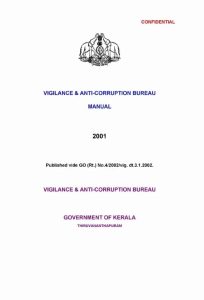
Vigilance Manual – 2002
Since then, VACB officials point out that corruption has evolved significantly, with illegal gratification increasingly shifting from cash payments to digital platforms and financial networks.
Recognising the need for a comprehensive revision, the state government entrusted VACB Director Manoj Abraham IPS with the task of rewriting the manual.
Working with a team of officers, he prepared a new edition incorporating current investigative practices, court observations, judicial directions, amendments to the Prevention of Corruption Act, procedures for investigating economic offences and modern techniques for collecting and analysing digital evidence.
The revised manual retains the existing five-part structure but almost doubles its content.
The number of chapters has increased from 14 to 29, covering several new operational areas that were absent in the earlier edition.
It also documents the functioning of two Special Investigation Units instead of one.
Also Read: Modi’s pre-2014 poll promise of ‘Na Khaunga Na Khane Dunga’ a hoax
One of the most significant additions is a dedicated procedure for handling bribery through digital money transfers.
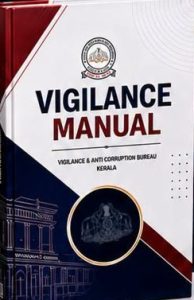
The revised Vigilance Manual of VACB-Kerala
Traditional trap cases have largely relied on currency notes coated with phenolphthalein powder to catch officials accepting cash bribes.
With corrupt officials increasingly opting for digital payments, the new manual introduces detailed procedures for conducting “digital money transfer traps.” The framework was prepared after consultations with forensic science experts and experienced investigators.
The revised manual also lays down detailed guidelines for gathering, preserving and presenting digital evidence during investigations.
Officials said special emphasis has been given to investigating benami transactions, tracing assets acquired through corrupt practices and collecting evidence that can withstand scrutiny in court. Procedures for confiscation and attachment of properties acquired through illicit wealth have also been elaborated.
The manual empowers vigilance officers to carry out comprehensive investigations into cases involving disproportionate assets acquired beyond known sources of income.
Also Read: Kerala PSC’s biggest recruitment blunder?
For the first time, the VACB will have an official field dress code.
Unlike agencies such as the NIA and CBI, vigilance officers previously had no prescribed operational uniform, often making identification difficult during field operations. The revised manual introduces jackets bearing the VACB insignia as the official dress for field duties.
The manual also strengthens the bureau’s intelligence wing. Vigilance Intelligence officers will continue to function in every district, while an intelligence team headed by the Superintendent of Police (Intelligence) will supervise operations from the Vigilance Directorate.
It also formalises the maintenance of the Suspected Officers Sheet (SOS), a database intended to record the history and activities of officials suspected of corrupt practices.
Another new feature is the detailed procedure for issuing Vigilance Clearance Reports required for appointments to sensitive government positions.
Responding to one of the biggest complaints from both government employees and complainants—that vigilance inquiries often drag on for years—the revised manual prescribes separate timelines for different categories of investigations.
It also includes procedures to expedite inquiries against officials approaching retirement, addressing situations where investigations remain pending until after an officer leaves service.
The manual incorporates provisions arising from amendments to the Prevention of Corruption Act, including procedures relating to Section 17A, under which prior government approval is required before investigating certain categories of public servants.
Detailed guidance has also been included on conducting lightning inspections, one of the bureau’s most important investigative tools, as well as on the functioning of vigilance courts and the disposal of false cases against government employees.
The revised manual expands the operational guidelines governing these surprise inspections, standardising the procedures to be followed by investigating officers.
The revised manual also reflects the bureau’s wider push towards complete digitalisation.
Over the past few years, officials said, the VACB has introduced several online systems to make it easier for citizens to approach vigilance authorities and file complaints. The manual explains the functioning of the Digital Case Management System (LVA), e-FIR, e-Office platform and the Vigilance Mobile App.
It also introduces a Centralised Processing System of Petitions (CPSP), designed to register complaints, monitor the progress of inquiries and standardise the handling of petitions across the organisation.
The manual also seeks to strengthen the integrity of the vigilance force itself.
It authorises the Vigilance Director to assess the service records and past performance of officers before recommending them for induction into the VACB. The Director will also be empowered to conduct aptitude assessments and recommend suitable personnel to ensure that only officers with proven integrity are posted to vigilance duties.
According to the state government, the revised manual is intended to serve as a practical operational handbook that promotes professionalism, transparency and uniformity in vigilance investigations.
Officials believe the updated procedures, combined with greater use of digital technology and time-bound investigations, will improve the efficiency of the Vigilance and Anti-Corruption Bureau and support the government’s anti-corruption initiative, Project Zero.
Home Minister Ramesh Chennithala summed up what the revised manual is: a milestone in the government’s efforts to eliminate corruption within the bureaucracy.
He said the revised document reflects the changing nature of corruption and equips vigilance officers with updated procedures to investigate offences that increasingly involve digital transactions, concealed assets and complex financial trails.
(Edited by Majnu Babu).



