

Published Mar 08, 2026 | 9:00 AM ⚊ Updated Mar 08, 2026 | 9:00 AM

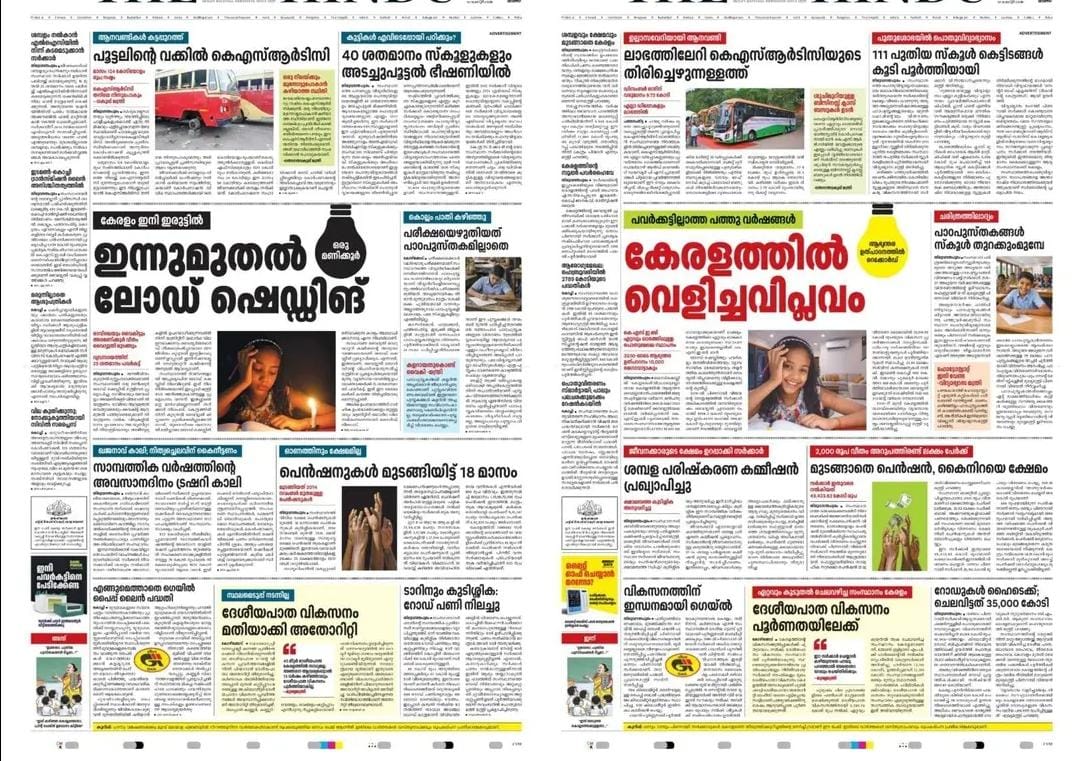
Kerala Information and Public Relations Department's ad on 5 March
Synopsis: The Telangana government placed an advertisement in a few newspapers in Kerala, highlighting its achievements. It drew sharp criticism from the CPI(M). Two days later, the Kerala I&PRD placed jacked ads in newspapers, trumpeting the achievements of the CPI(M)-led LDF government, and the ‘misrule’ of the earlier UDF government.
Two full-page jacket advertisements splashed across leading newspapers have swirled a political storm in poll-bound Kerala, triggering questions about the use of public money for publicity.
The first set of ads, issued by the Telangana government on 28 February and 3 March, promoted its programmes and achievements in newspapers, prompting criticism over the spending of taxpayers’ money.
Two days later, on 5 March, the Kerala government’s Information and Public Relations Department (I&PRD) placed similar jacket advertisements, inviting a sharper controversy.
Opposition parties accused the ruling LDF of using public funds for a political message that casts the UDF in a negative light.
Documents reviewed by South First suggested that the advertisement may run afoul of Supreme Court guidelines regulating government advertisements, as well as Kerala’s own 2021 order that set principles for placing government ads in the media — a move in which the government effectively sets aside its own rules in the run-up to elections for political mileage.
A series of expensive “jacket” advertisements released by the Telangana Information and Public Relations Department in leading Malayalam newspapers in Kerala has set off a political controversy in both states.
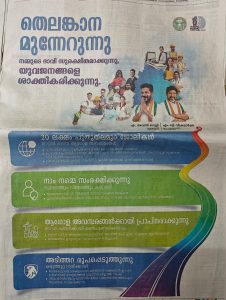
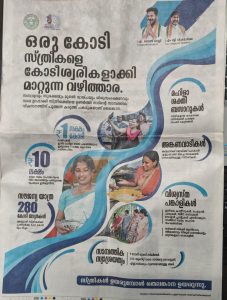
A jacket ad from the Telangana Information and Public Relations Department that appeared in a Malayalam daily on 28 February
The advertisements, which appeared prominently on 28 February and 3 March, showcased the welfare initiatives and achievements of the Congress government led by Chief Minister A. Revanth Reddy in Telangana.
The advertisements highlighted schemes such as the Indiramma Housing programme and other welfare measures, prominently featuring photographs of the Chief Minister and members of his Cabinet. They also carried visual elements associated with the Congress party, including its colours and branding.
What triggered criticism was the placement of these advertisements in Kerala-based Malayalam newspapers, even though the schemes being promoted are meant exclusively for residents of Telangana.
Critics alleged that the expensive publicity exercise, funded by Telangana taxpayers, was intended to create a favourable image for the Congress in Kerala ahead of the 2026 Assembly elections, where the party leads the Opposition United Democratic Front (UDF) against the ruling Left Democratic Front (LDF).
The controversy was first flagged by the Bharat Rashtra Samithi (BRS), the principal opposition party in Telangana. BRS leaders accused the Revanth Reddy government of diverting public funds to indirectly support the Congress party’s political campaigns in other states.
Former minister and BRS deputy leader T Harish Rao was particularly sharp in his criticism, alleging that the government was spending crores of rupees on publicity outside Telangana even while claiming the state treasury was under strain.
Rao argued that the government had failed to implement several major promises, including the Congress party’s “six guarantees”, and accused the leadership of turning Telangana into an “ATM for Congress politics in other states.” He demanded that the party reimburse the public money allegedly spent on such advertisements and cautioned voters in Kerala against what he described as political propaganda.
The issue soon gained traction in Kerala, where Chief Minister Pinarayi Vijayan and leaders of the CPI(M) amplified the criticism.
Kerala Chief Minister Pinarayi Vijayan questioned the Telangana government for placing the ad in Kerala.
Vijayan questioned why Telangana government schemes were being heavily promoted in Malayalam newspapers when they had no direct connection with the people of Kerala. He also linked the issue to broader criticism of the Congress government in Telangana.
In a statement on 2 March, Vijayan cited the recent demolition drive at Velugumatla in Khammam district, where hundreds of families were evicted from land associated with the Bhoodan movement. He accused the Congress government of adopting what he described as “bulldozer-style governance”.
Vijayan argued that the aggressive eviction drive and the simultaneous publicity campaign in Kerala reflected a troubling pattern.
The Chief Minister felt large-scale government advertising had also influenced media coverage, suggesting that expensive advertisements were being used to dominate public discourse.
Left leaders framed the episode as an attempt to shape political perceptions in a state heading into an election.
The issue gained further traction in the digital space, where several left-leaning commentators and online platforms amplified the controversy.
Social media posts and discussions framed the advertisements as an example of alleged misuse of public funds, questioning why Telangana government money was being spent on publicity in a state where the schemes had no direct relevance.
Many of these narratives went a step further, suggesting that the advertisements were part of a broader political strategy. They alleged that the campaign was indirectly aiding the Congress in Kerala ahead of the Assembly elections, with critics claiming that public funds from Telangana were effectively being used to bolster the party’s image in another poll-bound state.
However, leaders from the Telangana Congress rejected the allegations, describing them as politically motivated attacks by both the BRS and the Left.
Telangana Revenue and Housing Minister Ponguleti Srinivas Reddy accused Vijayan of raising the issue for electoral advantage in Kerala and defended the Khammam action as a lawful effort to reclaim government land from encroachers.
Ironically, just two days after those attacks against the Telangana government for splurging public money on publicity advertisements, the CPI(M)-led Kerala government’s I&PRD rolled out a high-profile newspaper campaign titled “Irunda Kalam” (dark times).
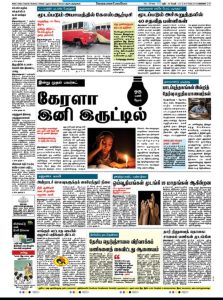
A Tamil daily carrying the advertisement issued by Kerala I&PRD.
It drew sharp criticism from the Opposition for allegedly using taxpayer funds to push a political narrative ahead of the Assembly elections.
The advertisement that came on 5 March presented a stark comparison between the period before 2016, when the Congress-led United Democratic Front (UDF) was in power, and the years under Chief Minister Pinarayi Vijayan.
Designed in the format of a newspaper page, complete with headlines, illustrations and article-style layout, the advertisement recreated reports from a decade ago, highlighting issues such as power cuts, delayed welfare pensions, struggling public transport and stalled infrastructure projects.
The second page flipped the narrative — portraying the LDF years as a period of recovery and administrative turnaround. It highlighted claims of timely pension payments, improved infrastructure, progress in highway development, better school facilities and the absence of large-scale power shortages.
While a small disclaimer stated that the content was a “creative advertising expression” issued by the government, critics felt the format blurred the line between advertisement and editorial content.
Opposition leaders wasted little time in attacking the campaign, calling it a blatant misuse of taxpayer money for political messaging months ahead of the Assembly elections.
Leader of Opposition VD Satheesan accused the government of using official machinery to target the legacy of former Chief Minister Oommen Chandy, describing the move as “a new low in political communication”.
Satheesan said the advertisement cherry-picked negative incidents from the past while ignoring the achievements of the previous government.
Senior Congress leader Ramesh Chennithala went further, alleging that the I&PRD had effectively turned into a publicity wing of the CPI(M). He said public funds were being spent to influence the political narrative ahead of the polls.
Congress leaders indicated that they may approach both the Election Commission and the courts, arguing that government departments cannot be used for partisan campaigns.
The Left leaders, however, insisted that the campaign is based on factual reports published during the UDF years and merely places them in perspective.
CPI(M) leader MV Nikesh Kumar, responsible for CPI(M)’s social media interventions and publicity-related matters, defending the advertisement on social media, said the campaign was intended to remind younger voters of the conditions that existed before the LDF came to power.
He said the contrast between the two periods reflects “verifiable realities” rather than propaganda.
Supporters of the government argued that many voters who are now first-time electors grew up entirely during the Pinarayi Vijayan administrations and may not recall the issues that dominated headlines a decade ago.
In its landmark judgment on 13 May 2015 in Common Cause vs Union of India, the Supreme Court laid down strict principles governing government advertising. The ruling came following concerns that governments were using public funds to promote ruling parties or political leaders.
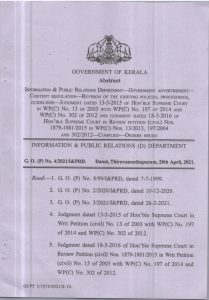
The 2021 order on advertising.
The court held that government advertisements must be objective, informative and directly related to government responsibilities. They should not be used to promote the ruling party or attack political opponents.
The judgment was later reaffirmed and clarified in March 2016 while deciding review petitions.
Following these directions, the Kerala Information and Public Relations Department issued G.O. (P) No. 4/2021/I&PRD on 28 April 2021, consolidating earlier guidelines and incorporating the Supreme Court’s principles on content regulation.
These guidelines, the government order said, applied to all government advertisements across media, including print, television and digital platforms.
The Supreme Court-mandated framework, reflected in Kerala’s 2021 order, laid down several key principles:
A close reading of the Supreme Court guidelines raised concerns over several areas.
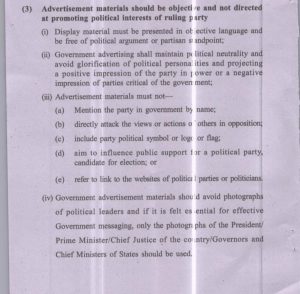
An excerpt from the order
First, the advertisement appeared to go beyond merely informing citizens about government schemes or services. Instead, it constructed a comparative political narrative contrasting two regimes — a format that resembles political messaging rather than public information.
Second, the guidelines specifically cautioned that government advertisements should not project a negative impression of parties critical of the government or contain partisan arguments. By portraying the pre-2016 period — when the UDF was in power — as a “dark time”, the campaign effectively targets a political opponent.
Third, the newspaper-style format could be seen as problematic under the principle that advertising content must be clearly distinguishable and presented objectively. The design, with headline-style text and article-like layout, may risk blurring the boundary between journalism and government publicity.
Fourth, the Supreme Court framework emphasised that facts must be accurate and verifiable, and that advertising should avoid presenting analysis or opinion as fact. However, in the case at hand, the narrative framing of two political periods inevitably involves interpretation rather than neutral information.
At the same time, the guidelines did not completely prohibit governments from highlighting their achievements or public programmes.
If the advertisement had simply listed initiatives, welfare schemes or development projects under the current administration, it would likely fall within the accepted scope of government communication.
The controversy arose primarily because of the comparative framing, where the performance of a previous government is juxtaposed with that of the current one.
Whether this crossed the legal threshold of “political advertising using public funds” is ultimately a matter that courts or regulatory authorities would have to determine.
(Edited by Majnu Babu).


