

Published Dec 14, 2025 | 8:22 PM ⚊ Updated Dec 14, 2025 | 8:22 PM

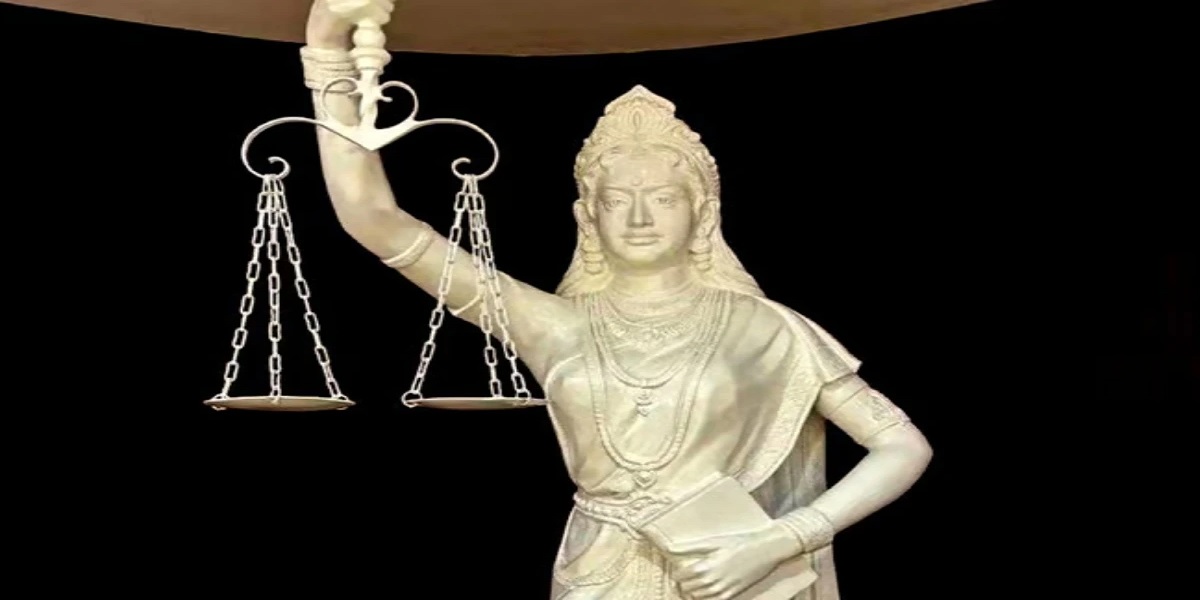
after years of silence, the survivor spoke out on Instagram, sharing her painful journey and the deep emotional toll of the case.
Synopsis: Days after the Ernakulam Principal Sessions Court verdict in the 2017 actress assault case, the survivor broke her silence, welcoming the conviction of six accused but questioning the acquittal of actor Dileep and alleging serious lapses and bias in the trial court proceedings.
Days after the Ernakulam Principal Sessions Court delivered its verdict in the high-profile 2017 actress assault case, the survivor of the case has spoken up, sharing painful journey and the emotional toll of the case.
While six of the accused were convicted, actor Dileep, Accused No. 8, was acquitted of criminal conspiracy. The court’s 1,709-page judgment also sharply criticized the police investigation, exposing major lapses in probing key evidence.
”After 8 years, 9 months, and 23 days, I finally saw a small ray of light at the end of a very long and painful journey. Six of the accused have been convicted, and for that, I am grateful” she wrote in a post on Instagram.
The survivor addressed false narratives, clarifying that Accused No. 1 was never her personal driver.
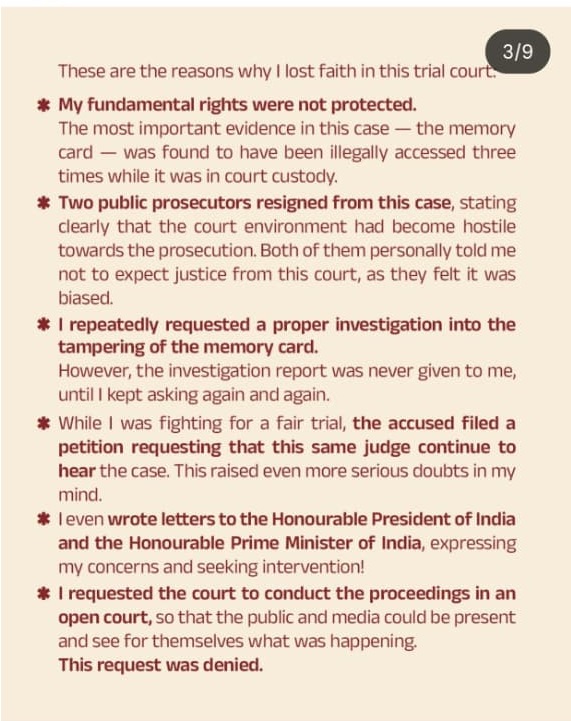
Screen grab of the survivor’s instagram post
”He was a random person assigned as a driver for a movie I worked on in 2016. I met him only once or twice back then, and never again until the day of this crime. Please stop spreading false stories!” she added.
The survivor also revealed her mistrust in the trial court, which began as early as 2020. Key evidence, the memory card was illegally accessed multiple times while in court custody, two public prosecutors resigned citing a hostile environment, and repeated requests to transfer the case were dismissed.
”I even wrote letters to the President and the Prime Minister of India seeking intervention” she said.
After years of struggle, she reflected on the broader lessons of her ordeal. ”Not every citizen in this country is treated equally before the law. Human judgment can shape decisions profoundly, and every court does not function the same way.”
Despite the pain and setbacks, she expressed gratitude to those who supported her, ”My heartfelt thanks to everyone who stood by me throughout this long journey. To those who continue to attack me with abusive comments or paid narratives, you are free to continue what you are paid to do. So many people have inspired me to be nothing like them. Thank you for all the lessons.”
The survivor explained why she lost trust in the trial court, stating that her fundamental rights were not protected. She said that the most important evidence in the case, the memory card, was illegally accessed three times while in court custody.
Two public prosecutors resigned, citing a hostile environment for the prosecution, and personally told her not to expect justice as they believed the court was biased. Despite her repeated requests for a proper investigation into the memory card tampering, the report was provided only after persistent follow-ups.
She also pointed out that while she was fighting for a fair trial, the accused filed a petition seeking the continuation of the same judge to hear the case, further deepening her doubts.
Additionally, she wrote letters to the President and the Prime Minister of India expressing her concerns and seeking intervention.
Her plea for open court proceedings, allowing the public and the media to witness the trial, was denied. The court proceedings were ultimately held in camera, as requested by Accused No. 8, actor Dileep.
Actress Manju Warrier, the former wife of Accused No. 8, Dileep, who was acquitted by the Ernakulam Principal Sessions Court, also broke her silence following the survivor’s statement.
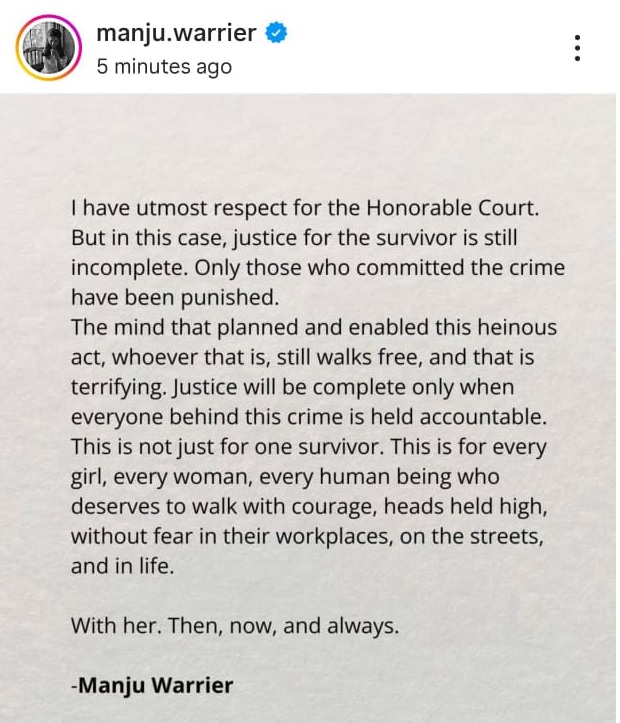
Screen grab of Manju Warrier’s Instagram Post
“I have utmost respect for the Honorable Court. But in this case, justice for the survivor is still incomplete. Only those who committed the crime have been punished,” Warrier wrote in a post on Instagram.
“The mind that planned and enabled this heinous act, whoever that is, still walks free, and that is terrifying. Justice will be complete only when everyone behind this crime is held accountable. This is not just for one survivor.”
She continued: “This is for every girl, every woman, every human being who deserves to walk with courage, heads held high, without fear in their workplaces, on the streets, and in life. With her. Then, now, and always.”
Advocate TB Mini, who represented the survivor in the actress assault case, she emphasised that it was not the survivor’s responsibility to file an appeal against the court’s verdict.
“In my personal opinion, she should not have to spend more money on this legal battle. The State government should take the responsibility and provide the necessary resources,” she told South First.
Earlier, the Kerala government confirmed that it would challenge the verdict in higher courts.
“The government remains fully supportive of the survivor in the actress assault case and will file an appeal to ensure that justice is thoroughly pursued. Since the outset, we have been dedicated to backing the survivor and maintaining her trust in the judicial process,” Law Minister P. Rajeev stated.
“Every stage of the investigation and prosecution was conducted with careful consideration of the perspectives of both the survivor and the prosecution team. Our commitment is firm and resolute. Additional guidance and decisions will be provided once the full judgment has been examined in detail.”
Ernakulam District and Sessions Court Judge Honey M Varghese, who delivered the verdict in the case, issued a strong warning to the media and members of the legal fraternity on the same day against misrepresenting court proceedings.
She cautioned that any distorted or misleading reporting would invite serious action, including contempt of court proceedings.
Addressing those present in the courtroom, Judge Varghese said that while scrutiny of her personal or professional background was acceptable, any attempt to portray court proceedings inaccurately or undermine the justice system would not be tolerated.
She clarified that she was unconcerned about personal criticism but would act firmly against distorted reporting of judicial processes.
She announced that all petitions relating to contempt of court in connection with the case would be taken up on 18 December.
The judge also pointed out that the case was conducted strictly in line with the Supreme Court’s guidelines laid down in Nipun Saxena v. Union of India, which prohibit the disclosure of the identity of survivors of sexual offences.
She noted that several reports related to the case had failed to adhere to these directions.


