

Published Jan 18, 2026 | 3:14 PM ⚊ Updated Jan 18, 2026 | 3:14 PM


Representational image. Credit: iStock
Synopsis: While denying bail to Palakkad MLA Rahul Mamkootathil, a court in Kerala made pointed observations underscoring the gravity of the accusations and the lack of any indication of consent. Activists noted that agreeing to a relationship or even to sex does not mean agreeing to every act that follows, nor does it mean consenting to harm, pregnancy, or abuse.
While denying bail to Palakkad MLA Rahul Mamkootathil in a case involving allegations of rape and criminal intimidation, a court in Kerala, on Saturday, 17 January, made pointed observations underscoring the gravity of the accusations and the lack of any indication of consent.
In its order, the Thiruvalla Judicial First-Class Magistrate Court–I referred to the First Information Statement (FIS), which stated that Rahul had approached the survivor during a troubled phase in her marriage and gradually developed a relationship by offering emotional support.
The court noted that, contrary to Mamkootathil’s claim of a consensual relationship, the survivor had been persuaded to book a hotel room in her name solely to protect his identity and public image.
The Special Investigation Team (SIT), probing the sexual assault allegations against the MLA, cited preliminary findings and informed the court that the survivor had suggested a meeting at a restaurant. However, Mamkootathil insisted on a hotel room, citing concerns that he was a well-known figure who could be recognised in public.
The court also took note of the survivor’s statement that Mamkootathil reprimanded her for mentioning his name as ‘Rahul BR’ in the hotel records.
According to the FIS, the survivor believed they would go out together after Mamkootathil arrived. However, she alleged that she was sexually assaulted soon after he entered the room.
The statement further alleged physical assault, including being beaten and spat upon. The court noted the survivor’s claim that she later became pregnant and suffered a miscarriage.
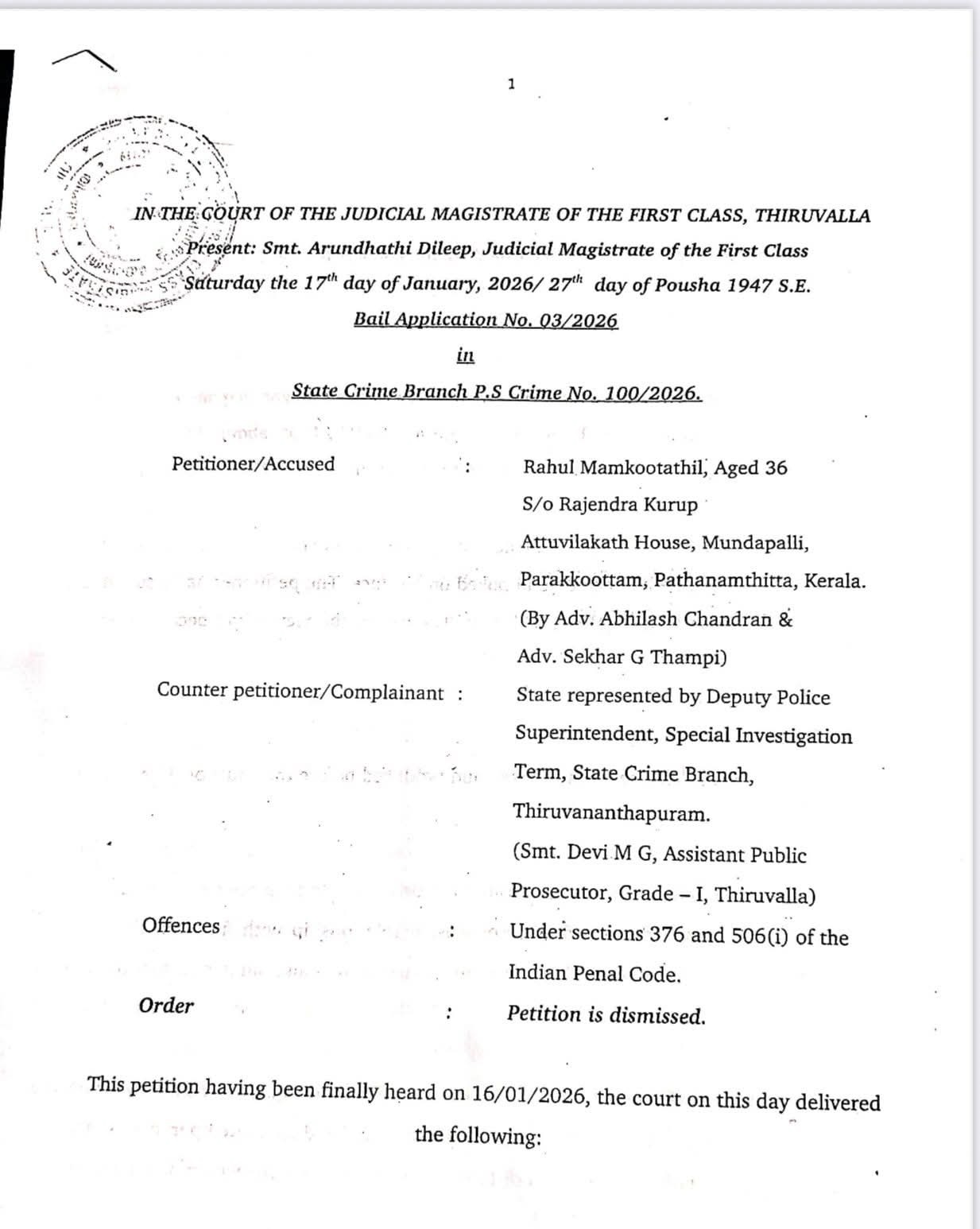
Copy of Court Order
The order also recorded allegations of intimidation, with the survivor stating that Mamkootathil threatened to expose the relationship to her husband’s family, invoked fears about her father’s health, and challenged her to pursue legal action.
The court further acknowledged her claim that she delayed filing a complaint due to fear, citing online harassment faced by another survivor in a separate sexual assault case involving Mamkootathil.
The copy of the order accessed by South First states that, after examining the material placed before it, the magistrate observed that the survivor’s statement did not, at any point, prima facie suggest a consensual relationship.
The court concluded that the allegations were “serious and grave” and that the offence of rape was made out at this stage.
Taking note of Mamkootathil’s alleged similar antecedents, the court expressed concern over the possibility of witnesses being influenced, evidence being tampered with and the investigation being obstructed, thereby justifying the denial of bail.
The arrest of Mamkootathil reignited a critical conversation in Kerala about what consent truly means. Much of the public debate around the case has focused narrowly on chat messages and the existence of romantic relationships, reducing consent to a simplistic yes-or-no idea.
This framing ignores how consent actually works in real life.
Supreme Court lawyer Babila Ummerkhan told South First, “Consent is not a one-time permission given at the start of a relationship. It is a continuous, voluntary agreement that can change with circumstances. It can be withdrawn, limited, or violated. When sexual intimacy is shaped by deception, pressure, fear or unequal power, consent becomes fragile and, in many cases, meaningless.”
“Section 63 of the Bharatiya Nyaya Sanhita (BNS) sets out what constitutes rape, centring on the absence of free and informed consent. It covers sexual acts carried out without consent, with consent obtained through fear, deceit, intoxication, or coercion, or where the woman is unable to consent.”
“The provision also makes it clear that consent is meaningless in cases involving minors and that a woman’s lack of physical resistance cannot be treated as consent,” she said.

Palakkad MLA Rahul Mamkootathil
In this case, survivors have alleged that intimacy occurred under false assurances, coercion, and manipulation, including pressure to engage in unprotected sex and to avoid contraception.
Such actions fundamentally alter the terms under which consent was given.
Agreeing to a relationship or even to sex does not mean agreeing to every act that follows, nor does it mean consenting to harm, pregnancy, or abuse.
Another uncomfortable truth is that a lack of resistance is often mistaken for consent. Power imbalance, intimidation, emotional dependence, and fear can silence people, especially in private spaces.
The law itself recognises that silence or compliance does not automatically amount to consent.
When society treats messages, past intimacy, or the absence of physical resistance as proof of consent, it places an unfair burden on survivors to constantly justify their pain. True consent must be understood as informed, ongoing, and freely given — not extracted through lies, pressure, or power.
Geetha Nazeer, a Kerala-based journalist and activist, told South First that it would be incorrect to say Kerala courts are evolving.
”At best, this could be seen as an exception — perhaps a judge who is more sensitive and gender-aware. Most of our courts are products of patriarchy,” she said.
She pointed out that discussions on consent often stop at the threshold. “Consent is spoken about before closing the door. But once intimacy begins, especially in sexual relationships, whose consent is considered valid? Our legal system still treats rape within marriage as non-offensive. So how can relationships outside marriage be viewed differently?” she asked.
According to her, such judicial observations are rare and depend largely on individual judges.
“Courts are yet to be trained to read cases through a gender perspective. We’ve seen how insensitive the judiciary can be — Justice Basant’s controversial remarks against a 16-year-old survivor in the Suryanelli case are a stark reminder,” she said.
Nazeer argued that real change in Kerala has not come from the judiciary, but from women themselves. “It is women in Kerala who are taking risks and pushing change. Survivors in cases like the actor assault and the Franco Mulakkal case came forward without hiding their identities. Social media, too, is witnessing bold revelations that challenge patriarchy. Even a recent book exposing another side of MT Vasudevan Nair reflects this shift,” she noted.
“The system, including the courts, remains largely insensitive and anti-women. The transformation we are seeing is driven by women, not by the judiciary,” she added.
(Edited by Muhammed Fazil.)


