

Published Jan 30, 2026 | 8:00 AM ⚊ Updated Jan 30, 2026 | 8:00 AM

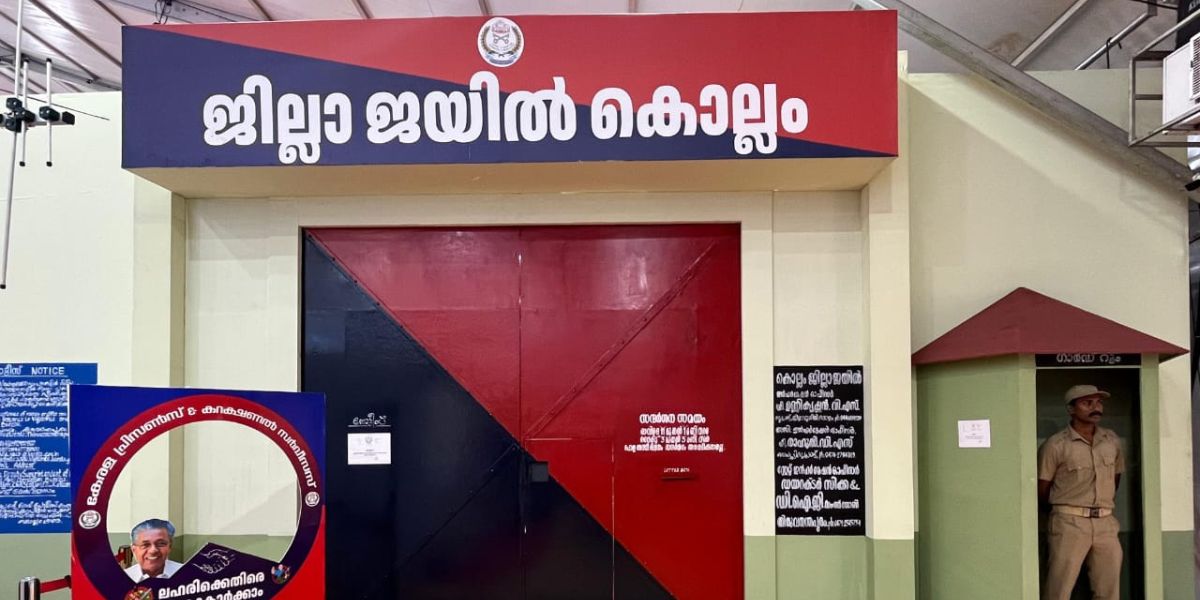
District Prison in Kollam Kerala.
Synopsis: A revision of wages paid to prison inmates in Kerala unexpectedly turned into a political and public controversy, exposing fault lines over criminal justice, victims’ rights, and the state’s policy-making process. While the government described the move as a constitutionally mandated, humane reform guided by Supreme Court principles, critics argue that the scale of the hike lacks transparency and empirical justification.
A long-overdue revision of wages paid to prison inmates in Kerala unexpectedly turned into a political and public controversy, exposing fault lines over criminal justice, victims’ rights, and the state’s policy-making process.
The state Home Department’s 9 January order sharply increasing daily wages for inmates working inside prisons — after a seven-year freeze — triggered intense public backlash, social media outrage, and accusations of misplaced priorities.
While the government described the move as a constitutionally mandated, humane reform guided by Supreme Court principles, critics argue that the scale of the hike lacks transparency and empirical justification.
With wages for skilled prison labour now set at ₹620 a day, and semi-skilled and unskilled work raised to ₹560 and ₹530 respectively, up from a previous range of ₹63 to ₹168. The decision quickly shifted from administrative correction to political flashpoint.
The chief minister, who also holds the Home portfolio, has stepped in to defend the move in the Assembly, insisting that inmates do not receive the full amount directly, with portions earmarked for victims’ compensation, prison expenses, and family welfare.
Yet, even as the government invokes constitutional morality and judicial guidance, a critical question remains unanswered: whether any authoritative study or evidence-based assessment formed the basis for fixing the revised wage structure.
The Home Department’s silence on this has only deepened the controversy, keeping the debate alive both inside the legislature and beyond it.
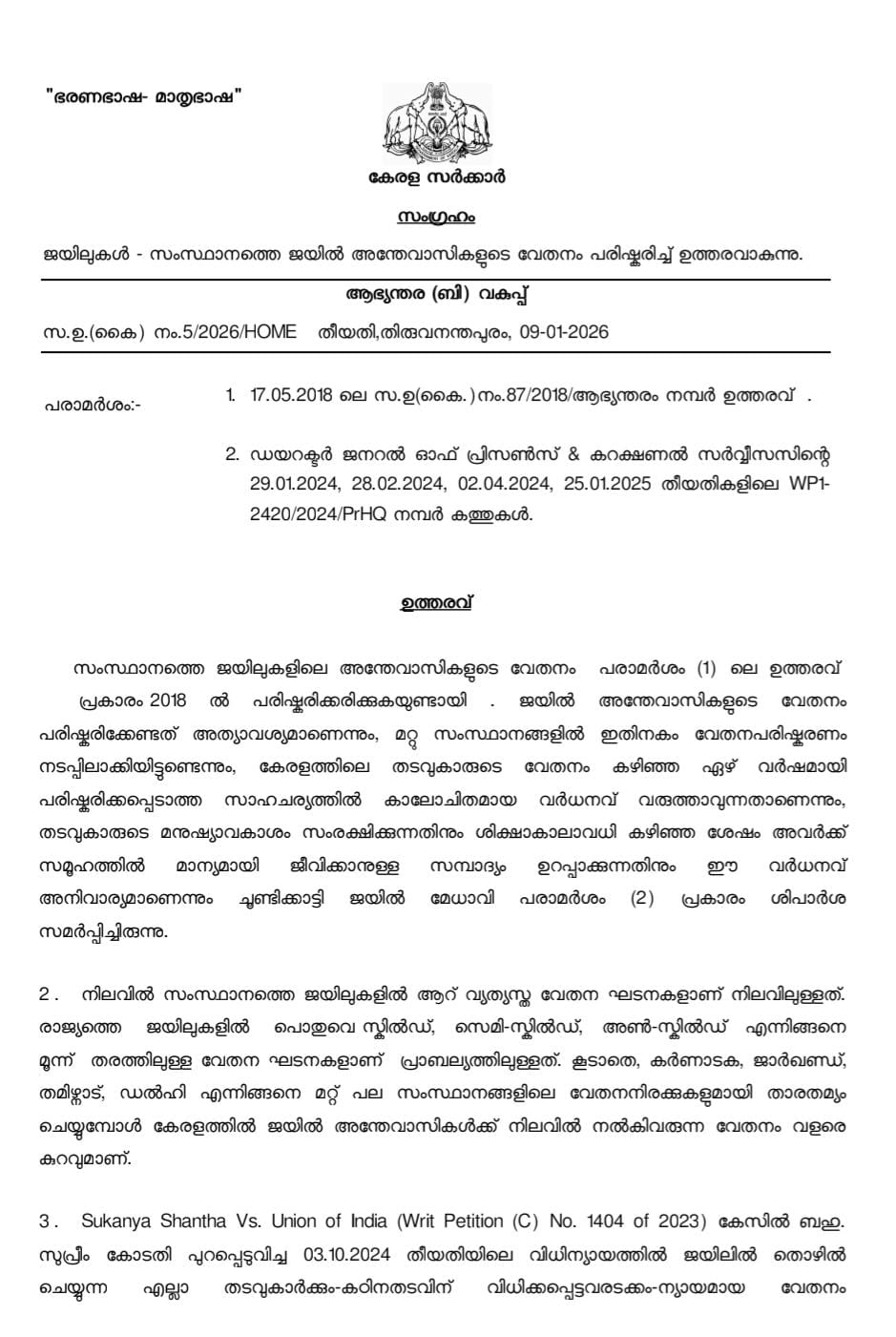
The order detailing wage revision
The state Home Department said that the decision to revise the wages came after a seven-year freeze. It frames the decision as a measure rooted in human dignity, rehabilitation and constitutional obligation rather than mere financial adjustment.
Home Secretary Bishwanath Sinha IAS, in an order on 9 January, stated that the revision follows a detailed examination by the government and a recommendation from the Director of Prisons, who flagged the urgency of protecting prisoners’ human rights and enabling a dignified life after release.
Officials acknowledged that Kerala’s inmate wages had remained significantly lower than those in several other states, including Karnataka, Tamil Nadu, Jharkhand and Delhi, even as prisoners here continue to contribute to production units, construction activities and essential prison services.
The order stated that the government streamlined the existing six wage slabs into three uniform categories — skilled, semi-skilled and unskilled — bringing Kerala in line with prevailing national norms.
Under the revised structure, skilled inmates will receive ₹620, semi-skilled ₹560 and unskilled ₹530.
The move also reflects the Supreme Court’s October 2024 ruling in Sukanya Shantha vs Union of India, which held that all prisoners, including those undergoing rigorous imprisonment, are entitled to fair wages based on reasonable standards.
Beyond remuneration, the state government is of the view that the revised wages are expected to help inmates support their families, meet basic needs through prison canteens and build a modest release corpus — key to reducing repeat offending.
However, the decision to revise wages snowballed into a broader political and social controversy, far beyond the confines of prison reform.
While officials insisted the move corrects a long-standing anomaly and aligns Kerala with national norms, critics argue the timing and scale of the hike make it politically sensitive, especially with Assembly elections approaching.
The controversy largely stems from comparisons drawn with other worker categories.
Opponents noted that prisoners could now earn between ₹16,000 and ₹18,000 a month, pointing out that elected representatives in local bodies receive honorariums of around ₹8,600.
ASHAs (Accredited Social Health Activists), despite their frontline public health role, earn far less on a per-day basis, as do Employment Guarantee workers and labourers in sectors such as coir, cashew, and fuel stations.
This perceived imbalance has fuelled protests and sharpened accusations that the government has prioritised inmates over ordinary workers without revisiting minimum wage structures elsewhere.
The prison department, however, offered a detailed counter-narrative. Officials noted that the revision was overdue under the Model Prison Manual, which mandates wage updates every three years, and was prompted by recommendations from the Supreme Court’s Centre for Research and Planning.
Compared to states such as Karnataka, Tamil Nadu, and Delhi, Kerala’s inmate wages had lagged significantly.
Importantly, the higher wages apply only to a limited group — around 3,000 to 4,000 long-term and life-sentence prisoners performing strenuous work.
Earnings are not freely disposable either: Half is sent to families, a quarter goes to canteen needs, and a substantial portion is deducted towards victim compensation and post-release rehabilitation.
The government argues that the policy is rooted in human rights, rehabilitation, and restitution, not electoral calculus.
Chief Minister Pinarayi Vijayan, on 27 January, offered an elaborate justification for the revision of daily wages.
Responding to a question in the Assembly, the chief minister, who also holds the Home portfolio, said the increase was rooted in constitutional principles, Supreme Court directions and long-pending recommendations from prison authorities.
According to Vijayan, inmates sentenced to rigorous imprisonment are legally required to work and be paid wages under the Indian Penal Code and the Prison Rules.
He said it is a well-established principle that prisoners must receive fair remuneration for their labour, a position repeatedly upheld by the Supreme Court, which has directed that wage determination should be based on rational and humane criteria.
The chief minister pointed out that the last revision of prison wages in the state was in 2018, even though the Model Prison Manual, 2016 mandates annual revision.
He added that wages paid in several other states are higher than those in Kerala, and that the latest revision brings the rates broadly in line with skilled, semi-skilled and unskilled wage categories prevailing in neighbouring States, including Karnataka. He also underlined that the revised amount is not paid directly to prisoners in full.
Fifty percent of the wage is earmarked as a family share, 25 percent towards canteen expenses and 25 percent as a release share to help inmates reintegrate after imprisonment.
A portion of the earnings is also diverted to the victim compensation fund, in line with Supreme Court directions. Kerala’s victim compensation scheme, introduced in 2017, was revised in 2021 to operationalise this mechanism.
“This is not a direct wage hike meant for personal use by prisoners,” the chief minister said, describing it instead as a structured system that balances victim compensation, prisoner rehabilitation and family welfare.
On incentives, he explained that inmates in open prisons engaged in high-output traditional work, such as rubber tapping and stone cutting, earlier received six types of additional wages.
After restructuring the wage system into three categories, the government introduced an incentive scheme for open prisons, with additional payments announced during the Onam season based on annual production.
However, while the chief minister offered detailed explanations in response to the general question on the wage revision, he did not give written answers to a series of pointed questions raised by MLA KK Rama.
The unanswered questions included requests for item-wise details of the rates of increase in daily wages, whether any authoritative or scientific study had been conducted to justify the hike, and if so, which study formed the basis for the decision.
The MLA had also sought clarity on who specifically recommended the increase, along with the exact rates proposed by the Prison Department.
Further, the chief minister did not respond to the question of whether the final wage increase approved by the government exceeded the rates recommended by prison authorities, and if so, the circumstances that led to such an enhancement.
While the government has framed the wage revision as overdue and legally mandated, the absence of written responses on methodology, recommendations and deviations has left space for further scrutiny as the issue continues to draw attention inside and outside the Assembly.
The government has also retained seasonal incentives for inmates engaged in traditional labour in open prisons, reinforcing the link between work, responsibility and reintegration.
(Edited by Muhammed Fazil.)


