


Published Jan 13, 2026 | 12:13 PM ⚊ Updated Jan 26, 2026 | 8:47 AM

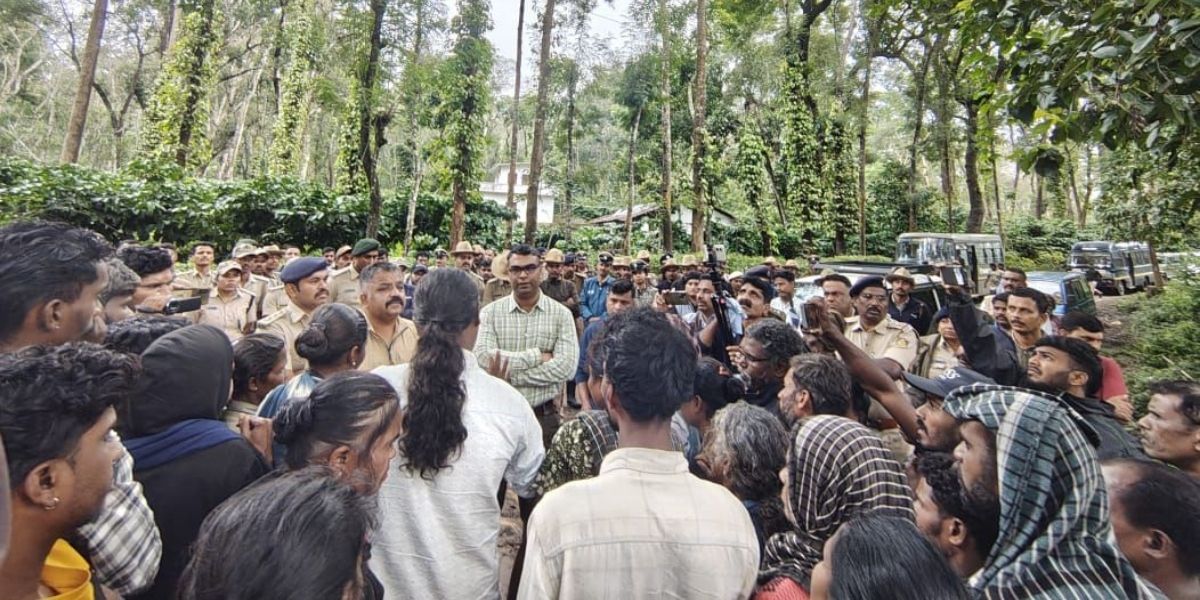
An image from June 2025 when security forces demolished the huts of the Jenu Kuruba community. (CNAPA)
Synopsis: The Jenu Kuruba community in Karnataka is protesting to assert their claim over ancestral land. Even after 20 years since the enactment of the Forest Rights Act 2006, the community’s forest rights have yet to be fully enforced and recognised by the government’s forest department. The Jenu Kurubas also alleged “enhanced” surveillance by the government as part of their Tiger Task Force and Elephant Task Force.
While the rest of the state rang in the New Year at midnight on 1 January, Shivu JK, a youth leader from the Jenu Kuruba community in Karnataka, was deep in the forests of Nagarhole, leading a 13-day padayatra to assert their claim over ancestral land. It was neither their first act of resistance nor likely their last.
The padayatra started on 21 December 2025, at Tithimathi in Kodagu district and ended at Kerehaadi in HD Kote, Mysuru district, on 2 January. Although the day of the march coincided with the 20th anniversary of the enactment of the Forest Rights Act 2006, the community’s forest rights are yet to be fully enforced and recognised by the government’s forest department.
“Due to the arbitrary rejection of our forest rights, our forests, traditional governance systems, customary rights, language, and ways of life are under severe threat from the compounding and historical injustice on our people,” the Nagarahole Adivasi Jamma Pale Hakku Sthapana Samiti (NAJHSS, a federation of Gram Sabhas), which organised the padayatra, said in a memorandum.
The padayatra concluded with a demand for talks with the district collectors of Kodagu and Mysuru, and a warning that if no official gets back to them within seven days, they would block all six forest checkposts within the Nagarahole forests.
The Jenu Kurubas, a honey-gathering community classified as a Particularly Vulnerable Tribal Group (PVTG), first filed claims for their ancestral land in Karadikallu Atturkolli under the FRA in 2011. Today, they are fighting a far larger battle, one not only with the government, but also with conservationists and a section of animal and environmental rights activists.
At its core, the dispute is over competing visions of the forest: One that treats it as a pristine, people-free wilderness, protected from those the authorities label as “encroachers”, and another that sees it as a living landscape, shaped and sustained for generations by the very communities now being asked to leave.
On 15 November, on Birsa Munda Jayanti, the Jenu Kuruba community in Nagarhole organised a cricket tournament in the Nagarhole Tiger Reserve. The event, however, drew objections, forcing the community to defend what they described as a simple and lawful activity.
Videos of the event were allegedly circulated by environmentalists who also wrote to the Forest Department, accusing the Adivasis of cutting down trees for the tournament. They claimed the “unauthorised” match was held in a protected zone, which was a violation of several provisions under the Wildlife Protection Act.
Soon after, Forest Minister Eshwar B Khandre wrote to the Forest Department officials, saying his office had received complaints from environmentalists who had sent satellite images of the area and said that trees had been cut down for the tournament. The minister sought a report within seven days.
For the Jenu Kurbas, the prompt enquiry ordered by the forest department based on claims of a couple of environmentalists was “painful”, the NAJHSS had said in a letter, at a time when the community’s years-old protests to claim their rights to the forest, or the Department’s alleged false cases against them and the killings of Adivasis remained unaddressed.
“Do indigenous people not have the right to privacy? You and your children have access to clubs, maidans, stadiums and theatres. All we want as indigenous people of Nagarahole is the right to live, celebrate, protect, and play, and co-exist with the forests and other living creatures with dignity and self-respect in the land of our ancestors,” they said.
The cricket incident was not an isolated episode. It reflects a broader pattern in which ordinary Adivasi life inside the forest is increasingly criminalised, while tourism and state-led conservation expand.
Denying allegations that any trees were cut for the cricket tournament, community members called out the irony of the Forest Department, alleging that they have been clearing lantana weeds and other plants on either side of the road to enable safari goers to see animals clearly.
Safaris in Nagarhole and Bandipur tiger reserves were temporarily suspended following a rise in tiger attacks in the Sargur and HD Kote areas in late 2025. However, there has been a growing demand for the Tourism Department to restart the safaris.
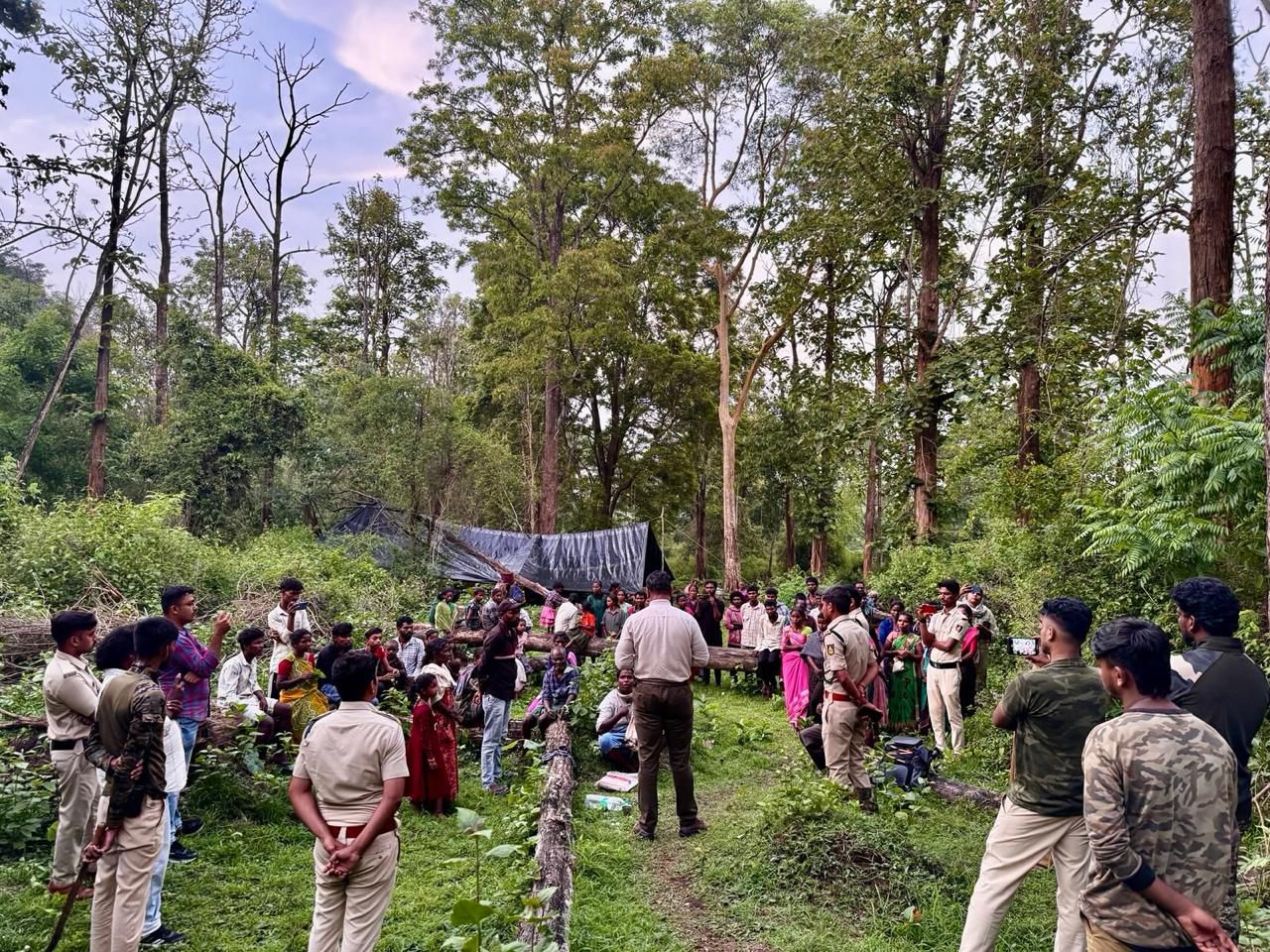
Jenu Kuruba community members during a protest in May 2025.
In a memorandum submitted to the Forest Minister in November 2025, the Minister in charge of Mysuru district, and the Deputy Commissioner, Mysuru Travels association president BS Prashanth argued that the sudden suspension of safaris has triggered booking cancellations, resulting in losses to hotels and resorts in the surrounding areas.
However, the routes for these safaris often pass over lands that are sacred for the Jenu Kurubas, including their burial grounds.
For the Jenu Kurubas, the tension between conservation, tourism and their rights has long been tangible. On the evening of 5 May 2025, after years of waiting for their claims under the FRA to be recognised, over 150 tribes from the Jenu Kuruba, Betta Kuruba, Yarava and Paniya communities returned to the forest and built homes for their sacred deities, which is a common practice in their community when they rebuild a village.
However, on 17 June 2025, the Forest Department issued notices to the families to immediately remove the newly constructed huts in the Nalkeri forest area, claiming that it was in violation of the Wildlife Protection Act 1972. The next afternoon, around 250 personnel from the Forest Department, Special Tiger Protection Force, and Police Department forcefully tore down six of the communities’ huts.
Some of these evictions were in fact carried out with the support of organisations like the Wildlife Conservation Society and Living Inspiration for Tribals (LIFT), according to Survival International. Rajan, a member of the Community Networks Against Protected Areas (CNAPA), pointed out that these organisations end up funding the Forest Department and the corresponding central ministry and its projects. “So they end up imposing their ideas of conservation,” he said.
Meanwhile, the Forest Department continues to run ‘rest houses‘ inside Nagarhole and allows the functioning of resorts and other commercial activities near the reserve. In fact, some resorts nearby, that are independent of the government, promote “visits to local tribal settlements” even though the communities do not receive any monetary benefits from such visits or the safaris organised by the government. “How do the conservationists not see this as a problem?” Rajan asked.
The Jenu Kurubas also alleged “enhanced” surveillance by the government as part of their Tiger Task Force and Elephant Task Force.
The Tiger Task Force was set up by the government of India to map out tiger conservation strategies following the shocking disappearance of tigers from Rajasthan’s Sariska in 2005. But Jenu Kuruba members allege that in practice, such forces have been associated with intimidation, harassment and forced evictions.
Since their return to the forest in 2025, they said, paramilitary personnel associated with such task forces have threatened residents, dismantled structures, including sacred sites and temporary shelters for menstruating women, and restricted access to villages.
At a virtual press conference in June 2025, where speakers joined from Karadikallu, Kaziranga, Bengaluru and Mumbai, Shivu’s anger was evident when he bluntly said he would not condole the death of Valmik Thapar, a conservationist and member of the Tiger Task Force.
The forest department, members of the NAJHSS said, is installing surveillance cameras and deploying paramilitary forces, as part of the Tiger Task Force and Elephant Task Force. “All these invasive measures are being taken without consent and consultation with our communities and without any social impact assessment as mandated by law,” they said.
Beyond these task forces, community members said their interests have consistently been ignored in both state and central government “protection” measures.
According to Section 38(v)(4) of the Wildlife (Protection) Act, 1972, the state government must, while preparing a Tiger Conservation Plan, ensure the agricultural, livelihood, developmental and other interests of the people living in tiger-bearing forests or a tiger reserve.
However, since the declaration of the Nagarhole forests as a protected area in 1870 — first as a wildlife sanctuary, as a national park in 1988 and a critical tiger habitat in 2007 — decisions have been made without consulting the Adivasis who have been living inside the forests for generations.
“This is despite the fact that they are the best conservationists and the people who have managed and protected the forest, and the wildlife that they share it with, for millennia,” said Sophie Grig, a researcher who works with the Jenu Kurubas and is the Asia campaigns director of Survival International.
She said that although the Congress-led UPA brought in the Forest Rights Act to redress the historical injustice to Adivasis and other forest-dwelling people, evictions and the failure to implement the Act and recognise the forest rights of the Jenu Kuruba and other Adivasi peoples have continued under all successive governments.
The NAJHSS alleged that such militarised conservation techniques by the forest department are targeted at forcefully preventing their people from collecting essential forest produce, such as honey, mushrooms, and tubers, which are vital for their food and livelihood security.
Project Tiger marked its 50th year in 2023, but Adivasi communities, a fact-finding report by Survival International noted, have borne its human cost.
At least eight Adivasis have been shot dead by the Forest Department officials on different pretexts, but there has been no criminal conviction in any of these cases, nor any compensation to the families, the report noted. The free, prior and informed consent of Gram Sabha, in writing, has not been taken before relocation of the tribal community from their ancestral land, which is a mandatory requirement as per Section 4(2)(e) of the FRA, 2006.
In areas where Adivasis have been resettled or evicted, the report observed that there hasn’t been full compliance with all provisions of the FRA Section 4(2)(f) — no resettlement shall take place until facilities and land allocation at the resettlement location are complete as per the promised package. The report said that the community raised concerns about the role of certain wildlife NGOs, such as LIFT, WCS and Wildlife First, in “misguiding and pressurising” the Adivasis living within Nagarhole Tiger Reserve to move out of the sanctuary.
Some of these NGOs allegedly forced Adivasis to sign blank papers or withdrew SHG membership of Adivasi women for asserting their legal and democratic rights. In fact, the fact-finding team too faced harassment and intimidation by the local police, with “the intention of preventing the team members from meeting the villagers and visiting the villages inside Nagarhole Tiger Reserve,” the report said.
“Conservationists and conservation organisations in India have long been pushing the false colonial view that indigenous peoples like the Jenu Kuruba cannot co-exist with tigers, and this has helped drive the evictions and sustain the violent and racist fortress conservation model that is still prevalent in India today,” Grig told South First.
She also referred to how Ullas Karanth, former director of WCS in India, had boasted about how he and the organisation pushed the narrative of so-called “voluntary relocations” as necessary and “win-win” for indigenous people and wildlife for decades.
On 7 January, as Siddaramaiah created a record of being the longest-serving chief minister of the state, tribal leaders and their allies wrote a letter addressed to him, demanding targeted allocations in the upcoming state budget for land and housing, implementation of forest rights, environmental restoration and political representation for Scheduled Tribe (ST) communities, particularly those living in and around the Western Ghats forest regions.
“We extend our heartfelt congratulations to you, Mr Siddaramaiah, on your distinction of becoming the chief minister who has governed Karnataka for the longest period. We also make a sincere appeal that the additional time you now have in office be devoted to the most neglected communities and to constructive work,” the letter signed by Adivasi Jana Parliament, Tribal Farmers’ Association, Development Through Education (DEED), among other organisations, said.
Grig said the solution lies in fully implementing the FRA, recognising community forest resource and habitat rights, and decolonising India’s conservation model.
“This means that the illegal and unconstitutional creation of tiger reserves and other Protected Areas across India, without the consent of the Gram Sabhas, must be scrutinised and exposed. It is time for a decolonised approach to conservation that recognises Indigenous peoples’ role in the fight to protect their own lands, and that respects their rights,” Grig said.
Stating that the tribal communities were expert conservationists long before the word “conservation” was even invented, Grig called on conservationists and NGOs to challenge the “violent and broken model” of conservation that is pervasive within the entire industry.
“Support a new model of conservation that ensures that Indigenous peoples and their rights are at the centre of the fight against environmental destruction and climate change,” she said.
(Edited by Muhammed Fazil.)


